Need help?
Do you have a question about the ORIUM 11094 and is the answer not in the manual?
Details two methods for positioning the clock: wall mounting or standalone setup.
Advice on placement to ensure good reception, avoiding interference sources like TVs and computers.
Adjusts the time difference relative to the German radio-controlled signal.
Manually sets hours, minutes, year, month, and date using UP/DOWN buttons.
Allows selection of display language for days of the week from seven options.
Procedure to set the daily alarm hour and minutes using the ALARM button.
How to turn the daily alarm on or off, indicated by an 'A' icon.
Triggers a 5-minute repetition of the alarm when it sounds.
Toggles between Celsius (°C) and Fahrenheit (°F) for temperature display.
Displays the current phase of the moon, illustrated with eight distinct phases.
Guidance on cleaning the clock face with a soft cloth to prevent scratches.
Instructions for replacing depleted LR6 batteries, emphasizing correct polarity.
Addresses issues like inaccessible functions, no signal, and temperature display errors.
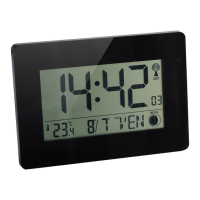
This document describes the Austin digital, radio-controlled clock (Ref. 11094), a device designed for precise timekeeping and environmental monitoring.
The Austin clock is primarily a radio-controlled timepiece, meaning it automatically sets its time and date by receiving the DCF 77 frequency signal. This ensures high accuracy and eliminates the need for manual time adjustments, including automatic transitions for summer and winter time changes.
Beyond basic timekeeping, the clock offers a comprehensive set of features. It can display time in either a 12-hour or 24-hour format, with an option for manual time adjustment if needed. A time zone adjustment feature allows for a difference of up to ±12 hours, accommodating various geographical locations.
The device includes a calendar function, displaying the date, month, and day of the week. The day of the week can be shown in seven different languages: English, German, Italian, French, Danish, Dutch, and Spanish, making it versatile for users from different linguistic backgrounds.
An integrated thermometer measures and displays the interior temperature in either Celsius (°C) or Fahrenheit (°F), covering a range from 0°C to 60°C. This allows users to monitor the ambient temperature of their environment.
A unique feature of this clock is its moon phase calendar, which visually displays the current phase of the moon. This adds an aesthetic and informative element for those interested in celestial cycles.
For daily utility, the clock incorporates an alarm function. This alarm can be set for a specific time and features a crescendo sound, meaning the alarm signal gradually accelerates. It also includes a repeated snooze function, allowing users to temporarily silence the alarm for 5 minutes before it sounds again.
Upon unpacking, users should gently remove any protective film. Battery installation involves opening the compartment at the back, inserting two 1.5V LR6/AA batteries, observing the correct polarity (+/-), and then closing the cover. Incorrect battery insertion can damage the device. The clock offers two installation methods: it can be wall-mounted or used as a standalone device by raising its integrated stand.
When batteries are inserted, the clock briefly lights up all symbols and emits an audible signal before entering DCF receiving mode for 7 to 10 minutes, indicated by a flashing aerial symbol. If automatic setting fails, the "Wave" button can be pressed to initiate a manual search for the DCF signal. Once received, the aerial symbol remains continuously displayed, indicating successful synchronization. To ensure good reception, the clock should be kept at least 2.5 meters away from electromagnetic sources like TVs, computers, or microwaves. If no signal is received within 10 minutes, the search stops, and the aerial symbol is erased. The clock will automatically attempt to resynchronize at 2 am daily, or at the next full hour if the 2 am attempt fails, repeating up to 5 times. Pressing the "Wave" button during reception can stop the search. A flashing aerial symbol indicates an ongoing search, while a continuously displayed symbol means the signal has been successfully received. Radio reception can be weaker in rooms with concrete walls or in offices, so placing the clock near a window may improve reception in such cases. During signal receiving mode, no other functions can be accessed.
The clock can be cleaned with a soft cloth or microfiber cloth to avoid scratching the face. Solvents or other harsh cleaning solutions should not be used as they may damage the product.
When the display information begins to fade, it indicates that the batteries need to be replaced. To do this, open the battery compartment cover at the back of the clock by gently pulling it. Remove the old batteries and insert two new LR6 type batteries, ensuring correct polarity (+/-). Close the cover after replacement. Incorrect battery insertion can damage the device.
Used batteries should not be thrown away or burned but should be scrapped according to local regulations for chemical waste. The product complies with WEEE and RoHS Directives, meaning it should be disposed of in line with local regulations for electronic waste.
 General
| Model | ORIUM 11094 |
|---|---|
| Category | Clock |
| Type | Wall Clock |
| Movement | Quartz |
| Dial Color | White |
| Case Material | Plastic |
| Shape | Round |
| Diameter | 30 cm |
| Battery Type | AA |

 To Next Page