
 Need help?
Do you have a question about the OtterBox OBFTC-0038-A and is the answer not in the manual?
Follow basic precautions, read instructions, supervise children, avoid fingers in product, protect from elements.
Do not use unrecommended chargers, exceed output ratings, or use damaged/modified power banks.
Do not disassemble, seek qualified service. Avoid fire or high temperatures to prevent explosion.
This document describes the OtterBox Power Banks, a series of portable power solutions designed to charge various electronic devices. These power banks are intended for general consumer use, offering convenient power on the go.
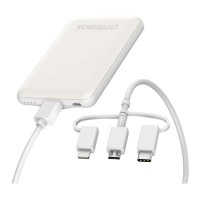
The OtterBox Power Banks serve as external battery packs for charging electronic devices. They are equipped with various output options, including USB-A, USB-C, and in some models, wireless charging capabilities. The primary function is to provide supplemental power to devices such as smartphones, tablets, and other USB-powered gadgets when a wall outlet is not available. The power banks are designed to be portable, allowing users to carry them for charging devices during travel, outdoor activities, or daily commutes. Some models include integrated cables for added convenience, eliminating the need to carry separate charging cables. The wireless charging feature, where available, allows for cable-free charging of compatible devices by simply placing them on the power bank's designated charging surface.
The power banks are designed for straightforward operation. To charge a device, users typically connect it to one of the power bank's output ports using a compatible cable, or place it on the wireless charging surface if the model supports it. The power banks themselves are recharged via a USB input, usually a USB-C port, allowing them to be powered up from a wall adapter, computer, or other USB power source.
Safety is a key consideration in the design and usage of these power banks. Users are advised to read all instructions before use to ensure proper and safe operation. Close supervision is recommended when the product is used near children. Users should avoid inserting fingers or hands into the product and protect it from exposure to rain or snow. It is crucial to use only power supplies or chargers recommended by the manufacturer to prevent risks of fire or injury. The power banks should not be operated beyond their specified output ratings, as overloading can lead to fire or injury.
Damaged or modified power banks should not be used, as they may exhibit unpredictable behavior, including fire or explosion. Disassembly of the power bank is not recommended; any servicing or repair should be performed by a qualified professional using identical replacement parts to maintain safety. The power bank should also be protected from fire or excessive temperatures, specifically above 100°C (212°F), to prevent explosion. When not in use, the power bank should be switched off.
For models featuring wireless charging, the "QI" symbol indicates compatibility with the Wireless Power Consortium standard, ensuring interoperability with other Qi-certified devices.
Maintenance for OtterBox Power Banks primarily involves proper handling and storage to ensure longevity and safe operation. Users should avoid physical damage to the power bank, such as dropping it or exposing it to harsh conditions. Keeping the device clean and dry is also important.
In terms of environmental responsibility, the power banks are marked with the WEEE symbol, indicating that they should not be disposed of with general household waste. Instead, they should be taken to a designated collection point for proper treatment, recovery, and recycling. This ensures that valuable resources are conserved and potential negative impacts on human health and the environment from inappropriate waste handling are prevented. Users can contact their local authority for details on the nearest designated collection point. Alternatively, in some countries, it may be possible to return the product to a local retailer upon purchasing an equivalent new product.
The device is designed to comply with FCC rules, meaning it has been tested and found to meet limits for a Class B digital device, providing reasonable protection against harmful interference in residential installations. If the equipment causes harmful interference to radio or television reception, users are encouraged to try corrective measures such as reorienting the receiving antenna, increasing separation between equipment and receiver, or connecting the equipment to a different circuit. Consulting a dealer or an experienced radio/TV technician is also an option for troubleshooting interference.
For European users, the CE mark signifies compliance with relevant European standards. Further details regarding the Declaration of Conformity and product standards can be found on the OtterBox website, demonstrating the manufacturer's commitment to product safety and quality within the European market.
 General
| Model | OBFTC-0038-A |
|---|---|
| Brand | OtterBox |
| Category | Accessories |
| Color | Black |
| Accessory type | Case |
| Material | Polycarbonate, Synthetic Rubber |

 To Next Page