S3 User Guide 64 PN 875-0196-000 Rev C1
Appendix A: Basic Troubleshooting
Testing Antenna Voltage
The S3 antenna is an “active” antenna that requires power to operate. Power is
supplied to the antenna via the coaxial cable connecting it to the S3. Testing the
antenna voltage can ensure the S3 receiver is supplying power to the antenna and
verify the antenna cable is not damaged.
To test antenna voltage:
1. Turn off the S3 and then disconnect the antenna cable from the S3 antenna.
2. Turn on the S3.
3. Using a voltmeter set to VDC, measure the voltage output across the
antenna cable. It should measure +5 VDC between the center conductor and
exterior connector shell.
• If the measurement is +5 VDC across the antenna cable, then neither the
cable nor the receiver is damaged (antenna voltage test complete).
• If the measurement is not +5 VDC across the antenna cable, go to
step 4.
4. Turn off the S3 and then disconnect the antenna cable from the S3.
5. Turn on the S3.
6. Using a voltmeter set to VDC, measure the voltage output across the
antenna output on the console. It should measure +5 VDC between the
center conductor and exterior housing.
• If the measurement is +5 VDC at the console connector, but not at the
end of the antenna cable, the cable is damaged. Replace the antenna
cable and return to step 1.
• If the measurement is not +5 VDC from the S3, contact Outback
Customer Service to return the console for servicing.
Checking the SBAS Differential Signal by
Verifying the BER
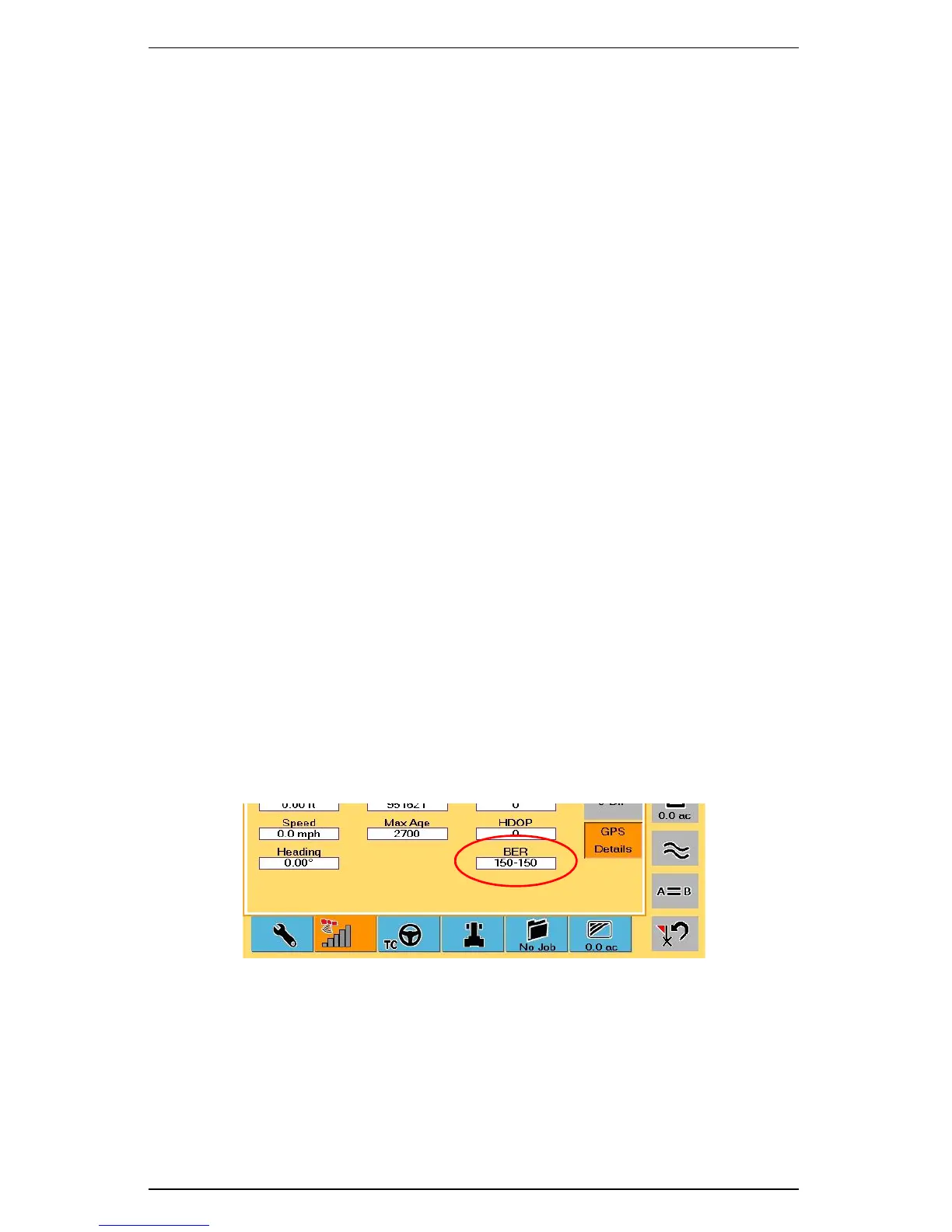
You can check the bit error rate (BER) via the BER field on the GPS Details screen.
BER is a check of the quality of the SBAS correction signal reception and is based on a
scale of 0 to 500. BER < 20 is ideal. If BER > 20 verify the antenna has a clear view of
the sky to properly find and track correction satellites. When using SBAS for the
correction type, S3 tracks one or two correction satellites. Each satellite has a different
BER and the value in the BER field represents each value separated by a hyphen.
For example, a value of 8-500 means the S3 has a very good signal on one satellite
(BER=8) and is not receiving corrections from the other satellite (BER=500, the lowest
reception value). Only one satellite must have a low BER value (less than 20) to
provide differential corrections.



 To Next Page
 Loading...