6.3 Sensor
The Sensor has light emitters and a detector
which measure Pulse Rate and Oxygen
Saturation by dierential light absorption
techniques (see Section 15 for more details).
This data, along with information about the data
quality and movement metrics, is sent to the
Base Station via Bluetooth®
For the Sensor to function properly, it is
positioned and held in a specific location on the
foot by a specialized Sock (see Section 8.1).
!
NOTE.
Pairing associates a new Base Station
and new Sensor. If the Sensor is
replaced, you will need to repeat the
pairing process with the new Sensor
and the Base Station. Contact
customer service for support.
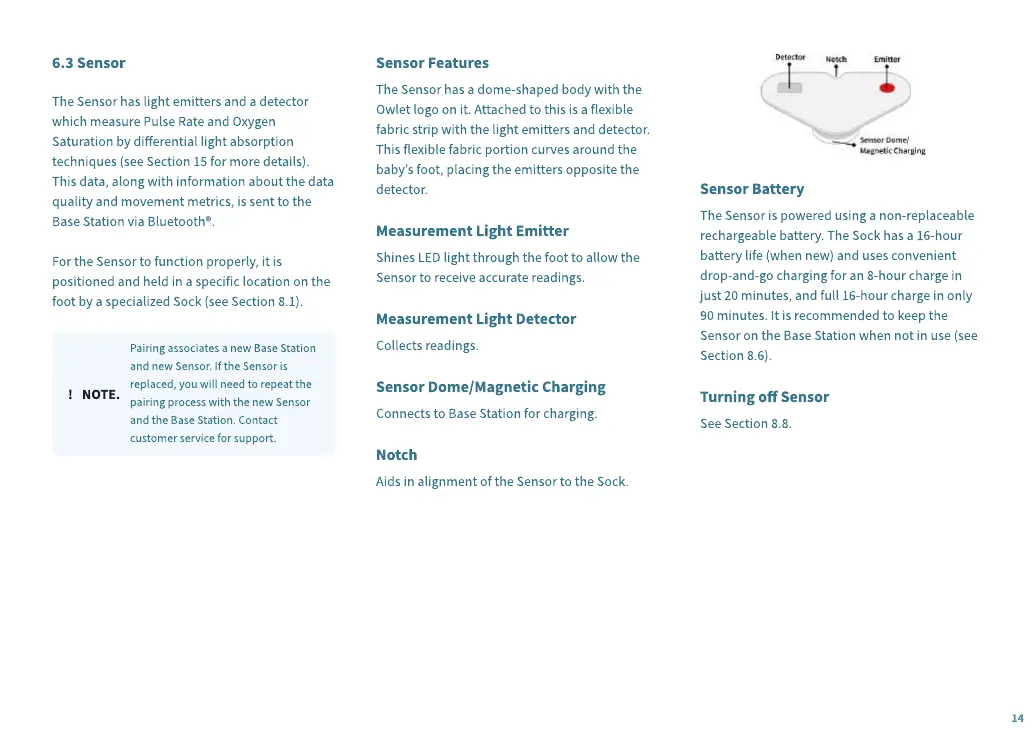
Sensor Features
The Sensor has a dome-shaped body with the
Owlet logo on it. Attached to this is a flexible
fabric strip with the light emitters and detector.
This flexible fabric portion curves around the
baby’s foot, placing the emitters opposite the
detector.
Measurement Light Emitter
Shines LED light through the foot to allow the
Sensor to receive accurate readings.
Measurement Light Detector
Collects readings.
Sensor Dome/Magnetic Charging
Connects to Base Station for charging.
Notch
Aids in alignment of the Sensor to the Sock.
Sensor Battery
The Sensor is powered using a non-replaceable
rechargeable battery. The Sock has a 16-hour
battery life (when new) and uses convenient
drop-and-go charging for an 8-hour charge in
just 20 minutes, and full 16-hour charge in only
90 minutes. It is recommended to keep the
Sensor on the Base Station when not in use (see
Section 8.6).
Turning o
Sensor
See Section 8.8.
14


 To Next Page
 Loading...