
 Need help?
Do you have a question about the OX Safety Series and is the answer not in the manual?
Details mask design, limitations, oxygen levels, and safety warnings for use.
Information on filter compatibility with the S450 halfmask and filter types.
Step-by-step guide on how to attach and remove filters from the mask.
Instructions for changing pre-filter pads and filter cartridges.
Guidance on how to achieve a comfortable and secure fit of the mask.
Procedure to check the respirator's efficiency using a card.
How to clean and disinfect the respirator body and seal surface.
Recommendations for storing and transporting the respirator safely.
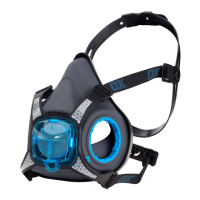
The OX S450 Halfmask Respirator is a personal protective equipment (PPE) designed to safeguard users from various airborne contaminants. Its primary function is to filter out harmful dust, gases, and vapours, ensuring a safer breathing environment for the wearer. The respirator is designed for use with the S450 filter system, which includes both gas and dust filters, and can be augmented with pre-filter pads and covers for enhanced protection.
A key usage feature of the S450 Halfmask Respirator is its adaptability to different hazards. Users can select appropriate filters based on the specific contaminants present in their work environment. The available filters are colour-coded and detailed on their packaging, making selection straightforward. For situations requiring protection against both gas and particulates, a combination filter can be created by using a gas filter with a P2 pre-filter. It is crucial to ensure that the chosen filter is correct for the identified hazard.
The respirator is not intended for use in oxygen-deficient atmospheres (below 19% Volume) or oxygen-enriched environments (above 25% Volume). It also does not provide protection against flying debris, projections from explosions, or for activities like sandblasting. Furthermore, it is not designed for firefighting or work with open flames or molten metal, as filter ignition could release toxic fumes. The respirator does not protect the eyes or skin from irritants, burns, or penetrating contaminants.
Proper fitting is paramount for the effectiveness of the S450 Halfmask Respirator. The fitting instructions emphasize a comfortable and secure fit. Before use, the rigid protective packaging should be removed from the faceseal, and the elastic straps checked to ensure they are not twisted and are securely held in all mounting positions, including the valve-cage, rear clips, and head cradle. The rear clips and head cradle are adjustable to fit the user's head size. The head cradle is placed on top of the head, and the mask is positioned onto the face before clipping the rear clips behind the neck. The fit should be comfortable and secure, and adjustments to the head cradle and rear clip elastic lengths should be made until this is achieved. The wearer's chin should rest comfortably in the bottom of the respirator.
A 'Face Fit Test' is recommended to ensure the mask is suitable for the user's face shape, as it may not fit all individuals. A simple fit check involves placing a piece of card in front of the filters and inhaling; the respirator should contract sharply if properly sealed. Facial hair, such as beards, is likely to prevent an acceptable fit, compromising the seal and effectiveness of the respirator.
Maintenance features are crucial for extending the lifespan and ensuring the continued effectiveness of the S450 Halfmask Respirator. All components should be clean and in good condition before each use. Filters must be changed frequently, at a minimum when breathing resistance increases or the hazard's smell is detected. Pre-filter pads should be changed even more often.
Changing filters is a straightforward process. To apply filters, the arrow on the filter (image symbol A) must be aligned with the arrow on the mask body (image B). The filter is then pushed onto the mask (image C) and turned clockwise until it locks into position (image D). To remove a filter, it is twisted anti-clockwise until it loosens. It is recommended to remove the mask from the face when changing filters. If a filter is removed and refitted, the integrity of the foam seal must be checked; if damaged, the complete filter should be replaced. When fitting a filter, supporting the inner plastic shell with a hand from inside the mask can prevent it from detaching from the rubber body. Used filters should be disposed of hygienically and safely. Users should also check that their filter has a gasket attached to the base of its locking feature; if missing, OX should be contacted.
The P2 pre-filter pad can convert a gas filter into a combination gas and dust filter, but it should not be used on a P3 dust filter. To change the pre-filter, the cover is removed, the used pad disposed of hygienically and safely, a new pad inserted, and the cover refitted. For changing the filter cartridge, the pre-filter cover is removed, the filter cartridge unscrewed, and removed from the mask along with its connector. These components should be disposed of hygienically and safely. The respirator should then be cleaned, and a new filter refitted, ensuring the foam sealing ring is undamaged.
Cleaning and disinfecting the respirator are essential for hygiene and longevity. After each shift or use, the respirator should be cleaned and checked for worn or damaged parts. The mask body can be cleaned and disinfected with a cloth moistened with a weak detergent solution and allowed to air dry. The seal surface should be wiped with a cloth moistened with soapy water and dried at room temperature. The product should not be immersed in water, nor should abrasive cleaners be used. If a filter cartridge is to be reused, it should not be removed from the respirator but cleaned with a cloth and warm soapy water, then dried with a clean cloth. Water must not enter the filter cartridge. Care should be taken not to damage the inhalation/exhalation rubber valves, which should be checked weekly and replaced if damaged or deteriorated. With correct maintenance, the mask is expected to last 2-3 years. Solvents, strong detergents, bleaches, or petroleum-based products should not be used to clean any part of the mask.
Proper storage and transportation are also vital. When not in use or during transportation, the respirator should be stored in its original packaging or another suitable container. It should be stored as detailed by the symbols on the package, within a temperature range of +2°C to +55°C and relative humidity less than 75%. The respirator should be kept away from direct sunlight and sources of possible contamination and physical damage.
Users are warned to immediately leave the work area and change the respirator and/or filter if breathing becomes difficult, dizziness, or other distress occurs, if the respirator is damaged, or if they sense irritation, smell, or taste contaminants. As required by European Health and Safety requirements, users are advised that susceptible individuals may experience an allergic reaction when in contact with the wearer's skin. If this occurs, the wearer should leave the hazard area, remove the respirator, and seek medical advice.
 General
| Material | Non-woven fabric |
|---|---|
| Standards | EN 149:2001+A1:2009 |
| Reusable | No |
| Filter Type | Particulate Filter |
| Filter Efficiency | ≥94% |
| Adjustable Nose Clip | Yes |
| Elastic Ear Loops | Yes |
| Certification | CE |
| Product Type | FFP2 |
| Usage | Industrial, Medical |

 To Next Page