
 Need help?
Do you have a question about the Ozark Trail Pop-Out A-Frame and is the answer not in the manual?
Hazards of fuel burning devices, carbon monoxide, and oxygen consumption within the tent.
Keep flame sources away, anchor tent, assembly safety, and consider safety glasses.
Clean dirt when dry, use water for stains, avoid scrubbing, and ensure tent is dry before storage.
6-month replacement parts warranty against defects, excluding normal wear and environmental damage.
Research area, check equipment, seam seal tent, and use checklists for a good camping experience.
Covers essential items for camp set-up, kitchen, food, clothing, hygiene, and miscellaneous needs.
Check all items against the list: tent, rainfly, poles, stakes, and tablet pocket.
Remove tent from carry bag and unfold with the fabric floor facing down.
Lift roof line to center hub and pull outward to erect tent walls.
Stake down tent corners at a 45-degree angle, ensuring the floor is pulled taut.
Place fly over tent, attach hooks to D-rings, and stake guy lines and fly loops securely.
Remove stakes, accessories, fly, collapse walls, fold, roll, and pack tent and stakes.
Ensure tent is clean and dry before storing in a clean, dry area off concrete.
Address condensation via ventilation and avoid touching walls; use seam sealer for leaks.
Store tent dry to prevent mildew; use mild soap for cleaning and water repellent compound.
Use patch kits for tears and rework zippers by moving the slider to the beginning.
Limit sun exposure to prevent fading; use a ground cloth for floor protection and insulation.
Install stakes at 45 degrees, keep loops taut, and use a hammer or puller for removal.
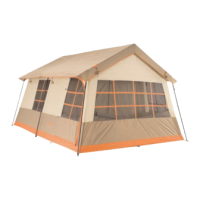
This document serves as an owner's manual for an Ozark Trail Pop-Out A-Frame tent, model WT186565, providing essential information for its safe and effective use, assembly, maintenance, and troubleshooting.
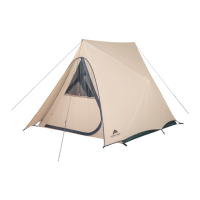
The Ozark Trail Pop-Out A-Frame tent is designed for recreational camping, offering a temporary shelter solution for outdoor enthusiasts. Its primary function is to provide protection from the elements, including wind, rain, and sun, while offering a comfortable space for sleeping and relaxation. The "Pop-Out" design suggests an emphasis on quick and easy setup, making it convenient for campers who prioritize efficiency. The tent is constructed with flame-resistant fabric that meets CPAI-84 specifications, enhancing safety, though it is explicitly stated that the fabric is not fireproof and will burn if exposed to continuous flame. The design includes features like a tablet pocket for convenience and guy lines for stability in varying weather conditions.
The tent's usage is centered around ease of assembly and a focus on safety. The assembly process is broken down into clear, step-by-step instructions. Users begin by verifying package contents, which include the tent body, rainfly, pre-attached fiberglass poles, a tablet pocket, and tent stakes. The tent is then unfolded with the fabric floor down. The key "pop-out" feature involves grasping the roof line along one wall, lifting it to locate a loop attached to the center hub, and then, with a foot along the bottom edge of the wall, pulling the loop outward. This action causes the wall to "pop out," erecting that section of the tent. This process is repeated for the other wall. Once the walls are erected, the tent is staked down at its corners, ensuring the floor is pulled taut. The rainfly is then unfolded and placed over the tent, attaching its hooks to D-rings on the tent corners and staking down its guy lines from each top corner and at various points around the base. This multi-step setup ensures the tent is secure and protected from the elements.
Safety warnings are prominently featured, emphasizing critical precautions. Users are strictly warned against using fuel-burning devices such as stoves, lanterns, candles, grills, or heaters inside or near the tent due to the risk of carbon monoxide poisoning, asphyxiation, and death. It is also crucial to keep all flame and heat sources away from the tent fabric, as it is not fireproof. Proper anchoring of the tent is essential, and campers are advised to carefully consider their campsite choice, being aware of potential hazards like falling rocks, tree limbs, lightning strikes, flash floods, and strong winds. The manual recommends a minimum of two adults for assembly, as tent poles are under tension and could cause injury if not handled firmly. Safety glasses are suggested during assembly.
The manual also provides a comprehensive list of "DO NOTs" and "DOs" for safe camping. Prohibited actions include pitching the tent near open fire, using open flames inside, leaving campfires or children unattended, using oxygen-consuming devices inside, building campfires upwind, refueling lamps or stoves inside, smoking inside, storing flammable liquids inside, using unapproved water repellent compounds, and spraying insecticide. Recommended actions include always extinguishing campfires before sleeping or leaving, exercising care with electricity and lighting, ensuring proper ventilation, anchoring the tent securely in changing climatic conditions (using snow pegs, skis, or heavy rocks if necessary), and properly taking down and storing the tent after camping.
Disassembly involves removing all stakes and folding guy lines, removing accessories and the rainfly, collapsing each wall by pushing inward at the center hub, and then folding and rolling the tent flat for storage in the carry bag, with stakes placed in their bags inside the carry bag.
Proper maintenance is crucial for prolonging the life of the tent and ensuring its continued functionality. The manual provides clear instructions for cleaning and storage. For dirt, users are advised to allow it to dry after rainfall and then lightly sweep it off with a brush. For tougher stains, spraying the area with water and lightly wiping it with a few strokes is recommended. Importantly, users are warned NOT to scrub the fabric and to ALWAYS MAKE SURE THE TENT IS COMPLETELY DRY BEFORE REPACKING. This prevents mildew and maintains the integrity of the fabric.
The manual also addresses common troubleshooting issues and their solutions, many of which relate to maintenance. For condensation, which is caused by temperature differences and body heat, users are advised to avoid touching walls, leave doors and windows open for ventilation, and store wet clothing outside the tent. Seam leakage can be remedied by applying a generous amount of seam sealer to the inside seams. Mildew prevention involves storing the tent only when thoroughly dry; if mildew occurs, it can be cleaned with a soft bristle brush or sponge with mild dishwashing soap or Fels Naptha soap, followed by thorough drying and application of an approved water repellent compound. Small tears can be repaired with a self-adhesive patch kit, while larger tears may require a canvas or awning repair shop. Faulty zippers, if separated, can often be repaired by moving the slider to the beginning of the zipper tape and reworking it. To prevent fabric fading, the tent should not be left in direct sunlight longer than necessary. Floor condensation can be mitigated by using a ground cloth underneath, which also prolongs the floor's life and provides insulation. The ground cloth should be smaller than the tent floor to prevent rain from running underneath. Finally, proper stake usage and removal are emphasized to prevent tears or leakage, recommending a hammer or stake puller for safe removal rather than pulling on the fabric.
The manual also includes a 6-month replacement parts warranty against defects in materials and workmanship, with the manufacturer providing replacement parts at its discretion upon proof of purchase. However, the warranty explicitly excludes normal wear and tear, misuse, abuse, inclement weather conditions (wind, rain, hail, lightning, tornados, hurricanes), acts of God, mildew, rotting, damage, or fading from prolonged UV exposure. This highlights the importance of proper usage and maintenance to avoid issues not covered by the warranty. The manual strongly advises against returning the product to the store for warranty issues, instead directing customers to call a provided phone number.
 General
| Shape | A-Frame |
|---|---|
| Material | Polyester |
| Setup Type | Pop-Up |
| Doors | 1 |
| Ventilation | Mesh |


 To Next Page