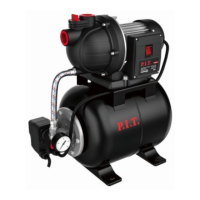
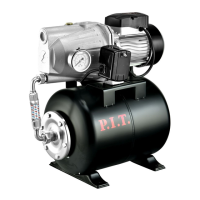
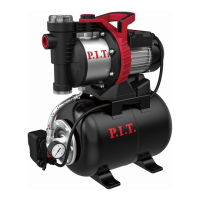
The P.I.T. POG900-P1 is a self-priming surface pump designed for various water pumping applications. It is a robust and efficient tool, ideal for both domestic and light industrial use.
Function Description
This self-priming pump is designed for pumping both clean and contaminated water. Its primary applications include:
- Water Supply: Drawing water from reservoirs, wells, and open water sources.
- Drainage: Pumping out waste water, including contents of septic tanks, and drying boats and yachts.
- Irrigation Systems: Suitable for use in garden and agricultural irrigation.
The station operates by maintaining constant pressure in the water supply network. When a tap or other device is opened, the system pressure drops. Once the pressure falls below 0.15 MPa (1.5 atm), the pressure switch automatically activates the pump to compensate for the water flow. When the tap is closed, the pump continues to run for a short period to refill the hydraulic accumulator. Once the system pressure rises to its initial state of 0.3 MPa (3 atm), the pump automatically turns off via the pressure switch.
Important Technical Specifications
- Model: POG900-P1
- Rated Voltage/Frequency: 220 V~/50 Hz
- Rated Power: 900 W
- Performance: 3.0 m³/h
- Lifting Height: 50 m
- Accumulator Volume: 24 L
- Suction Depth: 8 m
- Weight: 17 Kg
- Components: The station comprises a pump (1), a hydraulic accumulator (2), a connecting hose (3), and an automation unit that includes a pressure switch (4) and a pressure gauge (5). The accumulator features a food-grade rubber membrane and a pneumatic valve (6) for air pressure adjustment. The pump has inlet (7), outlet (8), filler (9), and drain (10) openings. For JS series pumps, water is filled through the pump outlet (8).
- Particle Size: The maximum allowable particle size in the water must not be exceeded, as specified in the instruction manual.
Usage Features
Safety Precautions:
- Intended Use: Only use the pumping equipment for purposes specified in the manual.
- Personnel: Do not allow unskilled persons, minors, or individuals with insufficient physical data to operate the equipment.
- Environment: Avoid using the pump near flammable liquids or gases to prevent fire or explosion risks.
- Handling: Always carry the pump by its handle. Do not use the power cable for transport or securing. Never carry it while switched on.
- Electrical Connection: Ensure network parameters match the pump's specifications. The pump must be grounded. All electrical connections must be protected from moisture.
- Personal Protective Equipment: Wear suitable clothing and personal protective equipment to prevent contact with the equipment and ensure nothing interferes with your work.
- Surface: Operate the equipment on a level surface for safety.
- Forbidden Liquids: Strictly forbidden to pump motor fuel, cleaning agents, or other chemical liquids.
- Temperature: Operate only at temperatures above freezing.
- Storage: Before long-term storage (especially winter), drain and dry the pump.
- Extension Cords: If using an extension cord, ensure it is rated for the pump's capacity.
- Supervision: Do not leave switched-on electrical equipment unattended.
- Water Requirement: Never operate the pump without water.
- Water Bodies: Do not operate the pump in water bodies where people or living organisms are present.
- Power Cable: Always completely unwind the mains cable before use. Keep it away from heat, oil, and sharp objects.
- Water Intake: Ensure water intake holes are free from silt or dirt during installation.
- Damage: Do not use the pump if it has been dropped or shows signs of damage. Contact an authorized service center for repair.
- Cable Replacement: If the power cable is damaged, it must be replaced by the manufacturer or a qualified person to avoid hazards.
- Children and Bystanders: Keep children, animals, and bystanders out of the work area.
- Disconnection: When disconnecting from the mains, grasp the plug, not the cable. Always disconnect when not in use, during malfunctions, before immersion/extraction, before maintenance, and after work.
- Intoxication: Never use the pump while under the influence of alcohol or drugs, or in any state that impairs objective perception. Do not entrust the pump to individuals in such conditions.
Installation and Commissioning:
- Pre-connection Check: Verify that the electrical and pressure data of the product align with your electrical and water supply network parameters.
- Professional Installation: It is recommended that installation and commissioning be carried out by a specialized organization.
- Mounting: Secure the station to a rigid base. Use rubber washers and gaskets to reduce noise and vibration.
- Check Valve: A 1-inch check valve at the suction line inlet is mandatory (not included).
- Suction Pipe: Connect a 1-inch suction pipe with a check valve to the station inlet (7). The suction line should be made of an incompressible hose or pipe.
- Outlet Pipe: Connect a standpipe to the station outlet (8).
- Pipe Diameter: The hose/pipe diameter must exactly match the pump inlet diameter (1 inch). Avoid connections that narrow or widen the flow area. Filter elements on the suction line are strictly prohibited.
- Tight Connections: All connections of the suction and pressure pipelines must be tight.
- Suction Line Length: Avoid horizontal suction lines longer than 10 meters, as this reduces suction lift.
- Suction Line Angle: Ensure a continuous angle of inclination of at least one degree from the station to the water intake source, with no reverse angles.
- Electrical Connection: Only connect electrically after all hydraulic connections are complete. A qualified technician must perform the electrical connection.
- Socket Requirements: The electrical outlet must be easily accessible, grounded, and connected to a high-sensitivity (30 mA) differential circuit breaker. It must be protected from splashing water.
- Damaged Cable: Do not operate with a damaged electric cable. Contact a service center for replacement.
- Initial Start-up: Pre-fill the pump and suction line with water through the filler hole (9) until water flows out without air bubbles.
- Accumulator Air Pressure: Before starting, check the air pressure in the accumulator using a car pressure gauge connected to the pneumatic valve (6). It should be 0.15 MPa (1.5 atm). If necessary, pump air into the accumulator; otherwise, the diaphragm may rupture.
- Air Removal: Open all water intake taps to remove air from the pressure line, then connect the station to the power grid.
Maintenance Features
Storage and Maintenance:
- Post-use Cleaning: Flush the pump with clean water after each use.
- Storage Conditions: Store equipment at an ambient temperature of 0 °C to +40 °C, with relative humidity not exceeding 80%, in a place inaccessible to children.
- Fasteners: Regularly check and tighten all screws to prevent injury.
- Accessories: Store and handle accessories with care.
- Cord Replacement: If the cord needs changing, contact an Authorized P.I.T. Power Tool Service Center to avoid hazards.
Maintenance and Cleaning:
- Before Work: Before any maintenance, tool changes, transport, or storage, remove the battery (if applicable) from the power tool to prevent unintentional activation.
- Cleanliness: Keep the machine and ventilation slots clean for safe and proper working.
- Battery Disposal: If the battery is no longer operative, refer to an authorized after-sales service agent for P.I.T. power tools.
- Service: Repairs should only be performed by qualified personnel using original spare parts to ensure safety.
- Cleaning Agents: Do not use cleaning agents (gasoline, aggressive substances) that can damage the pump.
Warranty and Service:
- Warranty Period: The warranty period for P.I.T. electric machines is 12 months from the date of sale.
- Warranty Certificate: This is the sole document confirming your right to free warranty service. Claims are not accepted without it. It is not restored if lost or damaged.
- Warranty Repair: During the warranty period, manufacturing defects are eliminated, and faulty parts are replaced free of charge. Replaced parts become the property of service providers.
- Conditions for Warranty Repair: The tool must be clean and accompanied by a duly executed Warranty Certificate and Warranty Card, with all fields filled out, bearing the stamp of the trade organization and the buyer's signature.
- Non-Warranty Cases: Warranty repair is not performed in cases of:
- Absence or incorrect execution of Warranty Certificate/Card.
- Failure of rotor/stator, charring/melting of primary winding, internal parts melting, or burn-down of electronic circuit boards.
- Warranty Certificate/Card not corresponding to the electric machine or supplier's form.
- Expiration of the warranty period.
- Attempts to open or repair the electric machine outside a warranty workshop.
- Constructive changes or lubrication of the tool during the warranty period (evidenced by creases on spline parts of fasteners).
- Use for production or profit, or malfunctions due to unstable power network parameters exceeding GOST norms.
- Improper operation (use for unintended purposes, non-manufacturer attachments).
- Mechanical damage to the case, power cord, damage from aggressive agents, high/low temperatures, foreign objects in ventilation grids, or improper storage (corrosion).
- Natural wear and tear of parts due to long-term operation (depletion of mean life, contamination, rust, waste lubricant).
- Use for purposes other than specified in operating instructions.
- Damages due to non-observance of operating conditions (Safety Precautions chapter).
- Damage due to non-observance of storage and transportation rules.
- Paid Services: Preventive maintenance (cleaning, washing, lubrication, replacement of anthers, piston, and sealing rings) during the warranty period is a paid service. Power cords, if insulation is damaged, are subject to mandatory replacement without owner's consent (paid service).
- Service Life: The product's service life is 3 years. Shelf life is 2 years. It is not recommended to operate after 2 years of storage without preliminary verification.
- Diagnostics: The owner entrusts the diagnostic procedure to be conducted in the service center in their absence.
- Malfunction Signs: Do not operate if there are signs of excessive heat, sparking, or noise in the gearbox. Contact the warranty service center to determine the cause.
- Carbon Brushes: Malfunctions caused by late replacement of carbon brushes are at the buyer's expense.
- Warranty Exclusions: The warranty does not cover replacement accessories (batteries, discs, blades, drill bits, chucks, chains, sprockets, etc.) or fast-wearing parts (carbon brushes, drive belts, seals, bearings, piston rings, etc.).
Product Date Description:
The date of manufacture is encrypted in the serial number on the instrument's body. The first two digits indicate the year, the next two the month, and the following two digits the day. For example, in "1707300395", "17" is the year, "07" is the month, and "30" is the day.

 Need help?
 General

 To Next Page