- - - - - - - - - - - - - - - - - - - - - - - - - - - - - - - - - - - - - - - - - - - - - - - - - - ▲ INSTRUCTION MANUAL
3601 E. 34th St. Tucson, AZ 85713 USA Tel. +1 520-882-6598 Fax +1 520-882-6599 email: pace@metallographic.com Web: http://www.metallographic.com
Please read this instruction manual carefully and follow all installation, operating and safety guidelines.
NANO 2000T Polisher
4.5.5 Alumina Ceramic
The preparation of hard / brittle / porous ceramic materials is not especially difficult when a few
simple preparation tricks are known for this class of materials. First, to minimize grain pull-out (which
may be falsely characterized as porosity), sectioning damage must be minimized. This is
accomplished by sectioning with the appropriate diamond wafering blade and using the finest
practical abrasive for initial grinding.
Planar grinding is best achieved with the use of the smallest diamond abrasive possible on a metal
mesh cloth. Note that there is a trade-off between planar grinding time (abrasive size) and induced
damage. In some cases for ceramics, it is better to take more time and minimize damage at planar
grinding in order to reduce overall polishing times.
The use of SIAMAT™ colloidal silica also provides a chemical mechanical polishing (CMP) action,
which is the most effective means for eliminating both surface and subsurface damage. The
combination of SIAMAT™ colloidal silica with a DIAMAT™ polycrystalline diamond also produces
excellent surface finishes.
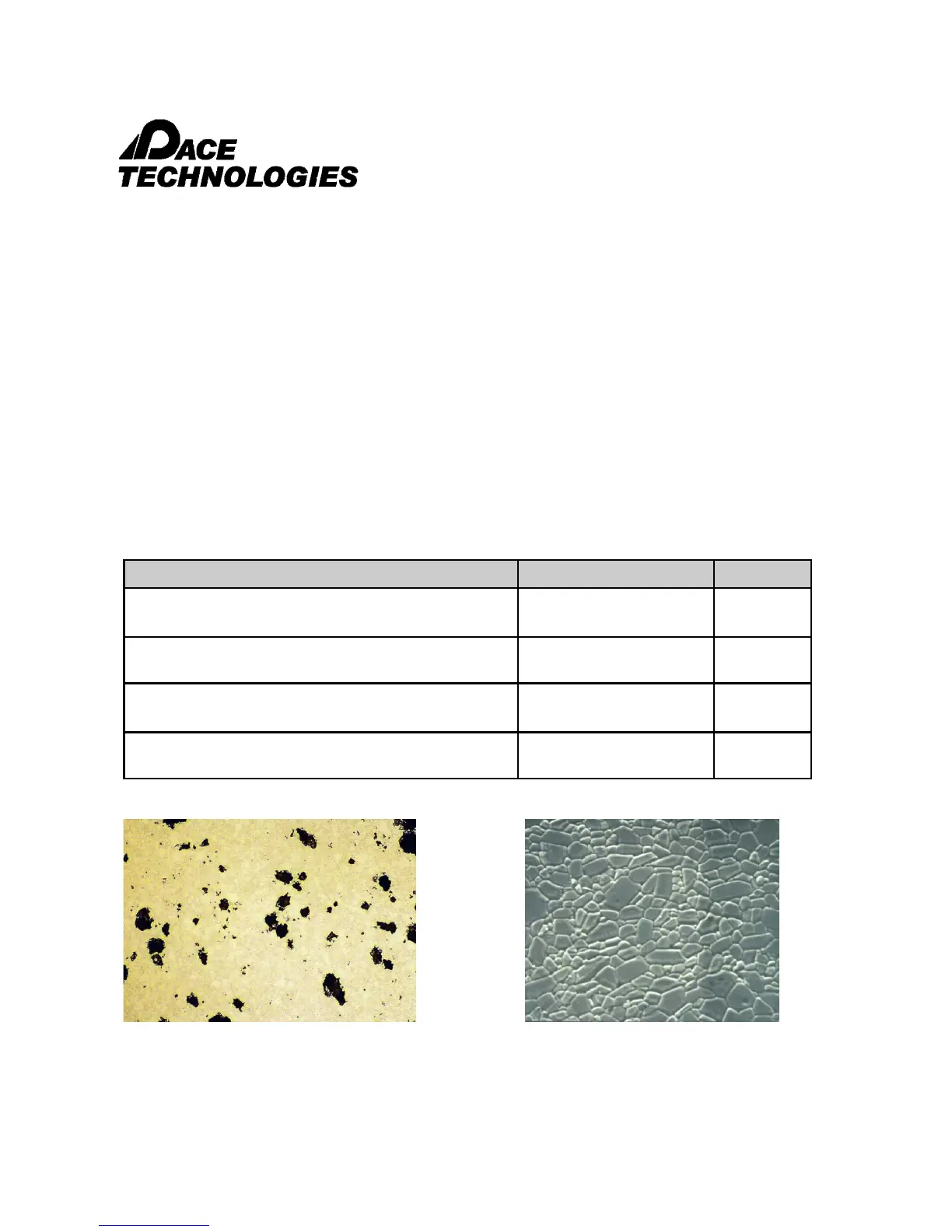
85% Alumina microstructure, 500X
(note the sharp edges - edge retention)
99+% Alumina microstructure, 5000X
(thermally etched)
18
Abrasive/surface Lubricant Time
30 um DIAMAT diamond on CERMESH metal mesh cloth Until plane
6 um DIAMAT diamond on TEXPAN polishing pad SIAMAT colloidal silica 5 minutes
1 um DIAMAT diamond on GOLDPAD polishing pad SIAMAT colloidal silica 5 minutes
SIAMAT Colloidal silica on TEXPAN pad 5 minutes


 To Next Page