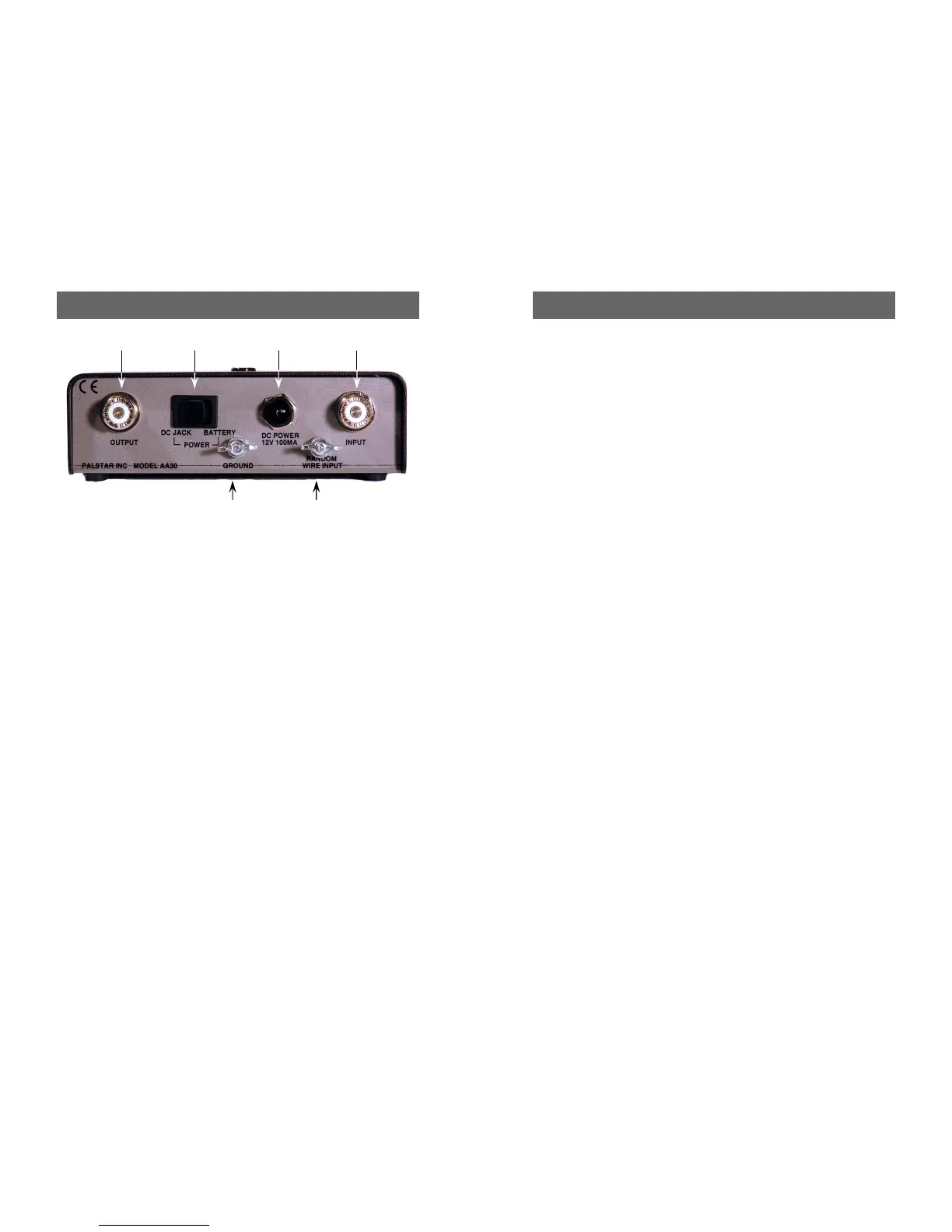
4 Rear Panel
1-8 00-773-7931 WWW.PALSTAR.COM
1 2 3 4
5 6
1. Output SO-239 Jack. Connect to the Antenna Jack of
your receiver.
2. Power Select Switch. Select between external
power jack and internal 9v Battery (PP3).
3. DC Power Jack. 12VDC input for external power.
4. Input SO-239 Jack. For connecting a low impedance,
coax-fed antenna. Disconnect all antennas during light-
ning storms.
5. Ground Post. Connect a ground or counterpoise wire
to this post when using a single ended (non-dipole) an-
tenna. Disconnect during lightning storms.
6. Random Wire Antenna Post. For connecting a ran-
dom length wire antenna. Disconnect all antennas dur-
ing lightning storms.
Operation 5
1-8 00-773-7931 WWW.PALSTAR.COM
Operation:
1. If operating from battery, remove the cover and install a 9V
battery (PP3), securing it in the battery clip on the circuit
board.
2. Chose the antenna you will use. If using the telescoping whip,
install as described on page 3. If using a wire antenna, con-
nect it to the appropriate connector (number 4 or 6 on page
4). Connect a ground wire (number 5, page 4) if needed. Do
not operate with both an external antenna and the telescop-
ing whip at the same time.
3. Select the power source with the switch on the back.
4. Connect the AA30 output to the antenna jack of your re-
ceiver.
5. Select the frequency range you wish to use with the Band
Switch (number 6, page 3), and set the Gain Control (number
4, page 3) to 9 o’clock. Turn on receiver and AA30. The
LED on the front panel will light.
6. Adjust the Tune control until an increase in signal is heard or
indicated on the receiver S-meter.
7. Most tuning will be between 5 and 14 on the Tune dial.
8. Increasing the Gain control beyond 12 o’clock is usually un-
necessary, and risks overloading the receiver or the AA30.
(The risk is bigger the longer your antenna is.)
9. You will notice that the tuning sharpness increases on the
low bands, and will be more broad on the higher bands.
10. Looking for the peaks where the AA30 tunes depends where
the Gain control is set, the conditions of the bands, and time
of day or night.
11. The bands tend to overlap at the band edges. If having trouble
tuning near a band edge, try switching to the next adjacent
higher or lower band.
12. Best results will be obtained with long wire antennas, even if
it is just wire strung around inside a room. However, good
results have been had with the short telescoping whip an-
tenna in the Medium Wave band.
13. A good ground is mandatory with long wires and generally is
a good practice. Disconnect ground and all antennas during
storms.


 To Previous Page
 Loading...