EasyManua.ls Logo

Panasonic AG-5700 - Safety Precautions; General Safety Guidelines; Electrostatically Sensitive Device Handling

Panasonic AG-5700
19 pages
Print Icon
To Next Page IconTo Next Page
To Previous Page IconTo Previous Page
Loading...
SAFETY
PRECAUTIONS
GENERAL
GUIDELINES
1.
When
servicing,
observe
the
origina!
lead
dress.
If
a
short
circuit
is
found,
replace
all
parts
which
have
been
overheated
or
damaged
by
the
short
circuit.
2.
After
servicing,
see
to
it
that
all
the
protective
devices
such
as
insulation
barriers,
insulation
papers
shields
are
properly
installed.
3.
After
servicing,
make
the
following
leakage
current
checks
to
prevent
the
customer
from
being
exposed
to
shock
hazards.
LEAKAGE
CURRENT
COLD
CHECK
1.
Unplug
the
AC
cord
and
connect
a
jumper
between
the
two
prongs
on
the
plug.
2.
Measure
the
resistance
value,
with
an
ohm
meter,
be-
tween
the
jumpered
AC
plug
and
each
exposed
metallic
cabinet
part
on
the
equipment
such
as
screwheads
con-
nectors,
control
shafts,etc.
When
the
exposed
metallic
part
has
a
return
path
to
the
chassis,
the
reading
should
be
between
1M
ohm
and
5.2
M
ohm.
When
the
exposed
meta!
does
not
have
a
return
path
to
the
chassis,
the
reading
must
be
©o.
LEAKAGE
CURRENT
HOT
CHECK
ee
Figure
1)
1.
Plug
the
AC
cord
directly
Into
the
AC
outlet.
Do
not
use
an
\solation
transformer
for
this
check.
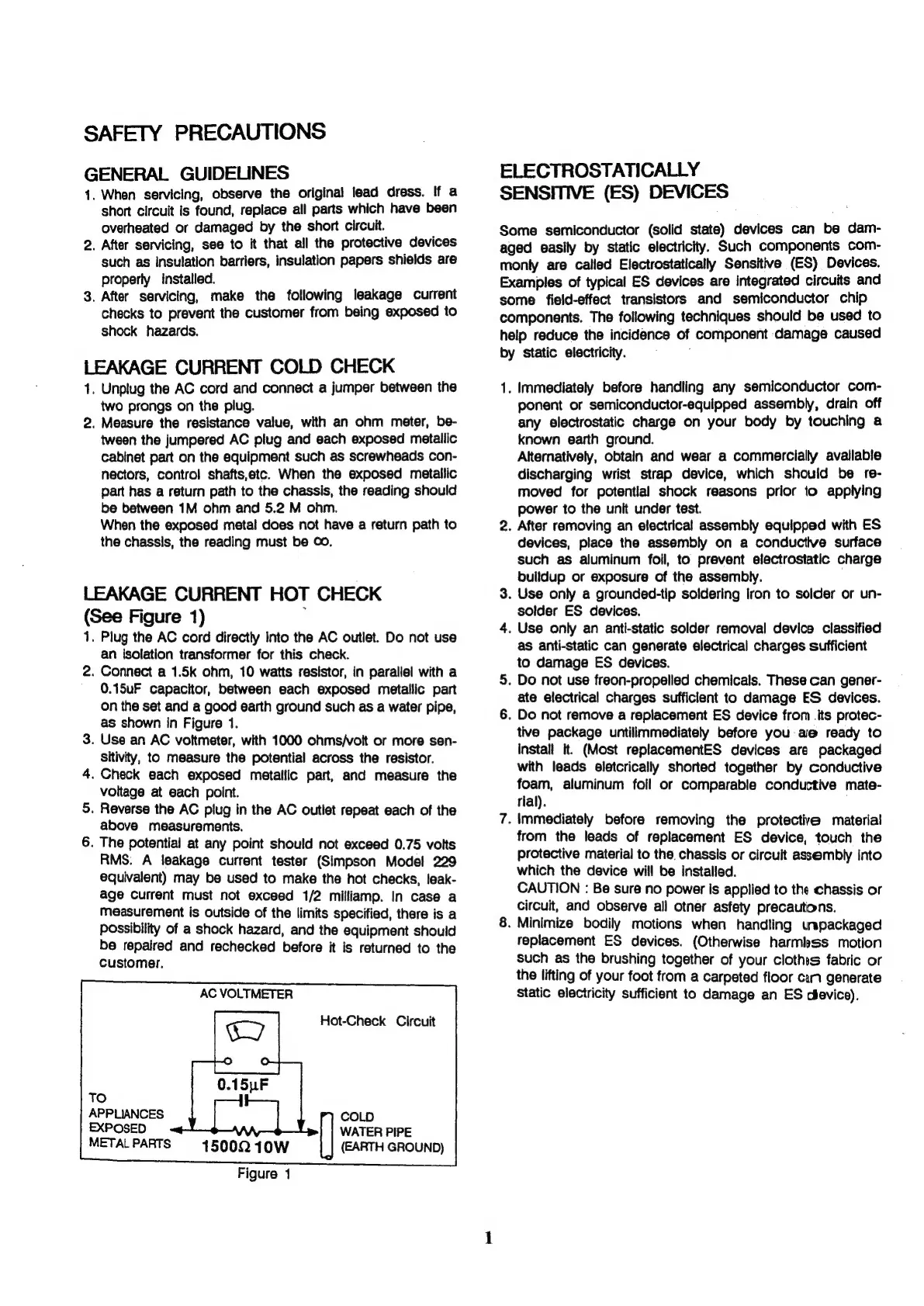
2.
Connect
a
1.5k
ohm,
10
watts
resistor,
in
parallel
with
a
0.15uF
capacitor,
between
each
exposed
metallic
part
on
the
set
and
a
good
earth
ground
such
as
a
water
pipe,
as
shown
in
Figure
1.
3.
Use
an
AC
voltmeter,
with
1000
ohms/voit
or
more
sen-
Sitivity,
to
measure
the
potential
across
the
resistor.
4.
Check
each
exposed
metallic
part,
and
measure
the
voltage
at
each
point.
5.
Reverse
the
AC
plug
in
the
AC
outlet
repeat
each
of
the
above
measurements.
6.
The
potential
at
any
point
should
not
exceed
0.75
volts
RMS.
A
leakage
current
tester
(Simpson
Model
229
equivalent)
may
be
used
to
make
the
hot
checks,
leak-
age
Current
must
not
exceed
1/2
milliamp.
In
case
a
measurement
is
outside
of
the
limits
specified,
there
is
a
possibility
of
a
shock
hazard,
and
the
equipment
should
be
repaired
and
rechecked
before
it
is
returned
to
the
customer.
AC
VOLTMETER
Hot-Check
Circuit
TO
APPLIANCES
{
COLD
EXPOSED
WATER
PIPE
METAL
PARTS
15002
10W
Figure
1
(EARTH
GROUND)
ELECTROSTATICALLY
SENSITIVE
(ES)
DEVICES
Some
semiconductor
(solid
state)
devices
can
be
dam-
aged
easily
by
static
electricity.
Such
components
com-
monly
are
called
Electrostatically
Sensitive
(ES)
Devices.
Examples
of
typical
ES
devices
are
integrated
circuits
and
some
field-effect
transistors
and
semiconductor
chip
components.
The
following
techniques
should
be
used
to
help
reduce
the
incidence
of
component
damage
caused
by
static
electricity.
1.
Immediately
before
handling
any
semiconductor
com-
ponent
or
semiconductor-equipped
assembly,
drain
off
any
electrostatic
charge
on
your
body
by
touching
a
known
earth
ground.
Alternatively,
obtain
and
wear
a
commercialy
available
discharging
wrist
strap
device,
which
should
be
re-
moved
for
potential
shock
reasons
prior
tio
applying
power
to
the
unit
under
test.
.
After
ramoving
an
electrical
assembly
equipped
with
ES
devices,
place
the
assembly
on
a
conductive
surface
such
as
aluminum
foil,
to
prevent
electrostatic
charge
buildup
or
exposure
of
the
assembly.
.
Use
only
a
grounded-tip
soldering
iron
to
solder
or
un-
solder
ES
devices.
.
Use
only
an
anti-static
solder
removal
device
classified
as
anti-static
can
generate
electrical
charges
sufficient
to
damage
ES
devices.
.
Do
not
use
freon-propelled
chemicals.
These
can
gener-
ate
electrical
charges
sufficient
to
damage
ES
devices.
.
Do
not
remove
a
replacement
ES
device
from
.its
protec-
tive
package
untilimmediately
before
you
aie
ready
to
install
it.
(Most
replacementES
devices
are
packaged
with
leads
eletcrically
shorted
together
by
conductive
foam,
aluminum
foil
or
comparable
conductive
mate-
rial).
.
Immediately
before
removing
the
protective
material
from
the
leads
of
replacement
ES
device,
touch
the
protective
material
to
the
chassis
or
circuit
assembly
into
which
the
device
will
be
installed.
CAUTION
:
Be
sure
no
power
is
applied
to
the
chassis
or
circuit,
and
observe
all
otner
asfety
precautons.
.
Minimize
bodily
motions
when
handling
unpackaged
replacement
ES
devices.
(Otherwise
harmbss
motion
such
as
the
brushing
together
of
your
cloths
fabric
or
the
lifting
of
your
foot
from
a
carpeted
floor
cam
generate
Static
electricity
sufficient
to
damage
an
ES
clevice).