EasyManua.ls Logo

Panasonic FV-20VEC1 - User Manual

Panasonic FV-20VEC1
14 pages
Print Icon
To Next Page IconTo Next Page
Loading...
Service Manual
PEG2104001CE
Version:2101
CONTENTS
3.Wiring Diagram
4.Parts List
PAGE
6
Energy Recovery Ventilator
FV-20VEC1
7~9
(North America Market)
WARNING
This service information is designed for experienced repair technicians only and is not designed for use by
the general public. It does not contain warnings or cautions to advise non-technical individuals of potential
dangers in attempting to service a product. Products powered by electricity should be serviced or repaired
only by experienced professional technicians. Any attempt to service or repair the product or products dealt
with in this service information by anyone else could result in serious injury or death.
IMPORTANT SAFETY NOTICE
There are special components used in this equipment which are important for safety. These parts are
marked by in the Schematic Diagrams, Exploded Views and Replacement Parts List. It is essential
that these critical parts should be replaced with manufacturer's specified parts to prevent shock, fire
or other hazards. Do not modify the original design without permission of manufacture.
We suggest to handle such parts after the static electricity prevention.
It is forbidden to touch the PCB parts by bare hands during the repairing process.
2.Parts Identification
2~5
1.Specifications
1
5.Maintenance And Troubleshooting
10~13
Question and Answer IconNeed help?

Do you have a question about the Panasonic FV-20VEC1 and is the answer not in the manual?

Overview

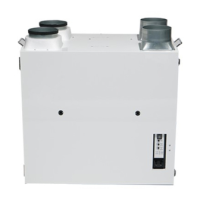
This document is a Service Manual for the Panasonic FV-20VEC1 Energy Recovery Ventilator (ERV), designed for the North America market. It provides comprehensive information for experienced repair technicians, covering specifications, parts identification, wiring diagrams, parts lists, maintenance, and troubleshooting.

Function Description

The Panasonic FV-20VEC1 is an Energy Recovery Ventilator designed to provide fresh air while recovering energy from the exhaust air. This process helps maintain indoor air quality and comfort while reducing the energy load on heating and cooling systems. The device operates by exchanging heat and humidity between incoming fresh air and outgoing stale air, minimizing energy loss. It features various sensors, including humidity and temperature sensors, to optimize its operation based on environmental conditions. The ERV is equipped with multiple filters to ensure the quality of both incoming and outgoing air.

Important Technical Specifications

  • Ventilation Performance:

    • Model No.: FV-20VEC1
    • Air Direction: Exhaust & Supply
    • Voltage (V): 120
    • Frequency (Hz): 60
    • Duct: 6"
    • Static Pressure: 0.4"WG
    • Net Air Flow (CFM): Exhaust: 200, Supply: 200
    • Power Consumption (W): Product: 129
    • Net Weight lb.(kg): 96.8 (44)
  • Energy Performance (Sensible Recovery Efficiency):

    • Heating Mode:
      • At 32°F (0°C) supply temperature: 83% (L/s: 24, CFM: 51, Power: 22W)
      • At 32°F (0°C) supply temperature: 77% (L/s: 59, CFM: 124, Power: 46W)
      • At 32°F (0°C) supply temperature: 73% (L/s: 80, CFM: 170, Power: 92W)
      • At -13°F (-25°C) supply temperature: 67% (L/s: 31, CFM: 66, Power: 46W)
      • At -13°F (-25°C) supply temperature: 61% (L/s: 51, CFM: 107, Power: 104W)
    • Cooling Mode:
      • At 95°F (35°C) supply temperature: 70% (L/s: 34, CFM: 71, Power: 25W)
      • At 95°F (35°C) supply temperature: 61% (L/s: 64, CFM: 135, Power: 56W)
    • Total Recovery Efficiency: 40% (at 95°F/35°C, L/s: 34, CFM: 71, Power: 25W) and 35% (at 95°F/35°C, L/s: 64, CFM: 135, Power: 56W).
    • The testing of ventilation performance and energy performance is in accordance with CSA-C439 standard.

Usage Features

The ERV is designed for integration into HVAC systems, allowing for controlled ventilation. It includes various components such as a main PCB, motors for exhaust and supply air, dampers (OA, EA, Center), and sensors for humidity and temperature. The unit can be controlled via a wall switch and can interface with an HVAC/AHU system. The device features a warning system with buzzer sounds and indicator lights (Green for Running, Red for Filter/Error) to alert users to operational issues or maintenance needs.

Maintenance Features

Routine maintenance is crucial for the optimal performance and longevity of the ERV.
  • Filter Maintenance: Filters should be inspected and cleaned every 2 or 3 months. Clogged filters can lead to condensation and reduced airflow. The replaceable OA filter should be inspected or changed every 90 days, potentially more frequently depending on outside air conditions. The washable return air filter should be inspected and cleaned every 90 days.
  • Cleaning: OA and RA filters can be cleaned with a vacuum cleaner. It is important not to clean the OA filter with water.
  • Safety Precautions:
    • Always disconnect power by switching off the main switch and unplugging the power plug before any maintenance or repair to prevent electric shock.
    • Wear gloves to avoid pinching fingers during maintenance.
    • Be cautious of dust, condensation, debris, or parts that may fall when the frame cover is open.
    • Never use petrol, benzene, thinner, or other harsh chemicals to clean the ERV.
    • Do not allow water to enter the ERV.
    • Do not immerse resin parts in water over 140°F (60°C).
  • Filter Reset: After maintenance and re-connecting power, press the filter reset button for approximately 3 seconds to reset the run timer.
  • Troubleshooting: The manual provides a detailed troubleshooting guide based on the running indicator (Green) and filter indicator (Red) lights, along with buzzer sounds. This helps identify issues such as wall control connection errors, PCB board errors, motor errors (SA, EA), damper errors (OA, EA, Center), sensor errors (temperature, humidity), and Wifi communication errors.
  • Automatic Operation: The ERV may stop operating automatically if the outdoor temperature is low (≤-22°F / -30°C) to protect the energy recovery core. It may also restrict air volume if the outdoor temperature is less than 14°F (-10°C). If the damper is frozen shut, a defrosting period of up to 24 hours may be required.
  • Buzzer Notifications: A 30-second buzzer sound every hour indicates that the RA and OA filters need maintenance. This notification can be canceled by long-pressing the filter reset button for 10 seconds. A 10-second buzzer sound every hour, while the ERV is working, also indicates filter maintenance is due.

Panasonic FV-20VEC1 Specifications

General IconGeneral
BrandPanasonic
ModelFV-20VEC1
CategoryFan
LanguageEnglish

Related product manuals