
 Need help?
Do you have a question about the Panasonic NE-1025F and is the answer not in the manual?
Specific guidelines to prevent harmful exposure to microwave energy and ensure safe operation.
Covers examining the oven, removing film, and placement for optimal operation.
Details grounding procedures and necessary wiring specifications for safe operation.
Guidelines for safe general operation, handling, and avoiding fire hazards.
Recommendations for safe food preparation, heating, and avoiding food-related hazards.
Explains how microwaves interact with metal, glass, and plastic materials.
Details how food molecules absorb microwave energy causing heat.
Addresses potential interference and methods to reduce it.
Identifies key parts of the microwave oven, including controls and structural elements.
This document is an owner's manual for a Panasonic Commercial Microwave Oven, Model No. NE-1025F. It provides comprehensive instructions for safe operation, installation, maintenance, and general usage of the appliance.
The Panasonic NE-1025F is a commercial microwave oven designed for heating and cooking food quickly and efficiently in a commercial setting. It utilizes microwave energy to excite food molecules, generating heat internally. The oven is equipped with a magnetron tube that converts electricity into microwave energy, which is then distributed within the oven cavity by a combination of stationary interior walls and a rotating antenna located underneath the bottom shelf. This ensures even heating and cooking of various food items.
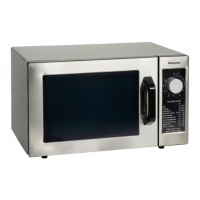
The oven features a simple rotary timer control for setting desired heating times, making it straightforward to operate in a fast-paced commercial environment. A cooking guide is provided on the control panel, offering recommended heating times for common food items such as rolls, turnovers, sandwiches, burgers, soups, stews, burritos, and "pocket" sandwiches, with adjustments suggested for specific product weights.
To operate the oven, the user first ensures it is plugged into a dedicated three-prong grounded 120V circuit. The food container is then placed inside the oven, and the door is securely closed. The desired heating time is set using the rotary timer. Microwave heating begins automatically once the timer is set. A sound notifies the operator when heating is complete, and the oven light turns off.
The manual emphasizes several safety precautions for proper use. It advises against operating the oven empty, as this can cause overheating and potential damage or fire. If a fire occurs, the timer should be turned to "0," the door left closed, and the power cord disconnected or circuit breaker shut off. The oven should not be used to dry clothes, newspapers, or other combustible materials. Recycled paper products should only be used if labeled safe for microwave oven use to avoid sparks and fires. The control panel should not be hit or struck to prevent damage. Pot holders are recommended when removing hot items from the oven. Flammable materials should not be stored near, on top of, or inside the oven.
Regarding food preparation, the manual recommends underheating rather than overheating, as food can always be returned for further heating if needed. Users should start with minimum heating times and follow USDA guidelines for food safety. Small quantities of food or foods with low moisture content can burn or dry out if heated too long. Microwave popcorn should be used according to the manufacturer's directions and wattage recommendations. Deep fat frying and boiling eggs in their shell are not recommended in the microwave oven. Foods with nonporous skins, such as potatoes, apples, egg yolks, whole acorn squash, and sausages, should be pierced before cooking to prevent bursting.
A critical safety note concerns "superheated" liquids. Liquids can become hotter than boiling water without appearing to bubble, and can "explode" out of the container when moved. To prevent this, liquids should be stirred vigorously before heating to mix with air, and should never be heated for an excessive length of time. Paper towels or cloths containing synthetic fibers like nylon should not be used, as they may ignite. The oven is equipped with a protective device that automatically turns off the unit in case of overheating and resets after cooling (approximately 30-60 minutes).
Regular cleaning is essential for maintaining the microwave oven. The manual advises unplugging the oven before cleaning. The inside of the oven should be kept clean, with spills wiped up immediately. If food splatters adhere to the walls, they should be wiped with a damp cloth. A mild detergent can be used for very dirty areas, but harsh detergents or abrasives are not recommended.
The air intake splash guard/light diffuser can be removed for cleaning by taking out the center plugs from the two plastic rivets. The top is held by two tabs. These parts should be washed in warm dishwater and replaced. The outside oven surfaces should be cleaned with a damp cloth, taking care to prevent water from seeping into the ventilation openings, which could damage internal operating parts.
If the control panel becomes wet, it should be cleaned with a soft, dry cloth. Harsh detergents or abrasives should not be used on the control panel. When cleaning the control panel, the oven door should be left open to prevent accidental activation. After cleaning, the TIMER SELECT DIAL must be set to the zero position.
If steam accumulates inside or around the outside of the oven door, it should be wiped with a soft cloth. This is a normal occurrence in high humidity conditions and does not indicate a malfunction. Grease and dust on the bottom surfaces of the oven should be cleaned often using a warm detergent solution.
The manual also includes important instructions regarding installation and grounding. The oven must be placed on a flat, stable surface with sufficient air flow (3 inches on both sides, 1 inch on top) and air vents must not be blocked. It should not be placed near hot, damp surfaces or operated in high humidity. The appliance must be grounded to a properly installed three-prong outlet on a separate circuit, and the voltage used must match the specified 120V. Any damage to the cord, plug, or oven itself, or any malfunction, requires service by qualified personnel. The oven door, hinges, latches, and sealing surfaces should be regularly inspected for damage, and any issues should be addressed by qualified service personnel to avoid exposure to excessive microwave energy.
 General
| Type | Commercial Microwave Oven |
|---|---|
| Power Output | 1000 W |
| Frequency | 2450 MHz |
| Power Consumption | 1450 W |
| Interior Light | Yes |
| Interior Material | Stainless Steel |




 To Next Page