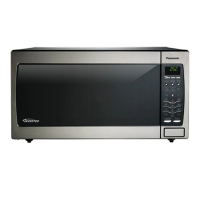
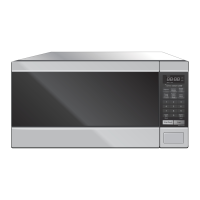
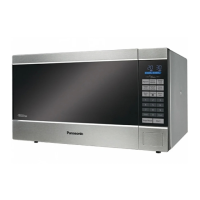
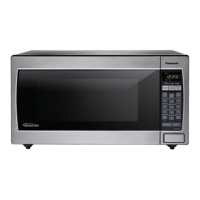
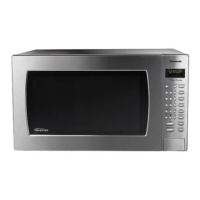
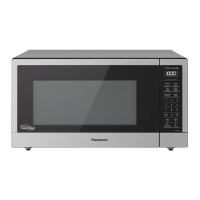
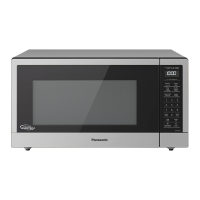
This document serves as a service manual for Panasonic microwave ovens, specifically models NN-SN776S, NN-SN756S, NN-SN756B, NN-SN756BT, and NN-SA746M, covering both APH (USA) and CPH (CANADA) versions. It is intended for experienced repair technicians and provides detailed information for the proper servicing and maintenance of these appliances.
The primary function of these devices is to heat food using microwave energy. They are designed for household use, offering a convenient and efficient method for cooking and reheating various food items. The manual highlights the use of an inverter power supply, a key component that drives the magnetron tube with extremely high voltage and current, enabling the microwave heating process. This inverter board functions similarly to a high voltage transformer and capacitor found in traditional microwave ovens.
For usage, these microwave ovens are equipped with a control panel that allows users to select various cooking settings, including power levels and cooking times. The door assembly includes a latch system with primary, secondary, and short switches, which are crucial for safe operation by ensuring the door is properly closed before microwave energy can be generated. The internal cavity is designed to accommodate a glass tray for food placement.
Maintenance features are extensively covered in the manual, emphasizing safety precautions due to the high voltage and high temperature components within the inverter power supply. Technicians are warned against touching the circuitry and aluminum heat sink, as they carry very high voltage and heat. The manual strictly advises against attempting to adjust or tamper with preset controls on the inverter board without proper test equipment, and for USA models, it explicitly states that the inverter PCB should not be repaired but replaced as a complete unit.
A crucial aspect of maintenance involves checking for microwave energy leakage. The manual outlines a detailed procedure for measuring radiation leakage both with the outer panel removed and with a fully assembled oven. This procedure includes using a radiation monitor with a 2-inch (5cm) spacer and specific water volume and temperature for testing. Technicians are required to record leakage readings on the repair ticket, even if zero, and to notify Panasonic if leakage exceeds specified limits after ensuring all parts are in good condition and genuine replacements have been used. Annual calibration of the radiation monitor is also recommended.
The manual provides a troubleshooting guide based on the "3/23 seconds rule" to help identify whether a problem lies with the magnetron, inverter, or other components. This involves observing the ammeter reading when the unit is started and noting if it shuts off in 3 or 23 seconds. Depending on the ammeter reading and shutdown time, specific remedies are suggested, such as checking magnetron circuits, continuity of D702 in the inverter PCB, or open circuits in latch switches, DPC, power relay, and CN701. It is explicitly stated that both the inverter board and magnetron should not be replaced simultaneously without following this procedure.
Furthermore, the manual includes exploded views and parts lists for various assemblies, such as the escutcheon base assembly, door assembly, and wiring materials. These sections are vital for identifying and ordering correct replacement parts. Technicians are instructed to use the part numbers provided in the list rather than relying on part descriptions. Special attention is drawn to components marked with a specific symbol, indicating their importance for safety, and emphasizing the use of only manufacturer-specified parts for replacement to prevent hazards like microwave leakage, shock, or fire. The manual also clarifies that "A" parts are supplied by CSD (Japan) and "F" parts by PHAMOS (China).
The digital programmer circuit diagrams are also included, providing a visual representation of the electronic components and their connections, which is essential for diagnosing and repairing electrical issues. This comprehensive approach ensures that technicians have all the necessary information to safely and effectively service the Panasonic microwave ovens.


 To Next Page
 General