
 Need help?
Do you have a question about the Panasonic Toughbook Series and is the answer not in the manual?
Discusses RF energy, safety guidelines, and usage restrictions in certain environments.
Covers responsibility for interference and compliance with regulations.
Explains CDMA technology, 1xRTT, and dial-up data services.
Details the need for a service provider account and initial provisioning.
Guides Win2000/XP users on software installation, port tool usage, and initial file setup.
Details the process of adding the SB555 modem profile in Windows Phone & Modem Options.
Explains how to launch the Watcher application and initiate the activation process.
Guides users on creating and configuring connection profiles within the Dial-up Manager.
Explains the functions of the Watcher application and the meaning of its various icons.
Describes the icons displayed in the Windows System Tray by the Watcher application.
Details the meaning and function of the three LED indicators on the SB555 modem.
Provides key technical specifications for the SB555 CDMA modem.
Lists registered trademarks and copyright information for the product and software.
States limitations of liability for errors, omissions, or discrepancies in the manual.
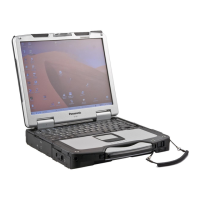
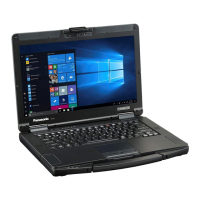
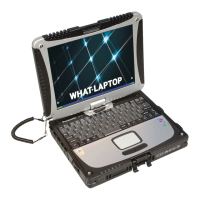
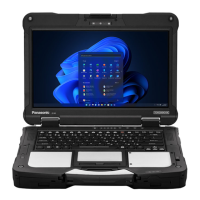
The Panasonic Toughbook is a personal computer designed for robust use, enhanced with supplementary instructions for models equipped with CDMA (Code Division Multiple Access) for wireless communication. This supplement specifically addresses the integration and use of the Sierra Wireless SB555 OEM CDMA modem within Toughbook computers.
The core function of the Toughbook, when equipped with the SB555 modem, is to provide high-speed wireless data service, effectively acting as a wireless network card. This enables users to connect to the Internet, send and receive e-mail, and access corporate networks without the need for physical network cables or phone lines. The SB555 modem operates over CDMA networks, offering a range of connectivity features including high-speed packet data (1xRTT) for Internet connections with data rates up to 153.6 kbps (downlink) and 76.8 kbps (uplink). It also supports circuit-switched (dial-up) data using the earlier CDMA IS-95 specification, allowing data connections to any dial-in service at rates up to 14.4 kbps. Additionally, the modem facilitates SMS (Short Message Service), enabling users to send and receive short text messages.
For optimal wireless communication, users are advised to raise the antenna when making a connection, if possible. The device's wireless communications rely on this antenna.
The SB555 modem requires an account with a CDMA service provider, as each SB555 is provisioned at the factory for a specific provider, determining the radio channels and services available. The activation process involves both the service provider and configuration of the SB555 modem.
The device incorporates safety precautions for various environments. In hospitals or other health care facilities, users must observe restrictions on mobile use and switch off the CDMA modem if instructed, as medical equipment can be sensitive to RF energy. Cardiac pacemakers, other implanted medical equipment, and hearing aids can be affected by interference, so pacemaker patients should keep the modem away from their device when it is on.
Before boarding an aircraft, the Personal Computer or Handheld Computer incorporating the CDMA modem must be switched off to prevent interference with communication systems. Operation of wireless appliances on an aircraft is forbidden.
The modem should not be operated in the presence of flammable gases or fumes. It must be switched off near petrol stations, fuel depots, chemical plants, or during blasting operations, as electrical equipment can pose a safety hazard in potentially explosive atmospheres.
The device transmits and receives radio frequency energy when switched on, and interference can occur if used near inadequately shielded equipment like TV sets, radios, or other computers. Users must follow special regulations and switch off the modem wherever forbidden or when interference or danger is suspected.
Road safety is emphasized, with a strong recommendation not to use the CDMA modem while driving. The computer should not be placed in an area where it could cause personal injury to the driver or passengers, such as over an airbag or in its deployment vicinity. It is recommended to stow the unit in the trunk or a secure stowage area while driving.
It is important to note that due to reliance on radio signals and cellular networks, the modem cannot guarantee connection in all conditions. Therefore, it should not be solely relied upon for essential communications, such as emergency calls. To make or receive calls, the modem must be switched on and within a service area with adequate cellular signal strength. Some networks may restrict emergency calls if certain network services or phone features (e.g., lock functions, fixed dialing) are active, requiring deactivation of these features. Some networks also require a valid SIM card to be properly inserted.
The Watcher application is a key maintenance and monitoring tool for the SB555 modem and CDMA network. It allows users to:
The Watcher provides visual indicators for various statuses:
The Watcher also displays an icon in the Windows System Tray, providing quick status updates on connection, voice mail, SMS messages, or missed calls.
The Toughbook features a power switch for the integrated SB555 modem, allowing users to power it on and off. Next to this switch are three LED indicators:
 General
| Processor | Intel Core i5 or i7 (varies by model) |
|---|---|
| Operating System | Windows 10 or 11 (various editions) |
| Durability | MIL-STD-810H certified |
| Connectivity | Optional 4G LTE or 5G |
| Ports | HDMI, Ethernet (varies by model) |
| Water and Dust Resistance | IP53 or IP65 (varies by model) |
| Weight | Varies by model (3.3 lbs to 8.5 lbs) |




 To Next Page