Appendix
© Copyright 2008 Panoramic Corporation
Panoramic Radiography
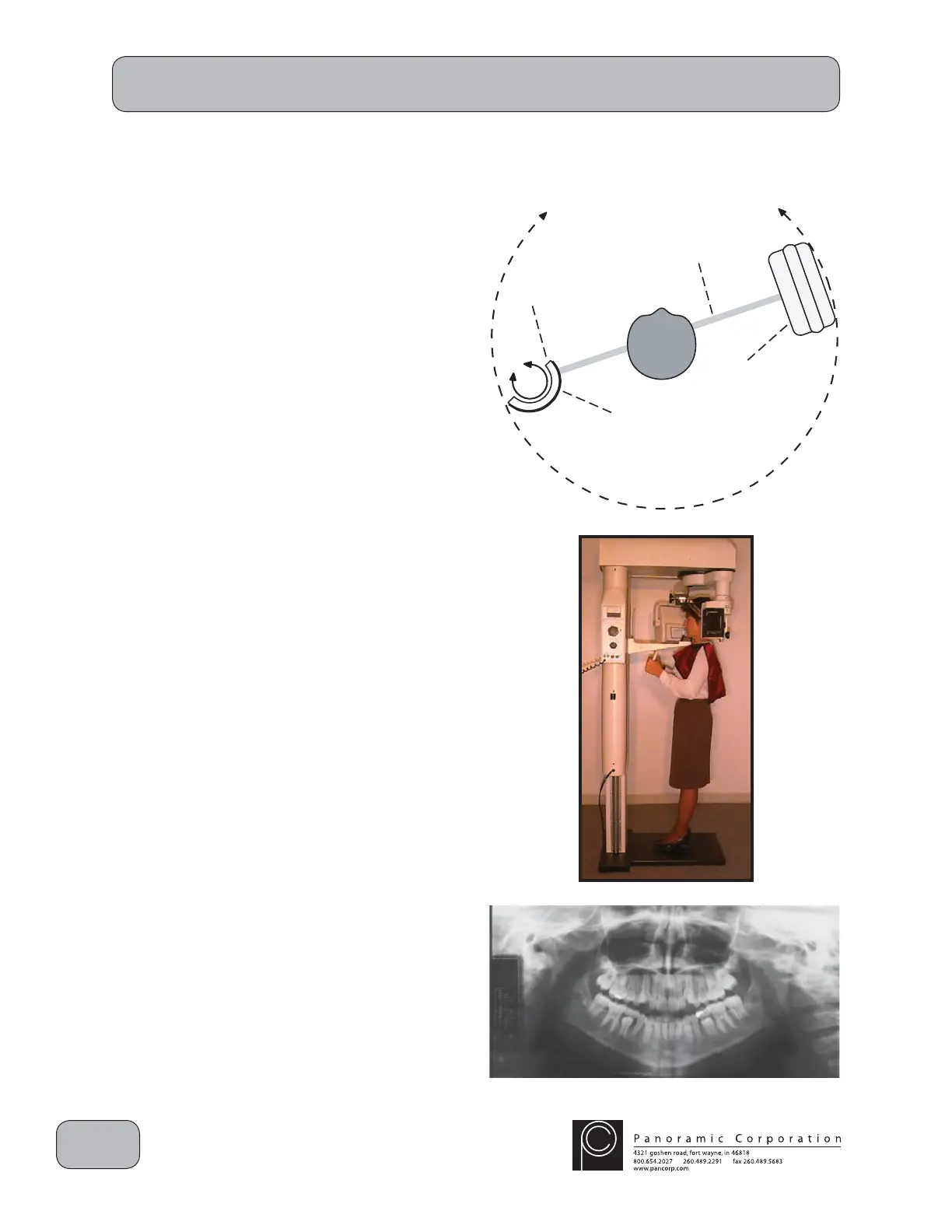
Panoramic Radiography has been in use for over
30 years. In panoramic radiography, the X-ray
source and fi lm rotate around the patient's head at
the same speed. Simultaneously, the fi lm rotates
about its own axis.
X-rays are emitted from the tubehead in a very
narrow vertical band, pass through the patient's
head (where some are absorbed), and strike
the fi lm cassette sleeve. Intensifying screens
are used inside the fi lm cassette sleeve. The
intensifying screens glow whenever X-rays strike
them, the more X-rays striking the screen, the
brighter the glow. Film, which is sensitive to light,
is placed between the intensifying screens. The
more light that is exposed to the fi lm, the darker
the fi lm is. Since the patient is between the X-ray
source and the fi lm, the amount of X-rays that
reach the fi lm will vary depending on the density
of the patient's anatomy. Dense matter, such as
bone, will absorb more of the X-rays than less
dense matter, such as tissue. Less X-rays reach
the fi lm when striking the teeth, causing them to
appear on the fi lm as lighter areas. More X-rays
reach the fi lm when striking tissue, causing it to
appear on the fi lm as darker areas.
In order to pass as many X-rays through the
patient's head as possible, the tubehead is tilted at
a slight upward angle to:
1. move the dense portion of the skull out of
the path of the X-rays
2. cause the upper and lower anterior root tips
to be aligned vertically
3. stretch the vertebrae in the neck to allow
the X-rays to pass more effi ciently through
the vertebrae to expose the anterior teeth
As the tubehead and fi lm rotate around the patient,
the fi lm is gradually exposed by a narrow vertical
band. It is imperative that the fi lm is aligned to
start at the correct position and that nothing stops
the fi lm drum or tubehead from moving while the
exposure is being taken.
A
Film Drum
X-rays
Tubehead
Film
Cassette
Sleeve


 To Next Page
 Loading...