The provided manual describes the ParkerBrand PCS-2600 Petrol Chainsaw, a device designed for cutting wood.
Function Description
The ParkerBrand PCS-2600 is a petrol-powered chainsaw intended for various wood-cutting tasks. It operates using a 2-stroke engine and requires a specific fuel mix of petrol and 2-stroke oil at a 25:1 ratio. The chainsaw features a chain brake for safety, a choke lever for starting, a primer bubble to assist with cold starts, and a recoil starter. It includes a 10-inch guide bar and a saw chain, which are essential for its cutting function. The device is equipped with a chain tensioner for proper chain adjustment and a throttle trigger with a lock for controlled operation. An oiling system ensures the chain is lubricated during use.
Important Technical Specifications
PCS-2600 Power Unit:
- Engine: 2-Stroke
- Displacement: 25.4 cm³
- Bore x Stroke: 34mm x 28mm
- Fuel Mix Ratio (Petrol/2 Stroke Oil): 25:1
- Fuel Tank Capacity: 230 cm³
- Chain Oil: ISO 100
- Oil Tank Capacity: 160 cm³
- Carburettor: Diaphragm Type
- Ignition System: Solid State
- Spark Plug: LD LTT
- Oil Feeding System: Mechanical Pump
- Power: 0.9 kW / 8,500 min⁻¹
- Max Speed: 10,500 min⁻¹
- Idle Speed: 3,500 min⁻¹
- Guaranteed Sound Power Level (LwA): 117 dB(A)
- Working Weight: 3kg
- Dimensions (LxWxH): 265 x 220 x 220 mm
PCS-2600 Guide Bar:
- Type: Sprocket Nose
- Sprocket Teeth x Pitch: 6T x ?.?
- Size: 10" / 30cm (Note: There is a discrepancy in the manual, showing both 10" and 30cm, which is approximately 12". The image shows a 10" bar.)
PCS-2600 Saw Chain:
- Pitch: 3/8" / 9.53mm
- Gauge: 0.05" / 1.27mm
Usage Features
The manual provides detailed instructions for safe and effective operation.
- Assembly: The chainsaw requires assembly of the guide bar, chain, and bumper spike. This involves disengaging the brake, removing the brake assembly, locating and attaching the bumper spike, installing the chain and guide bar, checking chain direction, adjusting the tensioner, refitting the brake assembly, finger tightening the bolt, tensioning the chain, and securing the brake cover.
- Fueling: The fuel tank must be filled with a 25:1 petrol/2-stroke oil mix. The chain oil tank should be filled with ISO 100 chain oil.
- Starting the Engine:
- Engage the brake by pulling the handle forward.
- Use the primer bubble (press 6 times or until filled with fuel).
- Close the choke for cold starts (pull choke lever up, then press throttle).
- Open the choke for warm starts (choke lever in downwards position).
- Switch on the ignition (press the switch to "On" position).
- Tension the recoil by pulling the starter handle outwards until tension is felt.
- Start the engine (cold): Ensure choke is ON/CLOSED (UP position), pull recoil starter twice in quick succession. After two pulls, turn the choke OFF/OPEN (DOWN position) and continue to pull starter until engine starts.
- Start the engine (warm): Ensure choke is OFF/OPEN (DOWN position), pull recoil starter in quick succession until the engine starts.
- Using the Throttle: To unlock the throttle trigger, press the throttle lock. Press the throttle trigger to increase engine revs. Releasing the trigger returns the engine to idle speed.
- Chain Brake: The chain brake is a safety device that stops the chain during kickback. It can be engaged manually or automatically. To release, pull the brake handle towards you. To engage, push the brake handle away from you.
- Oil Flow Adjustment: The oil flow can be adjusted using a small, flat-head screwdriver on the underside of the saw. Turning clockwise decreases flow, counter-clockwise increases flow.
Maintenance Features
The manual outlines a comprehensive maintenance schedule to ensure the chainsaw's longevity and safe operation.
- Cleaning the Air Filter: Regularly clean the air filter. This involves unscrewing the black winged screw, pulling the air filter cover, removing the air filter, cleaning it, and reinstalling.
- Removing the Spark Plug: The spark plug should be checked and replaced as needed. To remove, pull the air filter cover, grip and pull the spark plug lead, remove the spark plug with the provided tool, and unscrew.
- Adjusting the Spark Plug: A properly gapped spark plug is crucial. The gap should be between 0.6mm and 0.7mm.
- Adjusting the Carburettor: The carburettor is factory set but may require minor adjustments.
- Adjust Idle Speed (T screw): Controls engine speed at idle. Turning clockwise increases idle speed, counter-clockwise decreases it.
- Adjust Low Speed Adjustment (L screw): Controls the air/fuel mixture at low speed. Turning clockwise leans the mixture, counter-clockwise enriches it.
- Adjust High Speed Adjustment (H screw): Controls the air/fuel mixture at high RPMs. Turning clockwise leans the mixture, counter-clockwise enriches it.
- Troubleshooting: A table provides common problems, possible causes, and solutions (e.g., no spark, fuel mix issues, flooded engine, lack of power, clogged air/fuel filter, no oil flow).
- Maintenance Schedule:
- Before starting work: Visual inspection, check throttle/trigger/choke/stop switch, check chain brake, check manual fuel pump (if fitted), check chain lubrication, check chain (wear/damage), check guide bar (deburr).
- After finishing work or daily: Clean complete machine, clean fuel tank, clean chain oil tank, clean chain, clean guide bar, check chain sprocket, clean air filter, check anti-vibration elements, clean air inlet on fan housing, clean cylinder fins, check carburettor (idle adjustment), check spark plug (gap), check clutch.
- Weekly: Check pickup body/filter in fuel tank.
- Monthly: Replace pickup body/filter in fuel tank, check chain (wear/damage), turn over guide bar, check chain sprocket, clean air filter, clean cylinder fins, check clutch.
- Yearly: Replace pickup body/filter in fuel tank, replace chain, replace chain sprocket, replace air filter, replace anti-vibration elements, replace cylinder fins, replace safety labels, drain oil fuel, service (full inspection).
- If damaged: Replace parts as needed.
- As required: Replace pickup body/filter in fuel tank, replace chain, replace guide bar, replace chain sprocket, replace air filter, replace anti-vibration elements, replace cylinder fins, replace safety labels.
- After each refuelling stop: Check chain tension.
- Every 100 hours of operation: Replace spark plug.
- After first 100 hours of operation, then every 150 hours of operation: De-coke exhaust port.
- Periodically: Re-tighten all accessible screws and nuts (not adjusting screws). Replace chain catcher.

 Need help?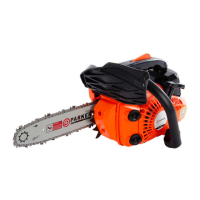

 To Next Page
 General