Photoelectric Effect Apparatus Model No. AP-8209
5
®
In 1901 Max Planck published his theory of radiation. In it he stated that an oscillator, or any
similar physical system, has a discrete set of possible energy values or levels; energies between
these values never occur. Planck went on to state that the emission and absorption of radiation is
associated with transitions or jumps between two energy levels. The energy lost or gained by the
oscillator is emitted or absorbed as a quantum of radiant energy, the magnitude of which is
expressed by the equation: E = h
ν
where E equals the radiant energy,
ν
is the frequency of the
radiation, and h is a fundamental constant of nature. (The constant, h, became known as Planck's
constant.)
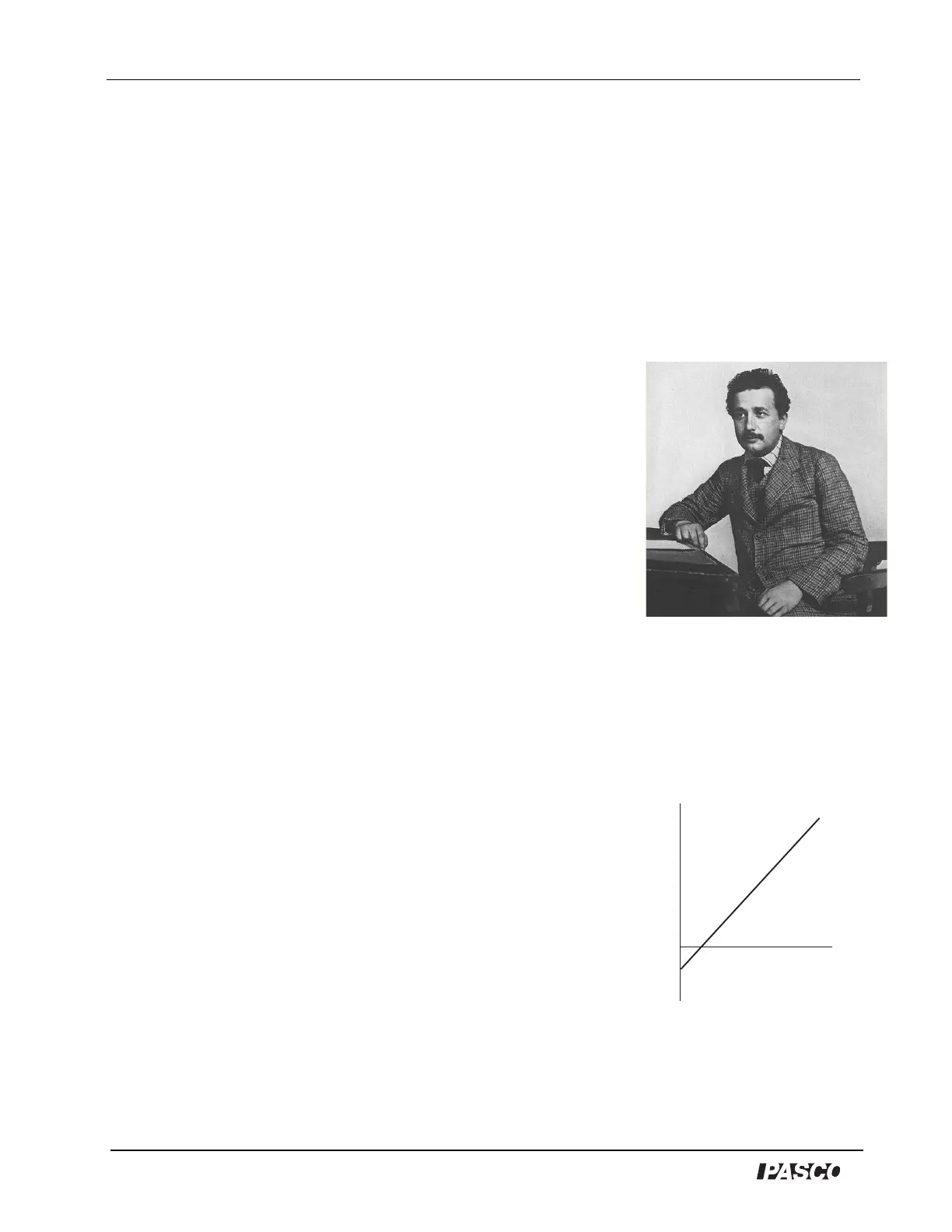
In 1905 Albert Einstein gave a simple explanation of Lenard’s discoveries using Planck’s theory.
The new ‘quantum’-based model predicted that higher frequency light would produce higher
energy emitted electrons (photoelectrons), independent of intensity,
while increased intensity would only increase the number of electrons
emitted (or photoelectric current). Einstein assumed that the light
shining on the emitter material could be thought of as ‘quanta’ of
energy (called photons) with the amount of energy equal to h
ν
with
ν
as the frequency. In the photoelectric effect, one ‘quantum’ of energy
is absorbed by one electron. If the electron is below the surface of the
emitter material, some of the absorbed energy is lost as the electron
moves towards the surface. This is usually called the ‘work function’
(W
o
). If the ‘quantum’ is more than the ‘work function’, then the
electron is emitted with a certain amount of kinetic energy. Einstein
applied Planck's theory and explained the photoelectric effect in
terms of the quantum model using his famous equation for which he
received the Nobel prize in 1921:
where KE
max
is the maximum kinetic energy of the emitted photoelectron. In terms of kinetic
energy,
If the collector plate is charged negatively to the ‘stopping’ potential so that electrons from the
emitter don’t reach the collector and the photocurrent is zero, the highest kinetic energy electrons
will have energy eV where e is the charge on the electron and V is the ‘stopping’ potential.
Einstein’s theory predicts that if the frequency of the incident
light is varied, and the ‘stopping’ potential, V, is plotted as a
function of frequency, the slope of the line is h/e (see Figure 1).
Eh
ν
KE
max
W
0
+==
KE
max
h
ν
W
0
–=
eV h
ν
W
0
–=
V
h
e
---
ν
W
0
e
--------
–=
Albert Einstein
Stopping
Potential, V
Frequency,
ν
Figure 1: Stopping Potential, V versus Frequency,
ν



 To Next Page