The Pascor Atlantic Type TTT7 Double End-Break Outdoor Air Disconnect Switch is a high-voltage air disconnect switch designed for outdoor use. It is capable of operating in systems ranging from 72.5 kV to 550 kV, with current ratings from 1200A to 5000A, and momentary current ratings from 61 kA to 120 kA. The switch's primary function is to isolate sections of an electrical circuit for maintenance or to reconfigure the system, ensuring safety by providing a visible air gap.
Function Description
The TTT7 switch operates as a double end-break mechanism, meaning the blade separates from contacts at both ends when opening. This design contributes to a robust and reliable disconnection. The switch can be operated manually via a swing handle or a worm gear mechanism, or remotely using a motor operator. Its design incorporates rotating insulator columns that facilitate the movement of the blade assembly. The switch is typically installed on a supporting structure, with careful attention to leveling and alignment to ensure proper operation.
Important Technical Specifications
- Voltage Range: 72.5 kV through 550 kV
- Continuous Current Rating: 1200A to 5000A
- Momentary Current Rating: 61 kA to 120 kA
- Operation: Manual (swing handle or worm gear) or Motor Operated
- Blade Movement: Double end-break, with the blade rotating to an open position at an angle of 70° to the centerline of the switch base.
- Insulator Columns: Rotating columns support the blade and jaw assemblies.
- Leveling: Achieved using shims for switches up to 230 kV and leveling screws for 345 kV and above.
- Contact Angle: Allowable blade contact angle of 4 degrees in the closed position, permitting a dimension X of 1/16" for each 1" of contact width.
- Blade Engagement: Distance between the blade and its stop (dimension H) may vary from 0" to 1" when fully closed, adjustable via insulator stacks.
- Vertical Operating Pipe: Pre-drilled at one end for a 5/8" diameter pin, supplied with coupling pins for connection to the rotor bearing shaft.
- Lock Plate Height (Swing Handle): Recommended 3 ft. 6 in. above ground.
- Arcing Horns/Arc Restrictors: Optional, adjusted to provide light contact pressure with the switch blade.
- Sleet/Corona Shields: Optional, installed over blade mechanism and jaws.
Usage Features
- Installation Flexibility: The switch can be fully assembled and adjusted at ground level before being hoisted into position, minimizing final adjustments at height.
- Alignment and Adjustment: Detailed steps are provided for checking bases, mounting switch bases, operating bearings, insulators, and current-carrying parts. Specific instructions guide blade entry, contact angle adjustment, and blade engagement.
- Interphase and Offset Crank Rods: Installation involves adjusting rod lengths to allow for pin insertion, ensuring proper compression or tension during opening.
- Accessory Integration: Provisions for auxiliary switches, mechanical interlocks, position indicators, and ground straps are made during vertical operating pipe installation.
- Locking Mechanism: The swing handle operator includes a lock plate assembly that acts as a lock for the manual operating handle in both open and closed positions. Worm gear mechanisms typically include provisions for padlocking.
- Space Efficiency: The TTTV type switch, a variation of the TTT, features a "V" shape formed by the two outside insulators, allowing for a smaller base structure and more space-efficient installation.
Maintenance Features
- Regular Inspection: Recommended frequency depends on atmospheric conditions and operational frequency.
- Cleaning: Insulators should always be kept clean.
- Contact Examination: Contacts should be checked for alignment, cleanliness, and firm, uniform pressure. Pitted or burned contacts should be replaced.
- Lubrication: Periodic maintenance includes thoroughly cleaning contact surfaces by scraping off contamination and sanding, followed by applying lubricant. Suggested lubricants include MOBIL 28 grease or NO-OX-ID "A Special."
- Linkage Maintenance: Operating linkages generally require minimal maintenance, but lubrication at pivot points may be desirable in contaminated atmospheres or where sleet conditions are common. Durable grease that retains viscosity over a wide temperature range is recommended.
- Terminal Connections:
- Aluminum-to-Aluminum: Clean contact surfaces with a stiff wire brush, coat with corrosion inhibitor (NO-OX-ID "A Special" or No. 2 EJC), abrade through the inhibitor, and torque bolts as per Table 1.
- Copper-to-Aluminum: For non-plated surfaces, clean contact surfaces with a stiff wire brush, prepare bare copper surfaces, coat with corrosion inhibitor (NO-OX-ID "A Special" or No. 2 EJC), abrade through the inhibitor, and torque bolts as per Table 1. If a tinned terminal clamp is used with a copper conductor, bolt it to the aluminum switch terminal pad and apply electrical joint grease.
- Renewal Parts: Ordered by referring to the switch nameplate, which contains serial number, switch type, max kV, B.I.L. kV, cont. amps, and mom. amps.

 Need help?
 General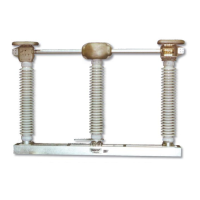

 To Next Page
