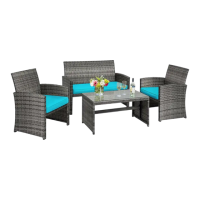
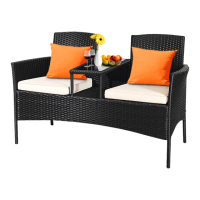
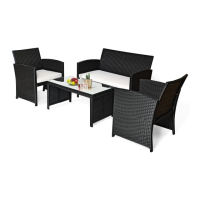
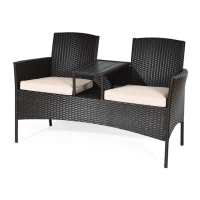
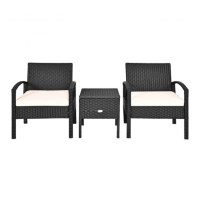
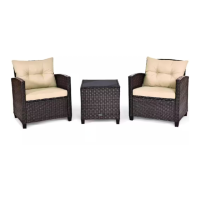
This document serves as an instruction manual for the "Patiojoy 3-Piece Rattan Patio Furniture Set," identified by model number HW63218. The manual provides assembly instructions and important information regarding product usage, maintenance, and claims.
Function Description:
The Patiojoy 3-Piece Rattan Patio Furniture Set is designed for outdoor use, providing comfortable seating and a functional table for patios, gardens, or other outdoor spaces. The set typically includes two chairs and one table, allowing for relaxation and social gatherings outdoors. The rattan construction suggests durability and weather resistance, making it suitable for various outdoor conditions.
Important Technical Specifications (Derived from Assembly Parts and Instructions):
- Components:
- Chairs: The set includes two chairs (A x2, B x2). Each chair appears to consist of a backrest (C x2), a seat frame (D x2), and a seat cushion (E x2). The chair frames are constructed from metal components, likely steel or aluminum, given the need for screws and an Allen key for assembly.
- Table: The set includes one table (F x1). The table appears to have a frame (G x2) and a tabletop (H x1), which is specified as 356x346x5mm, likely indicating a glass or composite material top.
- Fasteners:
- M6x35mm screws (1 x22)
- M6x55mm screws (2 x8)
- Ø6x14x1mm washers (3 x30)
- Tools:
- Allen key/Clé Allen 4x98mm (4 x1)
- Dimensions (Tabletop): 356x346x5mm (for component H)
- Material (Implied): Rattan for the furniture's exterior, metal for the frames, and potentially glass or composite for the tabletop. Cushions are likely fabric-covered foam.
Usage Features:
- Outdoor Use: Specifically designed for patios, gardens, and other outdoor environments.
- Assembly Required: The furniture set requires assembly by the user, utilizing the provided screws, washers, and Allen key. The manual provides step-by-step visual instructions for this process.
- Weight Capacity (Implied): While not explicitly stated, outdoor furniture is typically designed to support adult weight. The robust metal frame and multiple fasteners suggest a sturdy construction.
- Stability: The assembly instructions emphasize securing all screws, which is crucial for the stability and safety of the furniture.
- Ease of Assembly: The use of a single type of tool (Allen key) and clearly labeled parts aims to simplify the assembly process.
Maintenance Features:
- Cleaning: Although not detailed in the provided excerpts, rattan furniture typically requires regular cleaning with mild soap and water. Cushions may have removable covers for washing or spot cleaning instructions.
- Weather Resistance: Rattan furniture is generally designed to withstand outdoor elements, but prolonged exposure to harsh weather (e.g., extreme sun, heavy rain, snow) might necessitate covers or storage to extend its lifespan.
- Fastener Checks: It is good practice to periodically check and tighten all fasteners to ensure the furniture remains stable and safe.
- Damage Claims and Returns: The manual provides detailed instructions for handling returns and damage claims, which are crucial for product longevity and customer satisfaction.
- DO NOT discard the box/original packaging: Essential for returns.
- Take a photo of the box markings: Helps identify the product for replacement parts.
- Take a photo of the damaged part (if applicable): Required for filing claims and processing replacements or refunds quickly.
- Send an email with the images requested: Facilitates communication and resolution of claims.
Assembly Process Overview:
The assembly process is broken down into several steps, each with clear visual diagrams:
- Step 1 (Page 3): Attaching the backrest (C) to the chair frame components (A, B) using screws (1, 2) and washers (3). This step involves securing the backrest to the side frames of the chair.
- Step 2 (Page 3): Assembling the base of the chair, connecting the side frames (A, B) with crossbars (D) using screws (1) and washers (3). This forms the structural base of the chair.
- Step 3 (Page 4): Securing the assembled chair base, likely tightening all screws to ensure stability.
- Step 4 (Page 4): Attaching the seat frame (D) to the chair structure (A, B, C), again using screws (1) and washers (3). This step completes the main frame of the chair.
- Step 5 (Page 5): Placing the seat cushion (E) onto the assembled chair frame. This step also highlights the use of the Allen key for tightening screws, indicating that some fasteners may need to be fully tightened at this stage.
- Step 6 (Page 5): Assembling the table frame (G) using screws (1) and washers (3). This step involves connecting the table legs and crossbars.
- Step 7 (Page 5): Securing the assembled table frame, likely tightening all screws for stability.
- Step 8 (Page 5): Placing the tabletop (H) onto the assembled table frame. This completes the table assembly.
The manual uses symbols to indicate the percentage of tightness for screws during assembly (e.g., 50% for initial fastening, 100% for final tightening), which is a critical detail for proper and safe assembly. The inclusion of "FINISH / TERMINÉ" on the last page indicates the completion of the assembly process. The dual language (English and French) for instructions and claim procedures makes the manual accessible to a wider audience.

 Need help?
 General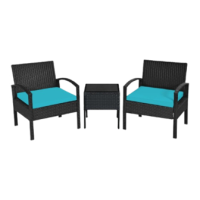

 To Next Page