The Paxster AS is an electric delivery vehicle designed for last-mile logistics and postal/packaging distribution, with customized versions for various delivery types such as hospital supply, food delivery, battery transport, and film camera platforms. It is approved for both outdoor and indoor use and is road-legal.
Function Description:
The Paxster is a 4-wheel light motorcycle, offering increased stability compared to 2-wheel motorcycles. It features a crumple zone, a 3-point safety belt with a rigid seat belt structure up to the operator's head, and a safety glass main windscreen for operator safety. For pedestrian safety, it includes soft plastic impact zones, a flexible plastic windscreen, and optional warning beacons and reverse cameras.
The vehicle is propelled by a 3-phase 48V electric PMAC motor acting on the rear wheels via a differential gearbox. Steering is direct mechanical, without power assistance, operated via a steering bar similar to ATVs. The electrical system comprises a LiFePo4 (LFP) traction battery (nominal 48V) for the drivetrain and a 12V lead-acid/AGM auxiliary battery for other consumers like lights, outlets, and the windscreen washer.
The Paxster offers four brake systems:
- Brake pedal brake: Hydraulic, operates on all 4 wheels.
- Brake handle brake: Hydraulic, operates on front wheels.
- Regenerative brake: Electrical, operates on rear wheels, automatically applied when the brake handle or pedal is slightly operated, throttle is released, on declines exceeding maximum allowed speed, or when switching between forward/reverse with throttle pulled.
- APBU (Automatic Park Brake Unit): Electromagnetic, operates on rear wheels, automatically engages when speed is zero and no throttle input is given, or no person is detected on the seat, or speed is less than 5km/h with no person detected.
The vehicle has three loading areas: a rear cargo compartment, a front cargo area, and side compartments (left and right), with an optional side cargo compartment. The rear cargo compartment can be either "delivery" type (approx. 750 liters) or "cargo" type (approx. 950 liters). The front cargo area is customizable for postal boxes or other equipment.
Important Technical Specifications:
- Homologation variants: L6e-BU (Delivery/Cargo) and L7e-CU (Delivery/Cargo).
- Top speed: 45km/h (L6e-BU), 60km/h (L7e-CU).
- Maximum motor power: 6kW (L6e-BU), 7.48kW (L7e-CU).
- Energy consumption: 84Wh/km (L6e-BU), 107Wh/km (L7e-CU).
- Seats: 1 (center seat).
- Dimensions: Length 2290mm (Delivery) / 2365mm (Cargo), Width 1180mm, Height 1860mm (Delivery) / 1880mm (Cargo).
- Wheelbase: 1530mm.
- Track width: 940mm.
- Front cargo area: 0.59m².
- Total loading volume: 1000 liters (Delivery) / 1250 liters (Cargo).
- Max permissible mass: 770kg (L6e-BU), 845kg (L7e-CU).
- Max payload: 240kg.
- Traction battery: LiFePo4, 48V, capacities of 6.0kWh (Small), 8.1kWh (Medium), 10kWh (Large).
- Auxiliary battery: AGM, 12V, 18Ah.
- Range: 40-60km (Small), 50-85km (Medium), 70-110km (Large) for L6e-BU; 35-50km (Small), 45-70km (Medium), 60-90km (Large) for L7e-CU.
- Tire types: Summer (145/70 R13, 155/70 R13), Winter without studs (145/70 R13, 155/70 R13), Winter with studs (155/70 R13).
- Tire pressure: 1.8-2.0bar.
- Noise emission level: 65dB (A).
- Radio equipment: Transponder keyless go (433.92MHz), PaxCon GSM module (various GSM, WCDMA, LTE FDD frequencies).
Usage Features:
- Operation: Designed for industrial, commercial, and public road use within -20°C to 40°C. Can negotiate slopes up to 18%. Driving on inclines of 25% may lead to tipping to the rear, and 30% across inclines may lead to tipping to the side.
- Controls: Main instrument displays speed, motor temperature, state of charge, mileage, and drive state. Left control unit operates direction indicators, full beam lights, warning lights, horn, and reverse gear. Throttle is integrated into the right handle grip.
- Charging: Equipped with an onboard charger, connected to a grounded 230V AC grid via various charging cables (Type 1 to Schuko, Type 1 to Type 2, Type 1 to UK plug). Charging indicator flashes to show charging mode and errors.
- Safety: Seat switch detects operator presence; if no person is detected, the vehicle will not move. If the operator leaves the seat while driving, the vehicle slows down using regenerative braking and the APBU engages.
- Drive Modes: Offers High, Eco, and Winter modes. Eco mode is recommended for best energy efficiency. Winter mode reduces regenerative braking and acceleration for slippery conditions. High mode is for steep inclines or starting on inclines up to 6km/h.
- Parking: Automatic parking brake unit (APBU) engages automatically. For short-term parking, push steering to the right, switch off ignition, and take keys. For long-term parking, push steering to the left, engage steering lock, and take keys.
- Loading: Heaviest loads should be placed lowest and as far forward as possible. Load should be distributed evenly. Overloading is prohibited (Max 190kg rear, 50kg front).
- Optional Equipment: Includes LED cargo compartment light, cabin light, lateral working lights (cab and cargo box), front parcel box, canvas front, and Key FOB remote control system.
Maintenance Features:
- General: Maintenance and repairs must be carried out by specialist personnel. Paxster offers a service network and certified partners.
- Electrical System: Ensure the electrical system is de-energized before maintenance. Capacitors discharge after approx. 10 minutes. Only trained electricians should work on the electrical system.
- Consumables: Used parts and consumables must be disposed of according to environmental regulations. Oils are flammable and poisonous and require careful handling.
- Wheels: Tires on one axle must be of the same manufacturer and type. All wheels must be of the same dimension and have either steel or aluminum rims. Always replace tires in pairs. Wheel nuts should be tightened to 100Nm (tolerance +0 - 20Nm) in a cross-tightening pattern.
- Brake Fluid: The vehicle has two separate brake fluid reservoirs. Low brake fluid is indicated by a warning light. Service technicians check and refill brake fluid during planned maintenance.
- Cleaning: Use mild car shampoo and plenty of water for plastic surfaces. High-pressure cleaners should be kept at least 30cm away from the vehicle and not used in internal areas. Do not use automated car washes or strong chemicals.
- Maintenance Schedules: Two schedules are provided: Schedule 1 for demanding conditions (dusty, rough, salt-spread roads, last-mile distribution) and Schedule 2 for less demanding conditions. Maintenance intervals are typically 6-month, 12-month, 24-month, 36-month, 48-month, and 60-month. Reduction gear oil replacement is crucial at 6 months.
- Accident Inspection: After an accident, contact Paxster for a vehicle check, especially if safety-critical components are involved. Observe for unusual sounds, uneven brake performance, steering issues, or damage.
- Disposal: Paxster offers a "second drive program" for vehicle refurbishment and recycling to reduce environmental footprint.

 Need help?
 General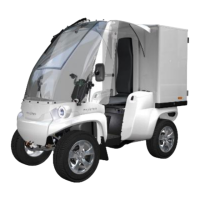

 To Next Page
