5
WET SPONGE TESTING
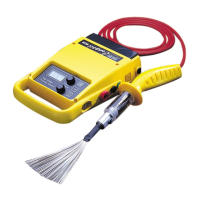
The PCWI Wet Sponge Porosity Detector detects pinholes in
coatings non-destructively up to 500µm employing the “wet
sponge method”. A voltage from the battery supply is transmit-
ted through the probe and dampened sponge
attached. Since the instrument’s earth is connected to the sub-
strate, when a flaw is encountered, the conductive path is
made and the alarm sounds.
2.0 OPERATION
1. Connect the earth and probe leads to the appropriate
terminals (green for earth, red for probe) on the
instrument.
2. Attach the sponge to the probe handle, using the bolt &
nut supplied.
3. Moisten the sponge with water: too much water will affect
instrument performance. The addition of a wetting agent
will assist in breaking down the surface tension. The
sponge should be damp, squeeze until water ceases to
drip from it.
4. Switch on and select the voltage required via the Selection
switch on the front panel: 9V for coatings up to 300µm;
67.5V for coating assessment to ASTM standards, and
90V for coatings up to 500µm. Note: the 67.5V model is
a fixed voltage unit.
5. Check that the instrument is functioning correctly by
touching the sponge with the earth clip: a high-pitched
note should be heard.
6. Connect the earth lead to an uncoated section of the metal
substrate of the surface under test.
7. Pass the sponge over the coated surface. The presence of
a pinhole is indicated by the emission of a high-pitched
note from the alarm.
8. Use a corner of the sponge to more accurately locate
small, porous areas.



 To Next Page