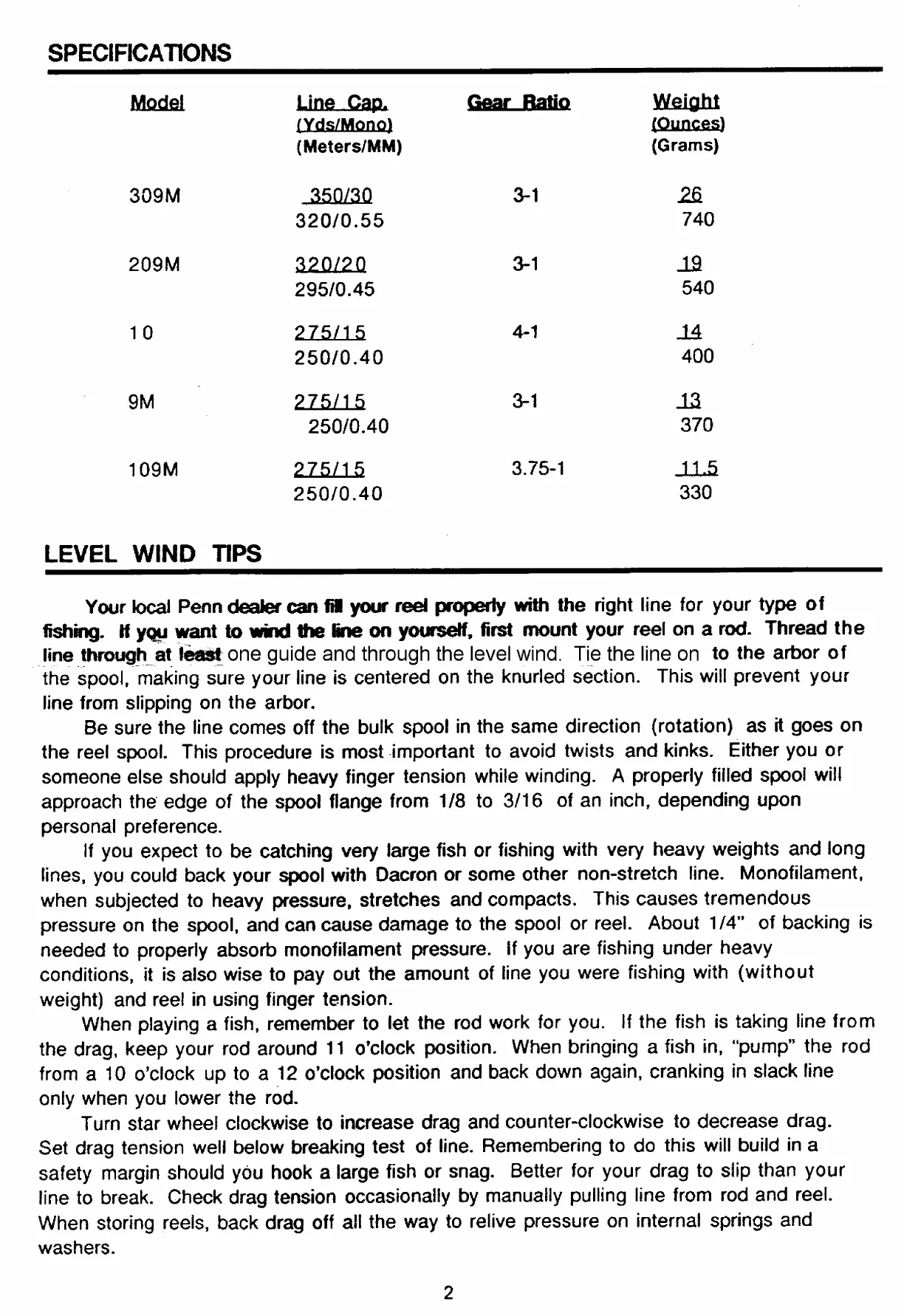
SPECIFICATIONS
Model
309M
209M
10
9M
109M
LEVEL WIND TIPS
Line Cap.
{Yds/Monp)
(Meters/MM)
350/30
320/0.55
295/0.45
250/0.40
250/0.40
275/15
250/0.40
4-1
3.75-1
(ounces)
(Grams)
740
540
400
370
11-5
330
Your local Penn debt en fil reel property with the right line for your type of
fishing. tf yw want to —'Dd on yotrsetf, first mount your reel on a rod. Thread the
line through at guide and through the level wind. Tie the line on to the arbor of
the spool, making sure your line is centered on the knurled section. This will prevent your
line from slipping on the arbor.
Be sure the line comes off the bulk spool in the same direction (rotation) as it goes on
the reel spool. This procedure is most -important to avoid twists and kinks. Either you or
someone else should apply heavy finger tension while winding. A properly filled spool will
approach the edge of the spool flange from 1/8 to 3/16 of an inch, depending upon
personal preference.
If you expect to be catching very large fish or fishing with very heavy weights and long
lines, you could back your spool with Dacron or some other non-stretch line. Monofilament,
when subjected to heavy pressure, stretches and compacts. This causes tremendous
pressure on the spool, and can cause damage to the spool or reel. About 1/4" of backing is
needed to properly absorb monofilament pressure. if you are fishing under heavy
conditions, it is also wise to pay out the amount of line you were fishing with (without
weight) and reel in using finger tension.
When playing a fish, remember to let the rod work for you. If the fish is taking line from
the drag, keep your rod around 11 0'clock position. When bringing a fish in, "pump" the rod
from a 10 0'clock up to a 12 0'clock position and back down again, cranking in slack line
only when you lower the rod.
Turn star wheel clockwise to increase drag and counter-clockwise to decrease drag.
Set drag tension well below breaking test of line. Rememberingto do this will build in a
safety marginshouldyou hook a large fish or snag. Better for your drag to slip than your
line to break. Check drag tension occasionally by manually pulling line from rod and reel.
When storing reels, back drag off all the way to relive pressure on internal springs and
washers.
2


 To Next Page
 Loading...