Check all fasteners (nuts, bolts, lags, etc.) for tightness.
Test the operation of the awning to be sure the extension and closure of the awning is working properly.
Be sure the awning closes tightly against the roller tube in order to keep your fabric clean.
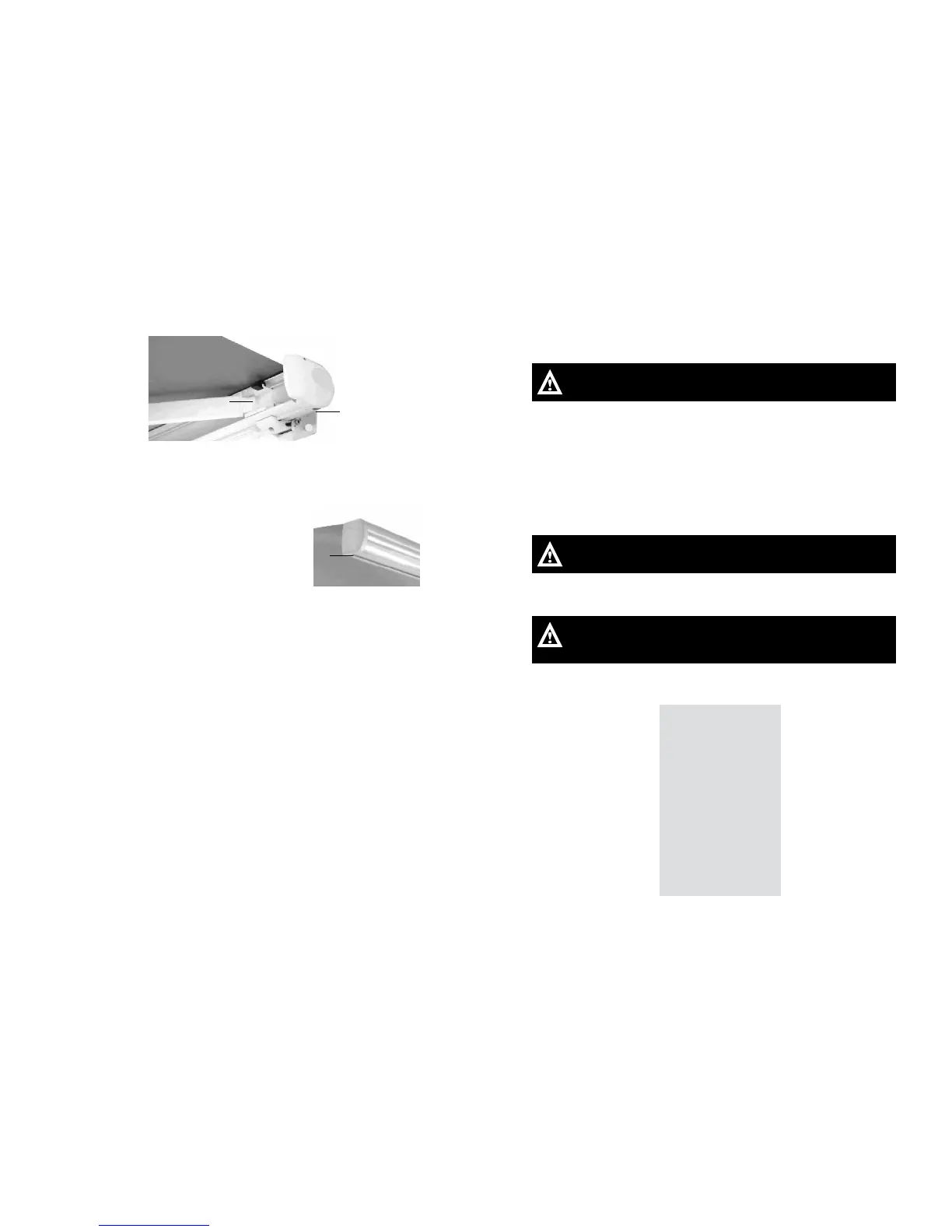
Reinstall the valance by doing the following:
Simply remove the one small screw from the bottom of the end cap.
Insert the PVC into the valance hem. (A - Fig. 3)
Next, one person should guide the valance into the track going in the
direction of the seams being careful not to tear the stitching or fabric.
The other person should guide the valance as it is pulled.
Line the fabric valance up with the main body fabric.
Re-attach the end cap to its original position and tighten the screw.
(Fig. 3)
Once a year, before winter
Before retracting your awning for the last time, make sure the awning fabric is clean and dry to prevent mildew
from forming over the winter.
We also recommend the removal of the valance to prevent weathering.
Remove the one small screw from the end cap.
Slide the valance out to the left when facing the awning, out of the front bar removing both the valance
and the PVC tubing.
Pull the PVC tubing out of the valance hem.
Roll up the valance.
Replace the PVC tubing back in the front bar.
Re-attach the end cap to its original position and tighten the screw.
**If you have a vario-volant drop, remove the bottom pipe out of the pocket on the bottom.
Roll valance up into the cassette and store the pipe in a safe place.
Be sure to place the valance in a dry, well-ventilated area away from rodents for the winter season.
Never store your fabric in a plastic bag; this can trap moisture and promote mildew.
If you have a plug-in motor, we suggest unplugging the power cord from your wall outlet and covering
the socket to prevent rain and moisture from entering the outlet.
(Fig. 2)
(Fig. 3)
B
C
A
Cleaning 6.2
Keep the fabric clean to prevent the formation of mold caused by deposits of dust or other materials on the fabric;
this can be done by vacuuming the dust or cleaning the fabric with a sponge or cloth and warm water. Dry the
fabric afterwards. Never allow debris to be rolled up in your awning. These items can cause staining or puncturing.
Never allow birds to nest on or near your awning.
If installation is near saltwater, rinse the awning framework at least once a month with water and lubricate the
moving parts with silicone spray. Avoid spraying the silicone on the fabric since this may cause discoloration or
staining. For added protection, you may apply a nonabrasive wax to the frame.
Cleaning using ladders, scaffolding and the like may only be performed by special staff who must observe current
safety legislation and use personal protective equipment such as safety harnesses and cables.
Troubleshooting 6.3
For any problems that are not indicated in the following table, please contact your local Perfecta dealer.
MANUAL AWNING
POWERED AWNING
Without electronic power unit
ATTENTION
Switch off the main supply before carrying out any maintenance and cleaning operations.
ATTENTION
Do not use solvents - ammonia - hydrocarbons.
ATTENTION
In case of faults or when troubleshooting, observe the safety regulations; in particular, danger
of lethal electrocution when troubleshooting or repairing electrical faults.
ELECTRICAL MAINTENANCE MAY ONLY BE PERFORMED BY QUALIFIED STAFF.
PROBLEM REASON REMEDY
The fabric does not roll up straight Arms out of symmetry Contact Local Dealer
Fabric thickness not uniform Fully rewind the fabric
PROBLEM REASON REMEDY
The fabric does not roll up straight Arms out of symmetry Contact Local Dealer
Fabric thickness not uniform Fully rewind the fabric
The awning does not fully close Limits incorrectly adjusted Contact Local Dealer
The awning does not fully open Motor gear moves Contact Local Dealer
The motor is very noisy Faulty wiring Contact Local Dealer
Faulty motor Contact Local Dealer
The motor stops after 4-5 Motor overheating Let the motor cool down
minutes of continuous use Protection tripped for 20 minutes


 To Next Page
 Loading...