SAFETY GUIDELINES / DEFINITIONS
IMPORTANT SAFETY INFORMATION
• To prevent accidents that could result in serious injury and/or damage to your vehicle or test equipment,
carefully follow these safety rules and test procedures at all times when working on vehicles.
• Always wear approved eye protection.
• Never use Fuel Pressure
Tester Kit on Diesel or Flex Fuel engines!
• Never attach Fuel Pressure
Tester to any place other than the fuel rail test port. Do not confuse Air
Conditioning Schrader valves with the fuel rail test port.
• Never attach or remove Fuel Pressure
Tester Kit from fuel rail test port with the ignition key on.
• Always place end of 6 ft. bleed-off hose in an approved container for fuel during testing and when
bleeding off fuel pressure.
• Never smoke or have open ames near vehicle. Vapors from fuel and charging battery are highly
ammable and explosive.
• Never permit fuel to spill on hot engine parts. If a spill or leak occurs, immediately turn ignition key off,
and clean up fuel.
• Only use the Fuel Pressure
Tester Kit for measuring fuel pressure on vehicles having Schrader valves
as their fuel rail test port. Do not use this kit for any other purpose!
• Always operate the vehicle in a well ventilated area. Do not inhale exhaust gases or fuel vapors - they
are very hazardous!
• Always keep yourself, tools and test equipment away from all moving or hot engine parts. These would
include fan blades or exhaust manifolds.
• Always make sure the vehicle is in PARK (Automatic transmission) or NEUTRAL (manual transmission)
and that the parking brake is rmly set. Block the drive wheels.
• Never lay tools on vehicle battery
. You may short the terminals together causing harm to yourself, the
tools or the battery.
• Never leave vehicle unattended while running tests.
• Always keep a re extinguisher suitable for fuel/electrical/chemical res handy.
• Always use extreme caution when working around the ignition coil, distributor cap, ignition wires, and
spark plugs. These components contain High Voltage when the engine is running.
• Complete all Pre-Testing Checks before beginning fuel pressure testing.
• Always follow vehicle manufacturer’s warnings, cautions and service procedures.
CAUTION: Some vehicles are equipped with SRS Supplemental Restraint System, safety air bags.
You must follow vehicle service manual cautions when working around the air bag components or wiring.
If the cautions are not followed, the air bag may open up unexpectedly, resulting in personal injury. Note
that the air bag can still open up several minutes after the ignition key is off, or even if the vehicle battery
is disconnected because of a special energy reserve module.
WARNING: Read and understand this entire instruction manual before attempting to assemble or operate
this tool. F
ailure to comply with the instructions may result in serious personal i
njury and/or property damage.
This instruction manual is intended for your benefit. Please read and follow the safety, installation, maintenance and troubleshooting
steps described within to ensure your safety and satisfaction. The contents of this instruction manual are based upon the latest
product information available at the time of publication. The manufacturer reserves the right to make product changes at any time
without notice.
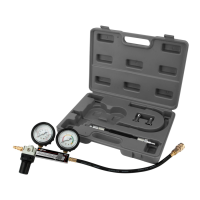
The W80595 Fuel Injection Pressure Tester Kit is designed to perform fuel pressure tests on
most domestic and import cars and trucks. The tester saves you time and money by helping
you test and troubleshoot fuel system problems which can affect your vehicle’s performance
and fuel economy.
The tester can help you identify and diagnose the following symptoms.
• Low fuel pump pressure • Leaking fuel injectors
• Faulty fuel pressure regulator • Clogged fuel lter
• Leaks in the fuel system
1. Gauge - Shows the amount of fuel pressure present in fuel system.
2.
Pressure Release Button - Removes fuel and pressure from the fuel rail as a result of the test.
3. Bleed Off Hose - Removes the fuel and pressure after the pressure release button has been
pressed. Hose should be long enough to t into an approved container for fuel.
Caution: Never use a short hose, must be long enough to clamp into an approved container
on the oor.
4. High Pressure Hose - Carries the fuel to the gauge for measuring pressure.
5. Test Port Adapter - This adapter is used to connect GM, Chrysler, Dodge, and Jeep models
to the test port Schrader valve on the fuel rail.
6. Test Port Adapter - This adapter is used to connect Ford, Lincoln, and Mercury models to the
test port Schrader valve on the fuel rail.
7. Tee Fitting Adapter – This adapter is used to connect some Import Vehicles to the Fuel Pres-
sure Tester. Use this on vehicles not factory-equipped with a test port Schrader valve.
8.
5/16" and 3/8" Hoses - Universal high-pressure hoses used with the tee tting, and hose clamps.
The adapters included with the tester t the most common fuel injection applications. Some ve-
hicle applications may require additional tools or adapters to properly test the vehicle. Always
refer to your vehicle’s service manual, when doing any testing.
2
ABOUT THIS TESTER
COMPONENTS
3
1
2
3
4
5
6
7
8


 To Next Page
 Loading...