Prior to Testing Follow these Pretest Procedures.
1. Read all safety precautions listed in this manual and the vehicles shop manual. Paying close
attention to Air Bag Connections and precautions.
2. Do a thorough hands-on inspection of the fuel system. Look for fuel or vacuum line leaks,
cracked or loose electrical connections. If fuel leaks are present wipe them up immediately.
3. Insure you have a fully charged battery and enough fuel to conduct this test.
4. Verify that the inertia switch on certain Ford/Lincoln/Mercury vehicles has not been tripped.
The inertia switch is designed to shutoff the fuel pump in the event of a collision. This switch is
typically mounted under the dash on the passenger side, or in the trunk.
5. Check that all fuel system fuses are good.
6. Verify that the fuel vapor recovery system, and gas cap are in good condition.
7. Locate the vacuum line which is attached to the fuel pressure regulator and remove it, this
line should be free of fuel, if fuel is observed the regulator has failed.
8. Once the inspection for the fuel pressure regulator is complete reinstall the vacuum line.
9. Test manifold vacuum to ensure it is within manufacturer’s specication. A typical vacuum
reading would be 18-20 in. at idle.
CAUTION: Be aware that fuel systems are UNDER PRESSURE AND HIGHLY FLAM-
MABLE. Relieve system pressure before connecting the tester. Refer to your vehicle’s service
manual for those procedures. Systems without test ports require that fuel lines be removed or
disconnected. Be aware that these lines are also UNDER PRESSURE AND HIGHLY FLAM-
MABLE. When removing the lines it could cause fuel to spray and/or leakage onto hot engine
parts. In addition to following all safety precautions, a basic understanding of your fuel injection
systems is necessary. Read your shop manual thoroughly to prevent personal injury or dam-
age to your vehicle.
1. Before connecting tester, relieve fuel system pressure. Refer to your vehicle’s service manu-
al for procedures. Loosen or remove cap from the fuel tank to relieve potential tank pressure.
2. Ignition key must be in the off position.
3. Locate the fuel system’s test port, and remove the protective cap. You’re A/C test port is sim-
ilar to the fuel system. Both have a protective cap and a Schrader valve inside. The low side
A/C port is typically larger than the fuel ports. Do not get these ports confuse. Refer to your
vehicle’s service manual to ensure proper connections. Wrap shop rags around tting when
connecting or disconnecting the tester.
Have shop rags ready to clean up leaks or spills.
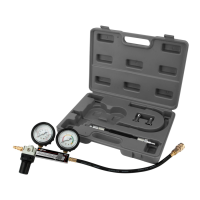
4. Connect the tester to your vehicle’s fuel system test port
- Ford, Lincoln, Mercury and some Chrysler vehicles
Install the port adapter on the throttle body or fuel rail test port. Be sure the threads are cor-
rect, it should thread on easily. Finger tight only, then connect the gauge hose to the adapter.
Clamp bleed-off hose into an approved drain container. Make sure the hose remains in the
container until testing is complete.
4 5
PRETEST PROCEDURES
PRETEST PROCEDURES
-GMC, Chevrolet, Buick, Oldsmobile, Pontiac, Cadillac and some Chrysler vehicles
The port adapter for the above models is permanently attached to the High Pressure Hose.
5. Connect the gauge hose directly to the test port, and nger tighten only. Clamp bleed-off hose into an
approved drain container. Make sure the hose remains in the container until testing is complete.
6. Make sure all of the vehicle’s accessories including the A/C, fan, radio, defroster, lights, etc. are all off.
7. Turn your key to the on position, (KOEO), listen for the fuel pump to activate. Most injection systems
will activate the pump for about two seconds to pressurize the fuel system.
8. Check the setup connections for fuel leaks. If you have a fuel leak, turn off the ignition immediately!
Repair the leak and clean up the spilled fuel.
9. If your fuel system does not activate as described above, turn ignition key off. Refer to the manufac-
turer’s service manual for repair procedures or fuel pump activation instructions.
10. When you hear the fuel pump activate, the fuel system is pressurized. Verify by looking at the pres-
sure gauge, it should show a system pressure.
11. Check this against the information in the Specication section of your vehicle’s service manual. If
pressure is not within specications, turn ignition off. Follow the repair procedures in the service manual.
If fuel pressure is within manufacturer’s specications, proceed to the next step.
12. Start the engine, (KOER), bring it to a normal idle. While warming recheck connections for fuel leaks.
13. Read the fuel pressure on the tester. If the fuel pressure is steady and within specications for your
vehicle, proceed to the next step. If pressure is not within specications, turn ignition off and follow the
test and repair procedures in your vehicle’s service manual. After all necessary repairs have been com-
pleted, return to step 12 and retest.
14. When your test is complete and the desired pressure has been reached, record the information and
turn the ignition off. Typically in the back of a service manual there is a “notes” section. This is a good
place to record the detailed results.
15. Make sure the bleed-off hose is still clamped to the drain container.
16. Press and hold the pressure release valve to bleed off pressure still in the tester. Hold the valve until
the gauge indicates 0 psi.
17. Jiggle the bleed-off hose to ensure all the fuel has been removed.
18. Use a shop towel to wrap around test port tting. This will aid in absorbing any residual fuel, and
guard against spray from potential pressure in the line.
19. Carefully unthread the tting from the port adapter. For Ford vehicles remove the additional adapter
from the vehicle’s test port. Replace protective cap on port tting.
20. After the bleed off hose has drained completely remove it from the drain container. Store the tester
in a well-ventilated area to dry completely. Service life of the port adapter’s O-rings can be prolonged by
applying a protective coating oil to them before storing.
21.
Verify that all fuel system components were reconnected. Start the engine, check for leaks and repair as
necessary. It might take a few extra cranks for the fuel system to energize after delivery was interrupted.
PRETEST PROCEDURES CONT.


 To Next Page
 Loading...