ENGLISH
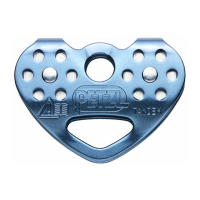
Nomenclature of parts
(1) fi xed side-piece, (2) auxiliary attachment point,
(3) axle / self-lubricating bushings, (4) sheaves,
(5) attachment point
Inspection, points to verify
Before use, check that the sheaves turn freely.
Verify the condition of the fi xed side pieces,
sheave grooves, and axles.
The self-lubricating bushings of the TANDEM
must be oiled regularly with a silicone lubricant.
If there is any doubt about the condition of the device,
return it to PETZL for inspection.
Instructions for Use
Fixed-side double pulley with aluminium alloy sheaves
for use on a rope tyrolean only.
Diagram 1. Tyrolean Traverse
A. The anchors must always be separated, with
one anchor for the safety tyrolean, and one for the
working tyrolean. For long traverses, the two lines
should be well separated.
B. Belayed progression.
C. Precautions.
D. Solo progression:
Using the TANDEM with the MINI-TRAXION (P07)
creates a system with a progress-capture feature.
E. Beginning the tyrolean traverse.
Diagram 2: Hauling System
Diagram 3: Installation of a rope tyrolean
Use a semi-static rope (EN 1891) of diameter
greater than 10 mm.
Caution: the force on the anchor points varies
according to the initial tension.
A. Direct hauling.
B. Indirect hauling.
General information
Important notice : Specifi c training is
essential before use
Read this notice carefully, it gives instructions for
the use of this product. Only the techniques shown
in the diagrams and not crossed out are authorised.
All other uses are excluded : danger of death.
A few examples of misuse and forbidden uses
are also represented (shown in the crossed out
diagrams or with the “skull and crossbones” symbol).
Many other types of misuse exist and it is impossible
to enumerate or even imagine all of them. In case of
doubt or diffi culty in understanding, contact PETZL.
Activities at height are dangerous activities which
may lead to severe injury or even death. Gaining
an adequate apprenticeship in appropriate techniques
and methods of protection is your own responsibility.
You personally assume all risks and responsibilities
for all damage, injury or death which may occur
during or following incorrect use of our products in
any manner whatsoever. If you are not able, or not in
a position to assume this responsibility or to take this
risk, do not use this equipment.
Use
This product must only be used by competent
and responsible persons, or those placed under
the direct and visual control of a competent
and responsible person.
Personal protective equipment (PPE) is to be
used only on or with energy absorbing systems
(for example dynamic ropes, energy absorbers
etc...). Check that this product is compatible
with the other components of your equipment.
To prolong the life of this product, care is
necessary, when transporting as well as when
using it. Avoid impacts, or rubbing against abrasive
surfaces or sharp edges.
It is up to the user to foresee situations requiring
rescue in case of diffi culties encountered while using
this product.
Checking = safety
Do not hesitate to scrap a product showing
signs of wear which might affect its strength,
or restrict its operation. For your safety we
advise you to adopt a 3-level checking schedule:
- before and after each use it is necessary
to check the condition of the product,
- during use, it is important to regularly monitor
the condition of the product and of its connections
to the other elements of the system.
- Periodically, a more thorough inspection must be
carried out by a competent inspector: approximately
every three months for textile products and helmets,
approximately annually for metallic products.
For more safety and better control of your
equipment, we advise you to keep an inspection
record for each product or batch of products.
It is preferable to personally issue each user of
P. P. E. such as helmets, impact absorbers or textile
products, with his or her own set of equipment to
ensure better traceability. On the other hand, it is not
necessary to personally issue metallic equipment or
anchors to a single user.
Major fall and impact
Do not continue to use this product after a major
fall or a major impact (fall of the product or impact
on the product). Even though no external signs may
be visible, a deformation may restrict its operation or
internal damage may have occurred, thus reducing its
strength. Do not hesitate to contact PETZL in case of
doubt.
Lifetime = length of time in storage +
length of time in use
Length of time in storage (in favourable conditions):
Helmets, harnesses, webbing slings and lanyards:
5 years
Metallic products: no limitation.
Maximum length of time in use (without taking
account of wear):
Helmets and harnesses: 5 years
Webbing slings and lanyards: 3 years
Metallic products: no limitation.
The operational lifetime depends on the intensity
of use. It is diffi cult to give a precise lifetime
because this depends on the environment where it
is used. Certain environments considerably increase
the amount of wear: marine or sandy environments,
or where chemicals are present. However wear or
damage could occur on the fi rst use which reduces
the lifetime of the product to that one single use.
For webbing slings and lanyards, because of
their direct contact with supporting structures
and the heavy demands that usage places on
them, their average operational lifetime is
6 months heavy use, 12 months normal use, 3 years
maximum occasional use.
PETZL guarantee
This product is guaranteed for
3 years against any faults in materials or manufacture.
Exclusions from the guarantee: normal wear and
tear, modifi cations or alterations, incorrect storage,
damage due to accidents, to negligence, or for use
in a way for which the product was not intended.
PETZL is not responsible for the consequences,
direct, indirect or accidental, or any other type of
damage befalling or resulting from the use of its
products.


 To Next Page
 Loading...