11
Practice on scrap materials first to see how the Rotary Tool's high-speed action
performs. Keep in mind that the work is done by the speed of the tool and by the
accessory in the collet. You should not lean on or push the tool during use.
Instead, lower the spinning accessory lightly to the work and allow it to touch the point
at which you want cutting (or sanding or etching, etc.) to begin. Concentrate on guiding
the tool over the work usin
g very little pressure from your hand. Allow the accessory to
do the work.
Usually, it is best to make a series of passes with the tool rather than attempt to do all
the work in one pass. To make a cut, for example, pass the tool back and forth over
the work, much as you would a small paint brush. Cut a little material on each pass
until you reach the desired depth. For most work, the gentle touch is best. With it, you
have the best control, are less likely
to make errors, and will get the most efficient work
out of the accessory.
The hanger is provided for the use of hanging your tool while using the flex-shaft or for
storage. If you do not use the hanger, snap it back into place so it will be out of the way
while the tool is in use.
Turn on/off the Tool
The tool is turn on or off by press the power switch.
Operating Speeds
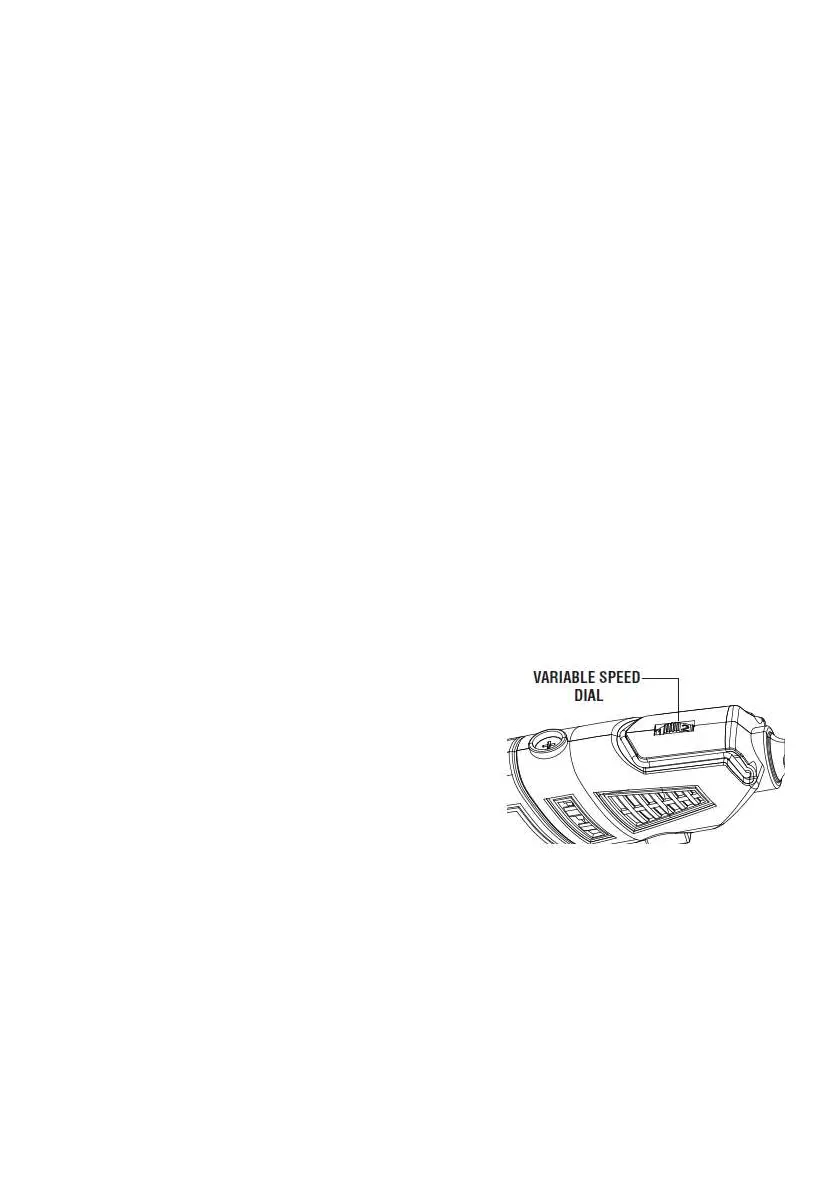
The speed of Rotary Tool can be adjusted by turn
the dial on the housing.
Ce
rtain materials, however, (some plastics and
precious metals, for example requires relatively
slow speed because at high speed the friction of
the accessory generates heat and may cause
damage to the material.
Slow speeds (15,000 RPM or less) usually are best
for polishing operations employing the felt polishing accessories. They may also be
best for working on delicate projects as “eggery” work, delicate wood carving and
fragile model parts.
All brushing applications require lower speeds to avoid wire
discharge from the holder.
Higher speeds are better for carving, cutting, routing, shaping, cutting dadoes or
rabbets in wood.
Hardwoods, metals and glass require high speed operation, and drilling should also be
done at high speeds.
Ultimately, the best way to determine the correct speed for work on any material is to
practice for a few minutes on a piece of scrap, even after referring to
the chart. You


 To Next Page
 Loading...