Need help?
Do you have a question about the PHI MAESTRO 2 and is the answer not in the manual?
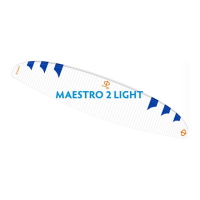
The MAESTRO 2 offers maximum performance and passive safety in the High B class.
Details the 78 cells, miniribs, line configuration, and optimized shaping for performance.
Discusses high stability in turbulence and responsive, progressive brake control.
Highlights flat polar performance and targets ambitious, trained pilots with an active style.
Emphasizes pilot judgment, education, and use of protective equipment for safe flying.
Covers initial checks, dealer inspection, and warranty registration.
Guidelines on paraglider modifications, harness selection, and weight limits.
Essential checks for launch, ground handling advice, and start behavior.
Describes straight flight, accelerator use, active flying, and turning.
Guidance on landing, rapid descents, big ears, B-stall, and safety altitudes.
Details deep spirals, collapses, stalls, spins, and cravate recovery.
Information on speed system mounting, usage, and R07 riser specifics.
Guidelines on UV radiation, folding, dirt, and line care for longevity.
Recommendations for ideal storage, transport, and cleaning methods.
Details on authorized repairs and recommended inspection intervals.
Instructions for registration, warranty, and environmentally friendly operation.
The MAESTRO 2 is a high-performance paraglider designed for ambitious and experienced pilots who engage in regular, active flying. It builds upon a long tradition within the High B class, setting new standards in performance and speed. The glider offers maximum performance for a broad target group, characterized by an easy-to-fly, limited aspect ratio and low line drag, which contributes to its exceptional performance at high speeds.
The MAESTRO 2 features 78 cells across its span, with 9 closed cells on each Stabilo, creating a very form-stable and homogeneous wing. The profiles combine high performance with forgiving flight behavior. The line system consists of 4 levels on the sail, leading to 3 or 2 main lines on each side, depending on the A, B, C cascades and size. The outermost A lines are attached to a separate riser for easy "big ears" maneuvers. The suspension system is highly optimized to minimize line resistance, and the speed system is attached to the front A riser. For better distinction, all A-lines on the maillon rapide are covered in red.
The glider is designed to provide very high stability in turbulent air, and if a collapse occurs, the reaction is typical for a B-class wing, with no dynamic movements. Its maneuver ratings of B in EN/LTF tests confirm a large safety margin.
Pilot Requirements: While a B-classification paraglider does not demand exceptionally high pilot skills, self-evident action is crucial. Pilots must have prior experience and have flown in various conditions to safely operate the MAESTRO 2. It is essential for pilots to accurately assess their skills and equipment against expected flying conditions. Continuous education in theory and practice, along with wise decision-making, is vital. Pilots are also responsible for using appropriate protective equipment and ensuring their gear is always functional.
Before the First Flight: Each MAESTRO 2 must undergo a test flight and inspection by a PHI dealer before being delivered to the customer. This initial flight, along with the date and pilot, must be recorded on the glider's type table sheet. To access all service and warranty benefits, pilots must register their paraglider on the PHI homepage under "SERVICE / REGISTRATION."
Start: Before take-off, pilots must ensure all equipment (wing, harness, rescue system) is in good condition and within the legal weight range. Essential pre-flight checks include:
Straight Flight: The MAESTRO 2 achieves its best glide performance at trim speed with fully released brakes in calm air. In headwinds or sinking air, maximum glide is achieved by using the accelerator. In turbulent air, dynamic reactions to collapses in accelerated flight should be considered, necessitating a greater safety altitude. The accelerator should never be pushed with insufficient safety altitude. In strong turbulence, a light, symmetrical brake input is recommended to enhance stability and provide feedback for active flying. Active flying involves constant control and correction of the angle of attack and airspeed in turbulent conditions, which can prevent most collapses.
Flying Turns: Turns are an interplay of inner brake, outer brake, and weight shifting. The MAESTRO 2 features sensitive handling, requiring small brake inputs for precise turns. It excels in modern, dynamic thermal flight, efficiently "carving" around turns and climbing dynamically. Tight, controlled, and swing-free curve changes are skills to be practiced. If brake lines become uncontrollable (e.g., due to a faulty start check), the MAESTRO 2 can be controlled to a limited extent via the C-risers, allowing for directional corrections and safe landings. C-risers should only be pulled down slightly to avoid a stall.
Rapid Descents: All rapid descent maneuvers should be practiced in calm air with sufficient safety height, ideally as part of a safety training course under teacher guidance. Before initiating maneuvers, pilots must ensure the airspace below and around is clear and constantly monitor altitude.
Cravates: A situation where part of the wing is tangled in the lines after a collapse or badly executed full stall. While rare with the MAESTRO 2, recommended actions include:
Winch Launch: The MAESTRO 2 is easy to launch on a winch, starting with a flat angle climb. Using a towing adapter connected to the main carabiner and tow release is recommended.
Flying with R07 Riser (C handle): The MAESTRO 2 can be optionally equipped with the R07 riser, offering an ergonomically optimized C handle. This setup allows effortless changes in the angle of attack in any flight position. The riser is spartan, clearly designed, and uses high-quality ball bearing rollers for easy operation. The central Edelrid 8001U-800 line can be replaced by a competent person or dealer. Pulling the C handle too far will stall the wing; it is not a substitute for the brake line and is primarily for adapting accelerator travel or correcting direction when accelerated.
General Advice: Proper and careful handling ensures the paraglider remains in perfect technical condition for years.
Storage: Ideal storage is light-protected and dry. Avoid permanent storage at very high temperatures (e.g., in a car during summer). For longer storage, the paraglider should not be compressed.
Transport: The paraglider can be compressed tightly for transport. Nylon monofilaments for nose stiffening are highly insensitive to permanent deformation. A compression bag can be used for very small pack volumes. Ensure the paraglider is dry to minimize weight, as nylon cloth absorbs water. During transport (e.g., motorcycle), ensure fittings (line locks) do not touch the sail cloth (use riser bags).
Cleaning: Only use water and a cleaning cloth. Never use solvents. Remove sand, dirt, or small stones from the canopy, as they can damage the coating and seams.
Repair: Repairs should only be carried out by the manufacturer or authorized companies. For questions, contact PHI directly. Exceptions include replacing lines and repairing small tears (up to 5 cm, not affecting seams) or holes in the cloth, which can be fixed with the original PHI repair set (a small set of sticking cloth is supplied with the wing).
Check: The general check interval is two years, unless the checker specifies a shorter interval for heavily used wings. Commercially used equipment (school gliders, tandems) must be checked annually. This is also recommended for gliders under heavy load (e.g., over 150 flight hours in two years) or with regular acro maneuvers. An annual check is advised for frequent flying in terrain that strains the material (rocky areas, salty air, or after salt water contact). Regular checks for damage are even more crucial in these cases. Each check must be confirmed by a check-stamp; non-compliance voids the quality seal. Further information on maintenance checks is available on the PHI homepage.
Environment-Friendly Behavior: Operate the sport in a nature and landscape-friendly manner. Do not leave garbage and avoid scaring animals by flying too close, especially in cold seasons when stress can be life-threatening for them.
Disposal: The plastic materials used in the paraglider require proper disposal. Return your used wing to PHI for disassembly and disposal.
 General
| Engine | Rotax 912 ULS |
|---|---|
| Manufacturer | PHI Aviation |
| Model | MAESTRO 2 |
| Crew | 1 |
| Passenger Capacity | 1 |
| Power | 100 hp |
| Cruise speed | 220 km/h |
| Engine Type | Piston |
| Range | 1, 000 km |

 To Next Page