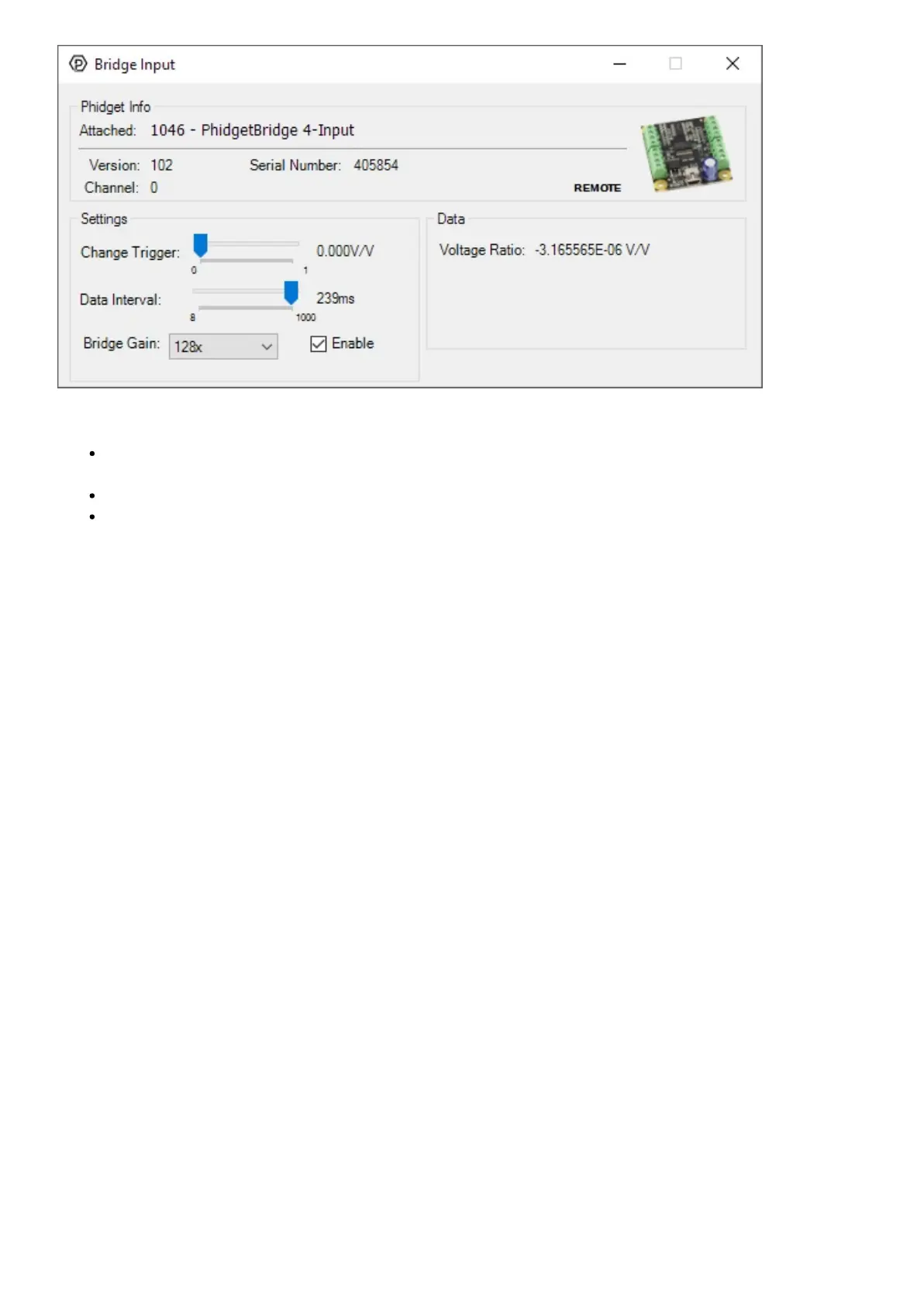
General information about the selected object will be displayed at the top of the window. You can also experiment with
the following functionality:
Modify the change trigger and/or data interval value by dragging the sliders. For more information on these
settings, see the data interval/change trigger page.
Toggle the Enable checkbox in order enable/disable the 1046.
Select a gain from the Bridge Gain drop-down menu. For more information about choosing the best gain, see
the technical section.
Technical Details
How to Calibrate the Bridge
We have observed a 1.5% difference between a 1x gain and an 8x gain. This may require that each system (1046 and
sensors) be calibrated as a whole. For maximum accuracy, decide on, and keep with a chosen gain before calibrating
the system.
Expensive sensors will ship with a certicate of calibration specifying, often in mv/V, how the sensor responds to
stimulus. Less expensive will have to be calibrated, which requires having at least two points where you know
accurately what is being measured. In the case of weight measurement, this would be a known force or weight.
Record the output from the 1046 at one known point, and at a second known point. It helps if the two values are
reasonably far apart. Use the values to make a linear equation to convert the 1046 output in V/V (called X) to the
appropriate unit you are measuring (called Y). Two calibration coecients (a,b) set the slope and offset for the
calibration: (Y = aX + b). It’s possible to use more than two points, if available.
The C# VoltageRatioInput example shows how to do a 2-point calibration and apply the coecients programmatically.
Gain Setting vs. Resolution
We report the measured voltage in a ratiometric unit known as V/V. This is how the maximum range of sensors that
use strain gauges is usually specied. V/V is the output value in V of the measured sensor, scaled for a 1V sensor
supply voltage. This value will correspond to the physical quantity that the sensor is measuring, regardless of the
actual voltage supplied to the sensor.
GainResolution Range
1 119 nV/V ± 1000 mV/V
8 14.9 nV/V ± 125 mV/V
16 7.45 nV/V ± 62.5 mV/V
32 3.72 nV/V ± 31.25 mV/V
64 1.86 nV/V ± 15.625 mV/V



 To Next Page