Need help?
Do you have a question about the Phil Jones Bass MICRO 7 and is the answer not in the manual?
Essential safety, installation, usage, and disposal guidelines for the amplifier.
Details the Bass Instrument Input Jack, LED Clip/Mute Indicator, and Input/Mute Switch.
Explains input level, bass, mid, treble, and master volume controls.
Covers auxiliary input, line out, headphone socket, power switch, and AC input.
Guidance on connecting, using EQ, and optimizing amp placement for optimal sound.
Guidelines for safe transportation and storage of the MICRO 7 amplifier.
Detailed technical data including frequency response, impedance, levels, and dimensions.
Information on the product's 1-year limited warranty and service procedures.
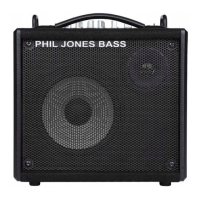
The Phil Jones Bass Micro 7 is a single-channel bass amplifier designed to deliver the true tone of a bass instrument while remaining affordable and versatile. It is engineered with a focus on high efficiency and sound quality, making it suitable for demanding bassists and a variety of other instruments.
The Micro 7 serves as a compact and powerful amplifier for bass guitars and other instruments. It features a 50-watt Class D amplifier, which is highly efficient and contributes to the unit's longevity by minimizing wasted power as heat. The amplifier operates on a wide range of AC voltages (100 to 260 Volts) without the need for a manual selector, thanks to its all-digital circuitry.
The sound output is handled by a proprietary 7-inch speaker, designed by Phil Jones, complemented by a high-energy 3-inch high-frequency transducer. This speaker system provides a broad frequency response from 36Hz to 22KHz, ensuring excellent fidelity not only for bass but also for other instruments. The robust construction includes a solid, kick-proof, acoustically transparent curved steel grill, ensuring durability and protection for the internal components.
The amplifier includes a preamp line out, allowing it to drive a powered cabinet or connect to a passive DI box for integration with a PA system or recording console. It also features a headphone socket, which mutes the speaker output when headphones are connected, enabling silent practice.
The Micro 7 offers a comprehensive set of controls for shaping your sound and managing input signals.
Bass Instrument Input Jack: This is a standard ¼ inch mono jack socket for connecting your instrument. For optimal sound quality and reduced noise, the use of a low self-capacitance, shielded instrument cable like the PJB BI-12 is recommended.
Input/Mute Switch: This three-position switch allows you to:
LED Clip/Mute Indicator: This LED provides visual feedback on the amplifier's status. It lights up red when the amplifier output is clipping, indicating signal overload. When the amplifier is muted, it lights up green.
Input Level Adjustment: This control allows you to adjust the input signal level to prevent clipping, which is indicated by the red LED. Proper adjustment optimizes the signal-to-noise ratio, maximizing the amplifier's tone and power. Different instruments and playing styles can affect the signal level, so this control should be adjusted accordingly.
Tone Controls (BASS, MID, TREBLE):
Master Volume Control: This is the primary control for the overall output power to the speakers and the line out socket. When setting up your tone or plugging in your instrument, it's advisable to keep this control at a low level. This control uses an "Audio Taper," which provides more precise control over the full rotation compared to a "Linear Taper" control, which might give an impression of more volume at lower settings.
Auxiliary Input Level Control: This adjusts the volume of the auxiliary audio source.
Auxiliary Input: A stereo mini-jack input for connecting external audio sources. It can also be connected to the headphone out of a PJB BIGHEAD headphone amp, effectively giving the Micro 7 a two-channel capability.
Headphone Socket: A stereo output for headphones. When headphones are plugged in, the main speaker output is automatically disconnected and muted, allowing for private practice.
Power Switch: This switch turns the amplifier's DC supply on or off. However, AC signal may still be present in the internal supply.
Power Indicator: This light illuminates when the power cable is connected and the amplifier is switched on, indicating that the unit is receiving power.
AC Input Socket: This is where you connect the power cord to your power source. It's crucial to ensure that the specified voltage and frequency match your country's requirements and to connect to a grounded outlet.
Before plugging in your instrument, always turn down the volume or engage the Mute switch on the Micro 7. It is essential to use a high-quality, grounded AC power cable and never operate the amplifier with the ground connection removed. PJB cables are recommended for speaker connections to ensure maximum power transfer and minimal loss.
Loudspeakers typically exhibit varying efficiency across frequencies, often being louder in the mid-range than in the bass or extreme high frequencies. This is why EQ controls are crucial in an amplifier. An EQ control acts as a frequency-selective volume control, boosting or cutting levels at specific frequencies. However, excessive boosting, especially of bass frequencies, can consume a significant portion of the amplifier's power (nearly 90%), potentially reducing the system's headroom.
The positioning of the amplifier significantly impacts its sound. Bass frequencies (below approximately 200Hz, such as the fundamental of a G string on the 12th fret or the open E and B strings at 41.2Hz and 31Hz respectively) are largely omni-directional, radiating in all directions. Mid-range and high frequencies, however, tend to be directional. Many players angle their cabinets towards ear level to better hear the definition.
When placed on a large stage without boundaries, bass frequencies can sound weaker because they radiate widely. Conversely, placing the speakers close to a wall or in a corner can significantly reinforce bass frequencies, making them appear much stronger. This strategic placement can reduce the need for excessive EQ boosting, preserving amplifier headroom and reducing stress on the speakers. Keeping the cabinet on the floor also reinforces low frequencies, resulting in deeper bass compared to placing it on a stand or chair.
The Micro 7 is designed for reliability and longevity, with quality parts comparable to those found in all PJB amps. To ensure continued performance and safety, certain maintenance and care guidelines should be followed.
Handling and Storage:
Ventilation: Do not install the equipment in confined spaces like bookcases. The amplifier requires good ventilation in an open area. Ensure that ventilation openings are not blocked by items such as newspapers, tablecloths, or curtains.
Power Cord Care: When moving or storing the unit, take care of the power cord. Tie it up with a cable tie and ensure it is free from sharp edges that could cause abrasion. Before reuse, inspect the power cord for damage. If any damage is found, replace it with one specified by the manufacturer or one with identical specifications.
Disposal: The product bears a marking indicating that it should not be disposed of with other household waste within the EU. To prevent environmental harm and promote sustainable reuse of materials, it should be recycled responsibly. Users should utilize return and collection systems or contact their retailer for environmentally safe recycling.
Warranty and Service: The Micro 7 comes with a 1-year limited warranty covering parts and labor, provided it is purchased from an authorized PJB dealer. The warranty covers defects in materials or workmanship under normal use. Improper handling, neglect, failure to follow instructions, unauthorized repairs, or damages from force majeure are not covered. For warranty issues, the first point of contact should be the retailer where the product was purchased. Warranty policies may vary outside the USA, so it's advisable to check with local distributors. Registering the product online at www.pjbworld.com within 15 days of purchase is recommended.
 General
| Type | Bass Combo Amplifier |
|---|---|
| Power Output | 100W |
| Speaker Configuration | 1 x 7" |
| Speaker Size | 7 inch |
| Channels | 1 |
| EQ | 3-band EQ |
| Tone Controls | Bass, Mid, Treble |
| Inputs | 1 x Instrument, 1 x Aux |
| Outputs | 1 x 1/4" (Headphones), 1 x XLR (DI Out) |

 To Next Page