Product Manual
© Philips Ledalite 2011Page 10
11.2 Transmission Path
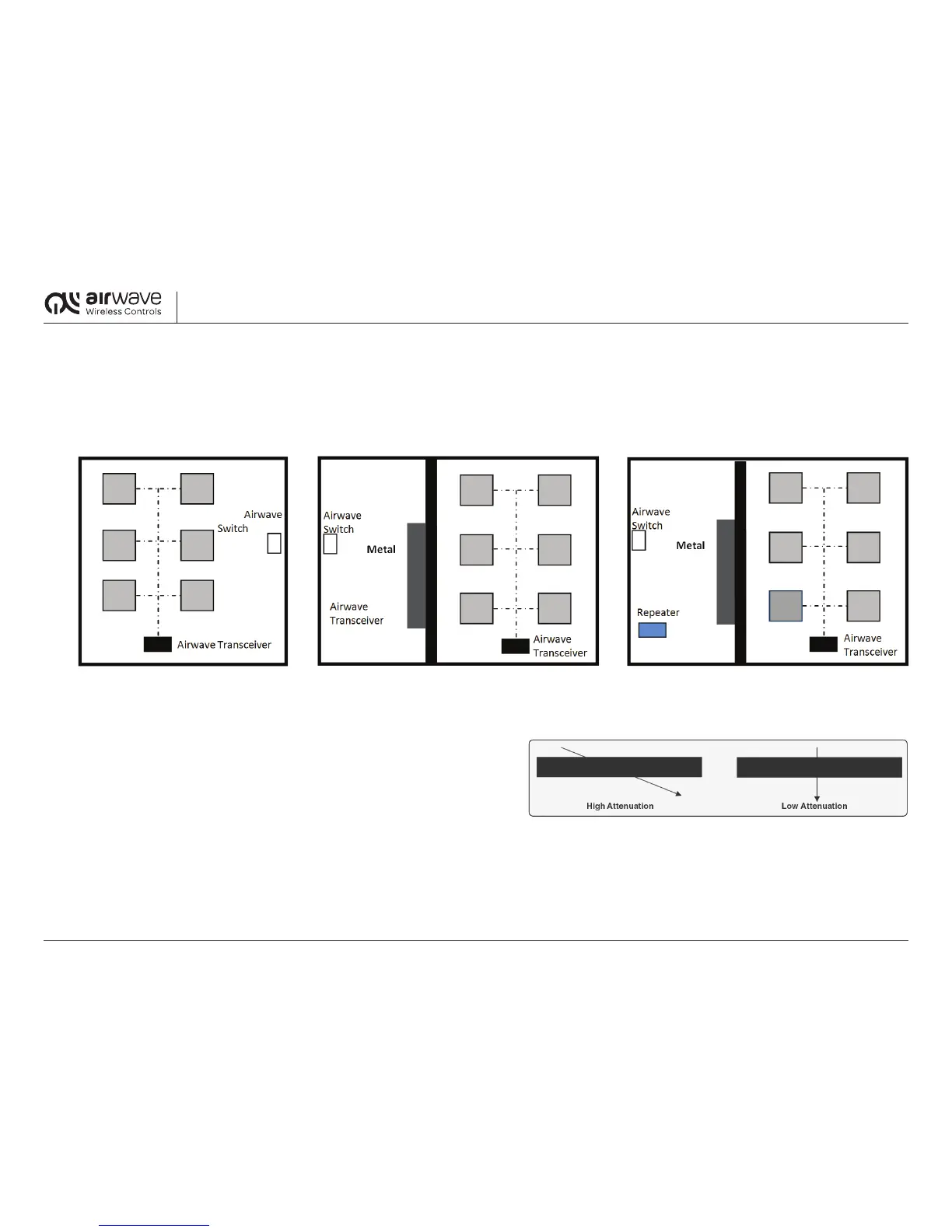
ItisveryimportanttoensurethattheAirwaveSwitchandPhotosensorhaveacleartransmissionpathinrelationtotheAirwaveTransceiver.Ifthereisametaldoorormetalwallobstructing
thewirelesstransmissionortransmissionisgreaterthan100ft,oneoptionistomovetheSwitchawayfromthemetalobstructionand/orclosertotheTransceiver.Theotheroptionistoset
aTransceiverthatiswithinrangeintoa“Repeater”modetopropagatethewirelesssignalfurtherand/oraroundthemetalobstruction.SettingaTransceiverto“Repeater”modedoesnotreduce
any of its original functionality.
11.3 Wall Penetration Angles
The angle at which the RF signal hits the wall is important when planning the placement of
theTransceiverandSwitch.TheAirwaveTransceivershouldbeplacedinanareawherethe
transmission signal is straight or direct. Avoid placing a Transceiver where the signal path is
limitedbyobjectssuchas:re-safetywalls,elevatorshafts,staircasesandsupplyareas.Aclear
anddirectline-of-sightpathwillprovidethebesttransmission.
11.4 Recommended distance between Airwave Devices and other Transmitters
Airwaveoperatesatauniqueradiofrequencythatdoesnotinterferewithothercommonwirelessdevicessuchasmobilephones,Wi-networks,andAM/FMradio.
However,itissuggestedthatAirwaveTransceiversbepositionedatleast20inches(50cm)awayfromdevicessuchaswirelessrouters,computers,audioandvideoequipment.
DIRECT PATH METAL OBSTRUCTION IN PATH REPEATER MODULE
There is no obstruction in the
transmission path.
The signal is received by the Transceiver.
There is a metal obstruction in the transmission path.
The signal is not received by the Transceiver.
The Repeater Transceiver is now placed in an area
where there is a direct transmission path.


 To Next Page
 Loading...