Need help?
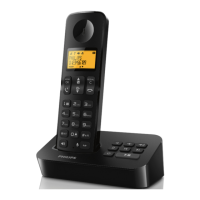
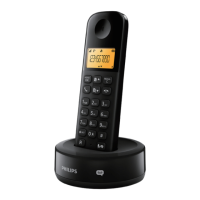
Do you have a question about the Philips D160 and is the answer not in the manual?
Covers power requirements, warnings, cautions, and operating/storage temperature guidelines.
Lists all items included in the product packaging.
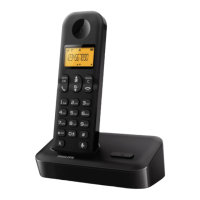
Provides an overview of the phone handset and the base station components.
Step-by-step guide for connecting the phone's base station to power and the telephone line.
Install batteries, set country/language, and configure date/time for initial phone use.
Instructions for charging the handset and checking battery level via the display.
Explains standby mode and the meaning of various icons shown on the handset screen.
Covers making normal/predial calls, answering, and ending calls.
Adjust volume, mute microphone, manage multiple calls, and switch between them.
Guides on making calls between handsets and switching between calls.
Steps for setting up a 3-way conference call involving internal and external callers.
Instructions on how to input characters and numbers using the phone keypad.
View, search, add, edit, and delete contacts in the phonebook.
Information on viewing, saving, and deleting call records.
Guides on viewing, redialing, saving, and deleting entries from the redial list.
Adjust ringtone volume, ringtones, key tones, docking tones, and display language.
Set the phone's date and time, and name the handset for personalization.
Turn the answering machine on/off, set language, and manage announcements.
Listen to, delete, and manage incoming voice messages.
Control remote access, change PIN, set ring delay, and manage messages remotely.
Configure auto conference, auto prefix, and network type settings.
Set the dial mode and enable/disable automatic clock synchronization.
Details on talk time, range, memory capacity, battery, power adapter, and physical dimensions.
Procedures for adding new handsets and removing existing ones from the base station.
Steps to reset all phone settings to their original factory defaults.
Statements on product compliance with essential requirements and GAP standard adherence.
Information on product disposal, battery recycling, and EMF compliance.
Addresses common problems like no signal, charging issues, bad audio, and display errors.
Reference tables for character mapping on the keypad for different languages.
 General
| Number of handsets included | 1 |
|---|---|
| Type | DECT telephone |
| Intercom | Yes |
| Handset type | Wireless handset |
| Answering machine | No |
| Number of melodies | 10 |
| Maximum indoor range | 50 m |
| Maximum outdoor range | 300 m |
| Backlight color | Amber |
| Display diagonal | 1.6 \ |
| Elderly phone | - |
| Mounting type | Desk |
| Product color | Black |
| Buttons quantity | 20 |
| Standby time | 200 h |
| AC input voltage | 100-240 V |
| Battery capacity | 300 mAh |
| AC input frequency | 50 - 60 Hz |
| Battery technology | Nickel-Metal Hydride (NiMH) |
| Battery recharge time | 8 h |
| Phonebook capacity | 50 entries |
| Specific absorption rate (SAR) value (EU) | 0.1 W/kg |
| Volume control | Buttons |
| Personalization | Ringtones |
| LED indicators | Signal strength |
 Weight and Dimensions
| Weight | 262 g |
|---|---|
| Package depth | 59 mm |
| Package width | 184 mm |
| Package height | 135 mm |
| Package weight | 346 g |

 To Next Page