EasyManua.ls Logo

Philips DCC 300 - Installation and Connections; Rear Panel Connections; Installation Guidelines and Warnings; Connecting External Components

Philips DCC 300
20 pages
Print Icon
To Next Page IconTo Next Page
To Previous Page IconTo Previous Page
Loading...
eines
Barone
eee
a
cos
=e
er
CI
oF
8”,
o
OO
Oe
ater
a
eet
oO
Oo
ee
oD
ree
‘es
re
RRO
IOI
ROODORGD
me
QO
sent
Ree
Serre
ine
ws
Cn
wii
‘5
i.
Cx oe
af
Ls
*
Ox?
7
COOK
a
*,
eran
ra!
Dolby
noise
reduction
manufachred
urider
lic
nse
from
Dalby
Laborataies
Licensing
Corporation.
"Dolby"
and
the
double-D
symbol
are
trade
marks
of
Dolby
Labex
Corperat!
Licensing
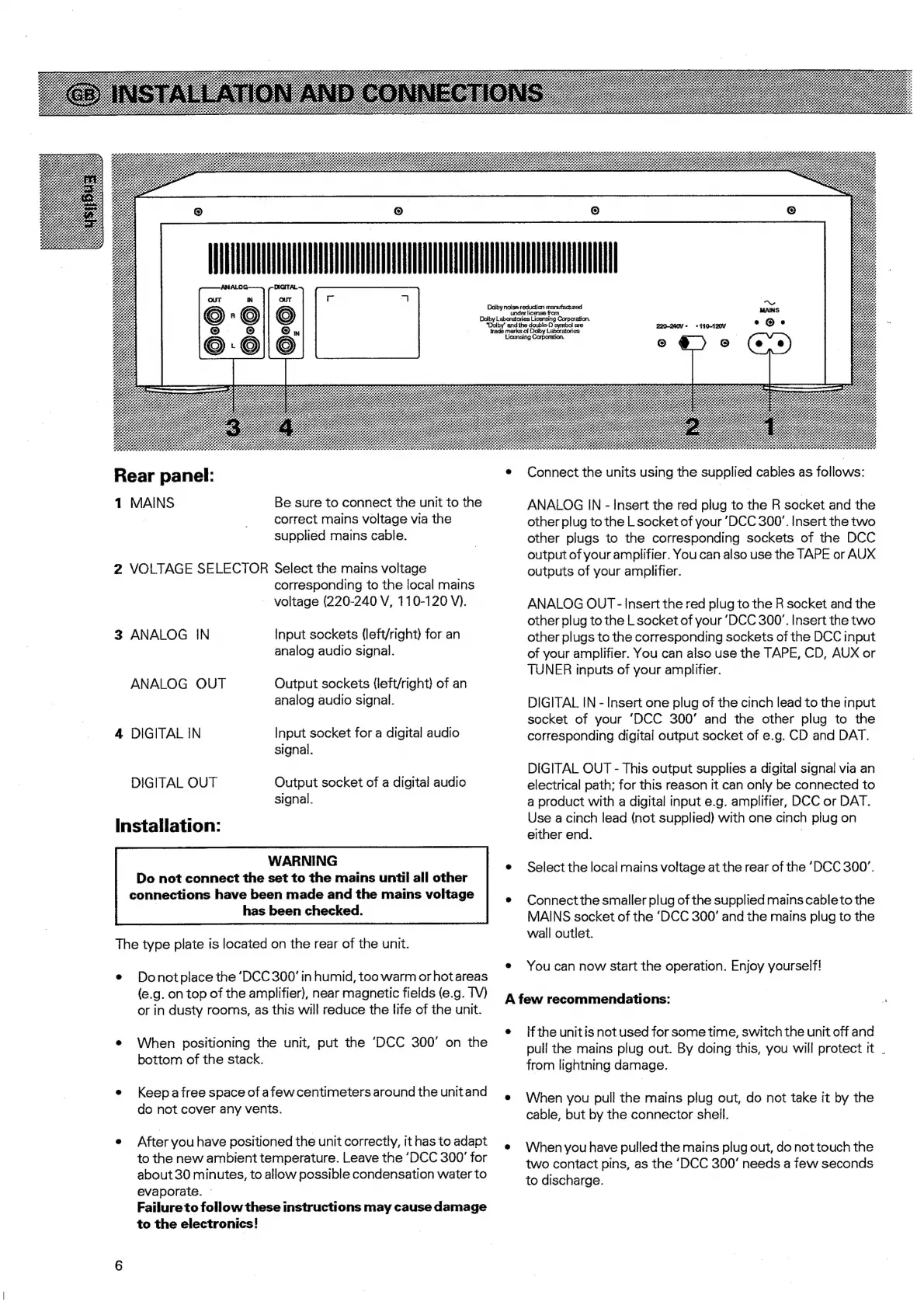
Rear
panel:
1
MAINS
Be
sure
to
connect
the
unit
to
the
correct
mains
voltage
via
the
supplied
mains
cable.
2
VOLTAGE
SELECTOR
Select
the
mains
voltage
corresponding
to
the
local
mains
voltage
(220-240
V,
110-120
V).
3
ANALOG
IN
Input
sockets
(left/right)
for
an
analog
audio
signal.
ANALOG
OUT
Output
sockets
(left/right)
of
an
analog
audio
signal.
4
DIGITAL
IN
Input
socket
for
a
digital
audio
signal.
DIGITAL
OUT
Output
socket
of
a
digital
audio
signal.
Installation:
WARNING
Do
not
connect
the
set
to
the
mains
until
all
other
connections
have
been
made
and
the
mains
voltage
has
been
checked.
The
type
plate
is
located
on
the
rear
of
the
unit.
e
Do
not
place
the
‘DCC
300’
in
humid,
too
warm
or
hot
areas
(e.g.
on
top
of
the
amplifier),
near
magnetic
fields
(e.g.
TV)
or
in
dusty
rooms,
as
this
will
reduce
the
life
of
the
unit.
When
positioning
the
unit,
put
the
‘DCC
300’
on
the
bottom
of
the
stack.
Keep
a
free
space
of
afewcentimeters
around
the
unit
and
do
not
cover
any
vents.
After
you
have
positioned
the
unit
correctly,
it
has
to
adapt
to
the
new
ambient
temperature.
Leave
the
‘DCC
300’
for
about
30
minutes,
to
allow
possible
condensation
water
to
evaporate.
~
Failure
to
follow
these
instructions
may
cause
damage
to
the
electronics!
e
Connect
the
units
using
the
supplied
cables
as
follows:
ANALOG
IN
-
Insert
the
red
plug
to
the
R
socket
and
the
other
plug
to
the
L
socket
of
your
‘DCC
300’.
Insert
the
two
other
plugs
to
the
corresponding
sockets
of
the
DCC
output
of
your
amplifier.
You
can
also
use
the
TAPE
or
AUX
outputs
of
your
amplifier.
ANALOG
OUT
-
Insert
the
red
plug
to
the
R
socket
and
the
other
plug
to
the
L
socket
of
your
‘DCC
300".
Insert
the
two
other
plugs
to
the
corresponding
sockets
of
the
DCC
input
of
your
amplifier.
You
can
also
use
the
TAPE,
CD,
AUX
or
TUNER
tnputs
of
your
amplifier.
DIGITAL
IN
-
Insert
one
plug
of
the
cinch
lead
to
the
input
socket
of
your
‘DCC
300°
and
the
other
plug
to
the
corresponding
digital
output
socket
of
e.g.
CD
and
DAT.
DIGITAL
OUT
-
This
output
supplies
a
digital
signal
via
an
electrical
path;
for
this
reason
It
can
only
be
connected
to
a
product
with
a
digital
input
e.g.
amplifier,
DCC
or
DAT.
Use
a
cinch
lead
(not
supplied)
with
one
cinch
plug
on
either
end.
¢
Select
the
local
mains
voltage
at
the
rear
of
the
“DCC
300’.
*
Connectthe
smaller
plug
of
the
supplied
mains
cableto
the
MAINS
socket
of
the
‘DCC
300’
and
the
mains
plug
to
the
wall
outlet.
e
You
can
now
start
the
operation.
Enjoy
yourself!
A
few
recommendations:
e
Ifthe
unitis
not
used
for
some
time,
switch
the
unit
off
and
pull
the
mains
plug
out.
By
doing
this,
you
will
protect
It
.
from
lightning
damage.
e
When
you
pull
the
mains
plug
out,
do
not
take
it
by
the
cable,
but
by
the
connector
shell.
e
Whenyou
have
pulled
the
mains
plug
out,
do
not
touch
the
two
contact
pins,
as
the
‘DCC
300’
needs
a
few
seconds
to
discharge.

Other manuals for Philips DCC 300

Related product manuals