The Philips PageWriter 100 (M1772A) is a cardiograph designed for acquiring and printing electrocardiograms (ECGs). It is a portable device that can operate on both AC power and a rechargeable battery, making it suitable for various clinical settings.
Function Description
The primary function of the PageWriter 100 is to simultaneously acquire 12 leads of ECG data from a patient. It offers both automatic (Auto) and manual (Manual) recording modes, allowing for flexibility in ECG acquisition based on clinical needs. The device features a digital array printer with continuous-feed Z-fold paper, capable of printing ECG reports in various formats.
In Auto mode, the cardiograph attempts to acquire a good signal for an ECG report before the user presses the "Auto" key (Pre-acquisition). This feature helps ensure a quality signal is captured. Once acquired, it prints a standard 12-lead ECG with a lead II rhythm strip. The device can store the last Auto ECG for multiple copies, provided another ECG has not been recorded or the device has not been turned to Standby.
Manual mode allows for continuous ECG recording until the "Stop" key is pressed. In this mode, the ECG waveform is displayed in real-time. Users can select different lead groups (3-lead or 6-lead) and adjust chart speed, ECG size, and V-leads sensitivity during recording.
The cardiograph incorporates filters to improve ECG signal quality. For Auto reports, it offers 0.15-40 Hz filters (with Baseline Wander and 40 Hz Noise filters enabled when the "Filter" light is on) for minimal noise, and 0.15-150 Hz filters (with "Filter" light off) for highest fidelity, though potentially more noise in suboptimal conditions. Manual reports also offer 0.05-40 Hz filters (with "Filter" light on) for less noise and 0.05-150 Hz filters (with "Filter" light off) for higher fidelity, especially when accurate ST contours are required.
Safety features include patient isolation to reduce hazardous currents and defibrillation protection against 400 joule discharges. The device is designed for use by qualified personnel and should not be used near flammable anesthetics or in explosive environments.
Important Technical Specifications
- ECG Controls: On/Standby, Auto, Manual, Copy, Filter, Page Advance (paper feed), Stop.
- ECG Format Controls: Chart Speed, ECG size, V Leads sensitivity.
- ECG Format Selections: Auto (3x4 with 1 rhythm lead); Manual (with 3 or 6 leads).
- Frequency and Impulse Response:
- Sinusoidal: 0.67 to 40 Hz ±10%
- Triangle: +0, -10%
- Impulse (0.3 mV/sec): Displacement less than 0.10 mV, Slope less than 0.30 mV/sec.
- Conforms to AAMI EC11-1991 standard for Diagnostic Electrocardiographic Devices.
- Patient Isolation: Less than 20 µA leakage with 120 VAC, 60 Hz; less than 50 µA leakage with 240 VAC, 50 Hz with patient cable.
- Defibrillation Protection: Protected against damage from 400 joule defibrillator discharges.
- Power:
- Line Power: 100 to 120 VAC, 50 to 60 Hz (at 115 VAC power-switch setting); 220 to 240 VAC, 50 to 60 Hz (at 230 VAC power-switch setting); 50 VA Maximum.
- Fuse: 0.4 A for both 115 and 230 VAC switch settings.
- Battery: Rechargeable sealed lead-acid battery (M2460A). A fully charged battery provides approximately 40 Auto ECGs or 40 minutes of continuous Manual ECG recording. A fully depleted battery charges to 90% in 7 hours and 100% in 16 hours (in Standby mode).
- Environmental Operating Conditions: 10 to 40°C (50 to 104°F), 15 to 80% relative humidity (non-condensing), up to 4,550 m (15,000 ft.) altitude.
- Environmental Storage Conditions: 0 to 50°C (32 to 122°F), 15 to 90% relative humidity (non-condensing), up to 4,550 m (15,000 ft.) altitude.
- Dimensions: 43 x 39 x 10 cm (17.0 x 15.3 x 3.9 in.).
- Weight: 8.5 kg (19.8 lbs.).
- Paper Capacity: 200 sheets Z-fold paper.
Usage Features
- Keyboard and Front Panel: The cardiograph features a user-friendly front panel with dedicated keys for various functions, including "On/Standby," "Chart Speed," "ECG Size," "V Leads," "Filter," "Page Advance," "Auto," "Manual," "Stop," and "Copy." Lights above these keys indicate the current operating status or selected settings.
- Pre-acquisition: In Auto mode, the device actively seeks a good ECG signal before recording, indicated by a flashing "Auto" light. This helps ensure a quality recording.
- Leads Off Detection: The cardiograph signals a "leads off" condition during Auto ECG acquisition by flashing the "Auto" light alternately with the "Manual" lead group lights. Leads off messages are also printed on the report.
- Report Formats:
- Auto Report: A one-page (at 25 mm/sec) or two-page (at 50 mm/sec) summary of all 12 ECG leads with a lead II rhythm strip.
- Manual Report: Continuous printout of selected lead groups (I, II, III; aVR, aVL, aVF; II, aVF, V2; or V1-V6) until "Stop" is pressed.
- Copy Function: The "Copy" key allows printing additional copies of the most recent Auto ECG.
- Battery Saver: The cardiograph automatically enters Standby mode after 30 minutes of inactivity (unless connected to a patient with all limb electrodes or plugged into AC power) to conserve battery life.
- Voltage Select Switch: Located on the back of the cardiograph, allowing selection between 115 VAC and 230 VAC operation.
Maintenance Features
- Cleaning:
- External Surfaces: Can be cleaned with mild soap and water or isopropyl alcohol.
- Patient Cable: Clean only with mild disinfectant or soap and water (do not use isopropyl alcohol).
- Electrodes and Cables: Clean with recommended disinfectants (e.g., Cetylcide®, Cidex®, Lysol® Disinfectant, Dial® Liquid Antibacterial Soap, 10% Clorox® solution). Avoid abrasive materials and wetting connectors.
- Digital Array Printhead: Clean with a foam swab dipped in 90% isopropyl alcohol to remove residues. Dry with a lint-free tissue.
- Paper Sensor Lens: Wipe dust off with a dry foam swab (do not use alcohol).
- Battery Care:
- The battery should be installed for proper operation, even when using AC power.
- It is recommended to keep the cardiograph plugged into AC power when not in use to maintain a full charge and prolong battery life.
- For storage, charge the battery for 16 hours, remove it from the cardiograph, and store it in a cool, dry place. Recharge every six months.
- Depleted batteries should be disposed of or recycled according to local regulations.
- Fuse Replacement: The AC fuses (0.4 Amp 250 V) can be replaced by qualified personnel. The procedure involves unplugging the cardiograph, turning it bottom-side up, locating the fuse holders, and using a screwdriver to remove and replace the fuses.
- Self-Test: An internal self-test can be initiated by pressing and holding both the "Auto" and "Manual" keys while turning on the cardiograph with the "On/Standby" key. The test results are printed for service personnel.

 Need help?
 General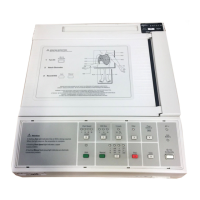

 To Next Page