EasyManua.ls Logo

Philips PM2519 - Page 30

Philips PM2519
126 pages
Print Icon
To Next Page IconTo Next Page
To Previous Page IconTo Previous Page
Loading...
2-14
2.4.
2.4.1.
DIGITAL
SECTION
ADC
interface
The
information
transport
to
this
device
is
by
means
of
an
2c
compatible
interface
(see
2.4.3.).
This
ADC
interface
is
activated
by
a
start
condition
so
that
it
first
reads
an
eight
bit
address.
The
four
most-
significant
bits
contain
the
group
address,
and
the
four
least-significant
bits
contain
a
command
to
be
executed
by
the
device.
This
is
in
contradiction
to
the
2c
specification
where
these
bytes
are
reserved
for
the
device
address.
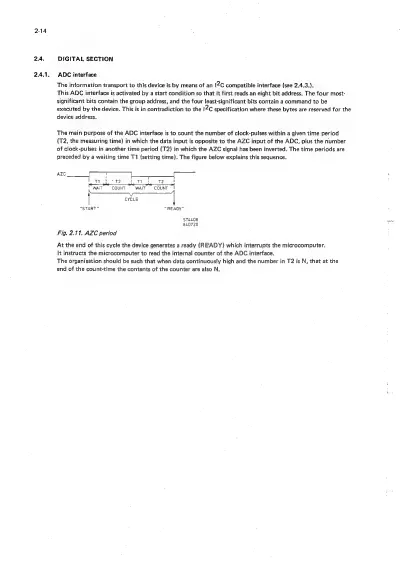
The
main
purpose
of
the
ADC
interface
is
to
count
the
number
of
clock-pulses
within
a
given
time
period
{T2,
the
measuring
time)
in
which
the
data
input
is
opposite
to
the
AZC
input
of
the
ADC,
plus
the
number
of
clock-pulses
in
another
time
period
(T2)
in
which
the
AZC
signal
has
been
inverted.
The
time
periods
are
preceded
by
a
waiting
time
T1
(setting
time).
The
figure
below
explains
this
sequence.
At
Ce
i |
-
toe
4
TH
T2
a
T2
|
i
rt
i
nN
WAIT
COUNT
WAIT
COUNT
|!
|
CYCLE
|
“START
“READY”
$T4408
840720
Fig.
2.11.
AZC
period
At
the
end
of
this
cycle
the
device
generates
a
ready
(READY)
which
interrupts
the
microcomputer,
It
instructs
the
microcomputer
to
read
the
internal
counter
of
the
ADC
interface.
The
organisation
should
be
such
that
when
data
continuously
high
and
the
number
in
T2
is
N,
that
at
the
end
of
the
count-time
the
contents
of
the
counter
are
also
N.

Related product manuals