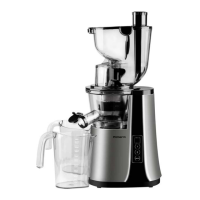
The Picberm Masticating Juicer, model PB2120, is designed for household use to extract juice from various fruits and vegetables. It operates on a power supply of 110-130V/60Hz and has a rated power of 150W.
Function Description
The juicer's primary function is to extract juice through a masticating process. Food material is loaded into the feeding chute, where an auger grinds and squeezes it against a juice strainer. The extracted juice is collected in a juice container, while the pomace (pulp) is separated into a pomace container.
Key components and their functions include:
- Power Cord (1): Connects the juicer to the power supply.
- Housing (2): The main unit containing the motor and other components, providing power output.
- Switch Knob (3): Controls product operation, including forward/backward rotation and turning the unit off. It has "SOFT" for soft fruits, "HARD" for hard fruits, and "REV" for reverse rotation (to clear blockages).
- Locking Button (4): Locks the juicing drum to prevent accidental release. Pressing and holding this button allows for unloading the juicing drum.
- Juice Container (5): Collects the extracted juice.
- Pomace Container (6): Collects the separated pomace.
- Pushing Rod (7): Used to push food material down the feeding chute, ensuring complete contact with the auger for maximum extraction efficiency.
- Feeding Chute & Cover (8): The chute is where food is loaded, and the cover holds the pushing rod while also serving as a safety feature to prevent hands from entering the chute.
- Tray (9): For interim storage of food material before processing.
- Juicing Drum (10): A main component where food is loaded and processed, with juice and pomace discharged from their respective outlets.
- Auger (11): Grinds and squeezes food material.
- Juice Strainer (12): Works with the auger to separate juice from pulp.
- End Cap (13): Where the pomace exits the juicing drum.
Important Technical Specifications
- Model: PB2120
- Rated Voltage: 110V~130V
- Rated Power: 150W
- Rated Frequency: 60Hz
- Continuous Operating Time: ≤10 minutes
- Interval Time: ≥10 minutes (rest period between operations)
- Protection Grade: Class-I (requires proper grounding)
Usage Features
Assembly:
- Connect the juicing drum (10) to the housing (2) by aligning the "▼" on the feeding chute with " " on the housing. Push the drum firmly and rotate it counter-clockwise until the " " on the feeding chute (8) aligns with " " on the housing (2). A "tick" sound and the locking button protruding confirm correct fastening.
- Place the auger (11) into the drum (10).
- Insert the juice strainer (12) into the drum (10).
- Place the end cap (13) onto the drum (10) and rotate it counter-clockwise.
- Place the juice container (5) and pomace container (6) under the drum set.
- Place the pushing rod (7) onto the cover of the feeding chute (8).
- Connect to power supply. Ensure the switch knob is in the "off" position before startup.
Operation:
- Prepare ingredients: Clean and cut food into appropriate pieces that fit through the feed chute. Remove hard cores, seeds, skin, or shells from fruits and vegetables. Lemon and ice cubes are prohibited.
- Open the juice outlet cover and rotate the switch knob to "SOFT" or "HARD" to start.
- Use the upper feeding hole for long-shaped foods (e.g., celery, carrot) and the side feeding mouth for bulkier or massive foods.
- Push food material in with proper force, sufficient to cut it off exactly, but not excessive.
- Move the juice outlet cover away from the center of the outlet before juicing to allow juice to flow out. Move it back after use to prevent dripping.
- The machine has intelligent protection chips, stopping automatically after 20 minutes of operation. Allow it to rest for 20-30 minutes to cool the motor and prolong service life.
- The product is designed to limit flow rate. If processing hard material causes the motor to lock and current to rise above 1.3A, the equipment will beep and stop for over-current protection.
- If current limit protection is triggered or the motor locks, disconnect power, set the switch to "0", press the "Reverse" button, discharge food material, then press "Soft" or "Hard" to restart. If the problem persists, remove food material from the auger before restarting.
- Do not put fingers or other objects into the feed chute during operation. Use the pushing rod or another piece of fruit to clear hovered food. If this doesn't work, turn off the motor and disassemble the juicer to remove the food.
- Keep continuous operation to less than 10 minutes to prevent motor damage.
Ingredient Selection Tips:
- Fruits: Efficiently juices hard and soft fruits. Bananas, mangoes, dried fruit, and sugar cane cannot be squeezed. Lemon is prohibited due to its strong acid.
- Vegetables: Cut into strips less than 4 inches. Juices various vegetables like carrots, beets, celery, peppers, and radishes, preserving natural flavor and nutrition. Starch vegetables (potato, cassava) cannot be used.
- Wheatgrass and Leafy Greens: Cut into strips less than 4 inches. Wheatgrass, kale, cabbage, and spinach are suitable.
- Preparation: Remove thick skins (orange, pineapple, raw beet root) and seeds (oranges) to avoid bitterness.
- Apple Juice: Concentration depends on apple type. Apple juice browns quickly; adding lemon drops can slow this.
- Leaves and Stems: Lettuce leaves and stems can be juiced.
Maintenance Features
Cleaning:
- Before cleaning, disconnect the power supply and shut off the switch.
- Clean the product after each use.
- The housing cannot be washed with water; clean it with a wet cloth.
- Ensure the product is clean and dry before storage.
- Disassembly for washing:
- Remove the pushing rod.
- Press and hold the locking button (4), then rotate the drum clockwise to remove it.
- After removing the juicing drum, detach the end cap, juice strainer, and auger. All removable components can be washed with water.
- WARNING: Do not immerse the motor base in water or any other liquid. Do not use a water jet to clean the motor base.
Troubleshooting:
- Product fails to work after connecting power:
- Wait 1 second after turning on; this is normal.
- If it still doesn't work, check for poor contact between the plug and socket. Re-plug or try another socket. If issues persist, contact customer service.
- Unpleasant smell during early uses: This is normal. If it occurs frequently, contact customer service.
- Machine stops during operation:
- Check if voltage is too low.
- Disconnect power and remove excessive food material.
- The motor may have operated continuously for too long; it will resume after a break.
- If problems continue, contact customer service.
- Too much noise during operation:
- Check if the auger or juice strainer is mounted in place correctly.
- If the starting motor in the frame is damaged, contact customer service.
- Parts missing upon receiving: Contact customer service for supplement.
- Ingredient becomes mash and juice does not come out: Open the cover of the juice outlet before juicing. Starch ingredients cannot be juiced.
- Parts missing or worn out after a long time use: Contact customer service for replacement parts.

 Need help?

 To Next Page
 General