Dear G-Scale Train Enthusiast:
Thank you for adding this PIKO model
to your collection. It has undergone
intensive testing throughout the
development phase, as well as numer-
ous inspections in the production
process, to ensure you smooth opera-
tion and many years of trouble-free
enjoyment.
Of course, we welcome reports of
your experience with the model under
“real world” conditions, which even
the most thorough developmental
testing cannot completely duplicate.
You can send us your comments by
several methods:
Via email to: hotline@piko.de
Via fax to: +49 3675 897250
Or via postal mail to:
PIKO Spielwaren GmbH
96515 Sonneberg
GERMANY
Naturally, we like to hear about posi-
tive experiences, but all comments
help us improve this and future mod-
els.
Thank you for your support,
Your PIKO Team
The Prototypes
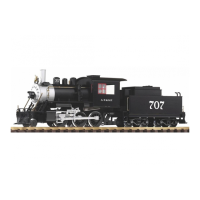
Beginning in the mid-1800s, the 0-6-0
wheel arrangement proved itself and
came to serve as one of the most
popular and enduring steam locos on
railroads across America. The 0-6-0
loco served on nearly every major rail-
road and on most smaller lines as
well, primarily in switching/shunting
and local service. 0-6-0 locos lasted
on many railroads long after larger
steam locos had been replaced by die-
sel locos. A number of 0-6-0 locos
even survive in the 21st century, ser-
ving faithfully in tourist and museum
railroad service.
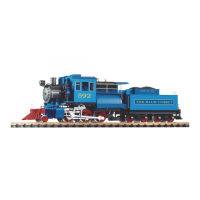
When the 2-6-0 wheel arrangement
was first introduced in the 1800s, the
big new locomotive received the nick-
name “Mogul”. This soon became a
popular type of loco on railroads all
across America. Thousands of Mogul
locomotives were built in the late
1800s, and even into the early 1900s.
In later years, Moguls served as the
main power on shortlines and branch-
lines. Some survive in operating con-
dition even in the 21st century.
The Model
The PIKO model combines attention to
detail with sturdy construction and
exceptional pulling power. The use of
special weather-resistant materials
makes this model suitable for both
indoors and outdoors. Additionally,
this model is equipped with a state-
of-the-art high-quality onboard digital
steam sound system developed exclu-
sively for PIKO by SoundTraxx®. This
sound system is actually a sound
decoder, enabling enjoyment of the
model’s numerous sophisticated fea-
tures automatically, on either Analog
DC or Digital DCC operation.
Technical Details of the Model
• Powerful 5-pole can-type motor,
protected from moisture
• Two axles gear-driven
• Ball-bearing drive axles
• Two wheels with traction tires
• 6-wheel electrical pickup with inter-
nal contacts
• 2 spring-loaded pickup shoes sliding
directly on the rails
• Metal wheelsets on tender
• Directional LED front and rear head-
lights
• Steam sound decoder functions
automatically on either Analog DC
or Digital DCC power
• Volume control under tender water
hatch
• Standard hook-and-loop rear coup-
ler
• 5-Volt smoke generator in smoke-
stack
• Quick-connect loco-tender coupling
system
• Length: 570 mm
• weight: approx. 3200 g
Details
• Detailed locomotive and tender with
many separately applied details.
• Separately installed front and side
windows
• Detailed cab interior with engineer
figure
• Constructed primarily of special
polycarbonate plastic and other
materials designed for outdoor use
• Authentic railroad decorations
Precautions and Recommendations
Minimum Radius
The locomotive can run on track with
a minimum recommended radius of
600 mm (23.62‘’). Naturally, extended
operation on small radius curves leads
to greatly increased wear of the loco-
motive and track.
Electronic Components
While the model itself is designed to
be as weather-resistant as practical,
the sophisticated electronic compo-
nents inside the model are not weath-
er-resistant. Take care to avoid expos-
ing the model to moisture and
extremes of temperature.
4


 To Next Page
 Loading...