
 Need help?
Do you have a question about the PITSOS B97981X and is the answer not in the manual?
Check appliance for transport damage and ensure correct electrical connection before first use.
Follow safety guidelines, especially regarding overheated oil and fat to prevent fires.
Warnings about touching hot hotplates and placing combustible items on the hob.
Caution regarding steam pressure from wet bases and the risk of injury.
Procedure for dealing with cracks in the glass ceramic to avoid electric shock.
Instructions for when a hotplate heats up but its indicator is not working.
What to do if the hob switches off automatically and cannot be used.
Warning against incorrect repairs and requirement for trained personnel.
Only authorized personnel should work on or replace the power cable.
Rough pan bases scratch the glass ceramic; avoid empty cookware on hotplates.
Do not place hot pans on the control panel or display area.
Salt, sugar, and sand cause scratches; do not use hob as storage.
Avoid damage from falling hard or pointed objects; do not store them above the hob.
Sugar and high-sugar content food damage the hob; clean spills immediately.
Aluminium foil and plastic melt on hot hobs; oven protective foil is not suitable.
Describes damage like stains, scratches, and color loss not covered by warranty.
Overview of the control panel, buttons, and displays for operating the hob.
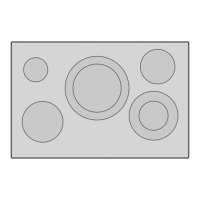
Description of single-circuit and double radiation cooking zones.
Explanation of the residual heat indicator 'H' and its meaning.
How to switch the hob on and off using the main switch.
Instructions on how to lock the hob to prevent accidental use by children.
How to use the plus and minus controls to set heat levels from 1 to 9.
Step-by-step guide to selecting and setting the cooking zone power level.
Procedure for modifying the selected power level for a cooking zone.
How to turn off a specific cooking zone and the residual heat indicator.
Provides examples of food, quantity, heat setting, and cooking times.
Continuation of the cooking table with more food types and cooking parameters.
Guidance on selecting saucepan size to match hotplate size for energy saving.
Importance of using lids on saucepans to save energy.
Tips for saving energy and retaining nutrients when cooking with water.
Advice to switch to a lower heat setting in good time for energy saving.
Steps to activate and use the rapid pre-heating function.
Instructions for cleaning the glass ceramic hob surface and suitable cleaning agents.
List of cleaning agents and tools to avoid to prevent damage.
How to use a glass scraper safely for removing dirt.
Detailed steps for cleaning the hob surface after use.
Explanation and solutions for discoloration caused by pan abrasion or cleaning agents.
Advice on keeping control panels clean and dry for proper function.
Checks to perform if the hob is not working, including power supply and circuit breakers.
Troubleshooting steps for when 'E' flashes on the displays, often related to dirt.
What to do if the hob switches off automatically due to accidental main switch touch.
How to diagnose and resolve issues with tripping circuit breakers.
Information that repairs must only be carried out by trained personnel.
Interpreting 'Er' error codes and troubleshooting electronic faults.
Table of fault codes (F0, F2, F4, F8, 0400) and their corresponding measures.
Guidelines for environmentally friendly disposal of packaging and old appliances.
How to find and provide E and FD numbers for after-sales service inquiries.

 To Next Page
 General