silicon carbide, but is tougher and more suited for woods and soft
(nonferrous) metals. Silicon carbide is extremely hard and is best suited for
surfacing stone, marble and glass.
Abrasives are classed as open-coated (grit spaced) or closed-coated
(Grit non-spaced). Closed coatings provide hard, fast cutting action for
hardwoods and dense metals while the open coatings are more suited to
soft materials and painted surfaces.
To obtain the best finish, start with a “COARSE” grade of abrasive and
change to “MEDIUM” and “FINE” grades as work progresses.
A wide range of available PORTER-CABLE Sanding Belts is listed in the
back of the manual. Keep a full assortment on hand so that the correct
belt will always be available.
INSTALLING AND REMOVING THE ABRASIVE BELT
CAUTION: Disconnect tool from
power source.
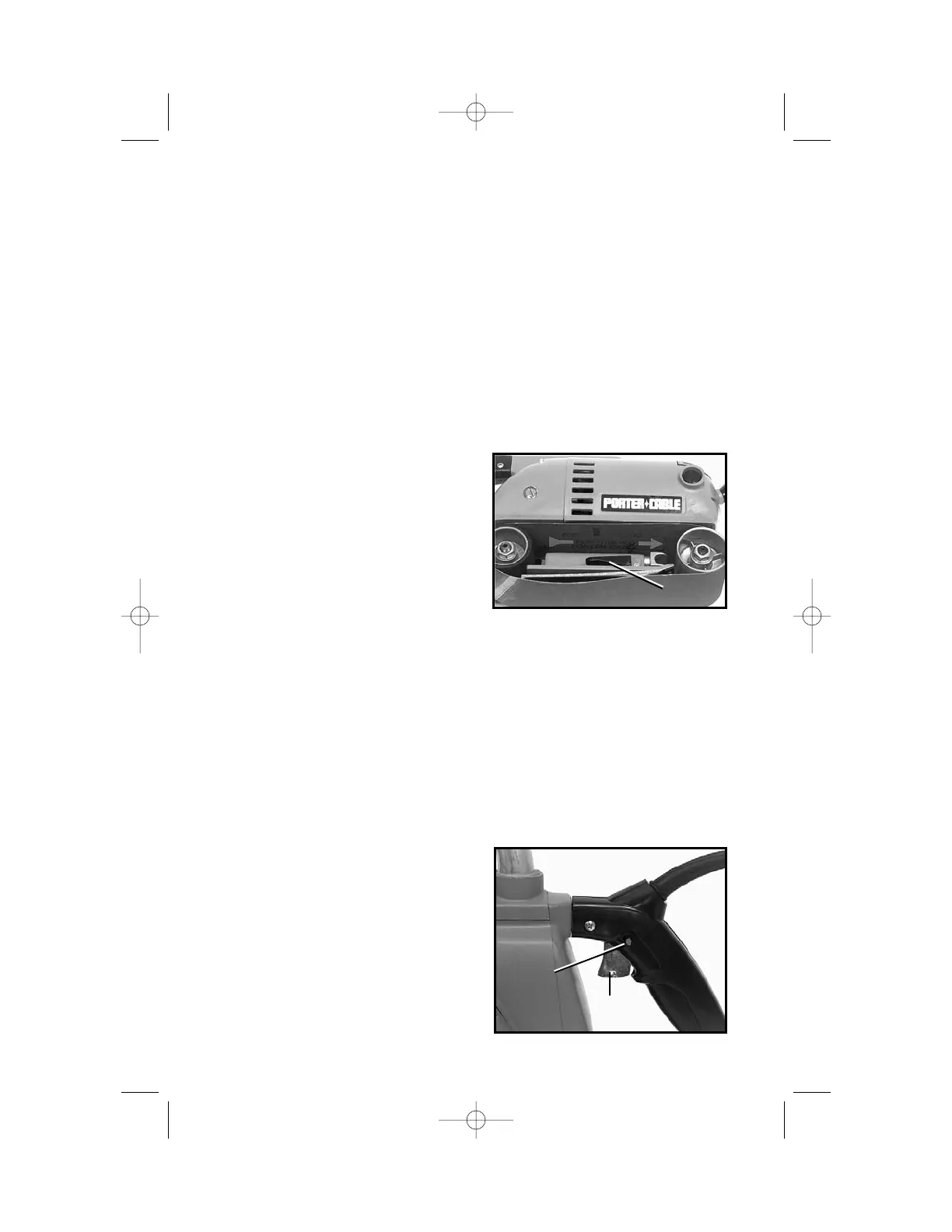
1. Lay sander on its left side and
turn the tension relief lever (A) Fig. 1,
locking it under the catch on the
plate.
2. Remove the old belt.
3. Install new belt so that arrow,
printed on inside of belt, is at the top
and pointing toward the front of the sander.
NOTE: Some sanding belts are bi-directional. These bi-directional belts
will not have arrows printed on them. They may be installed to run in
either direction.
4. Position the belt so that the outer edge is flush with the outer ends of
the pulleys.
5. Release tension lever to restore belt tension.
TO START AND STOP BELT SANDERS
CAUTION: Make sure switch is off
and power circuit voltage is the
same as the voltage shown on the
specification plate on the sander.
connect machine to power circuit.
1. Squeeze trigger switch (A) Fig. 2, to
start motor. Release trigger to stop
motor.
2. A lock button (B) Fig. 2 is
provided to keep motor running
continually without pressing the
trigger.
7
Fig. 1
A
Fig. 2
B
A


 To Next Page