9
2. LOWER sander to the work, letting the rear part of the belt touch
first. Level the machine as it is moved forward.
3. GUIDE the machine over the work in overlapping strokes, allowing
the sander to do the work.
4. AVOID applying excessive pressure when sanding. The weight of the
machine is usually sufficient for a fast, smooth finish.
5. WORK BACK and FORTH over a wide area to obtain an even surface.
6. DO NOT tilt the machine or sand with the edge of the belt.
7. Do not pause in any one spot during the sanding operation.
8. Lift sander from work before turning OFF motor.
9. ALWAYS be sure motor has completely stopped before putting sander
down.
FAST SANDING ON ROUGH
WORK
To smooth a rough surface
quickly, use a coarse grit abrasive
belt. With the belt positioned
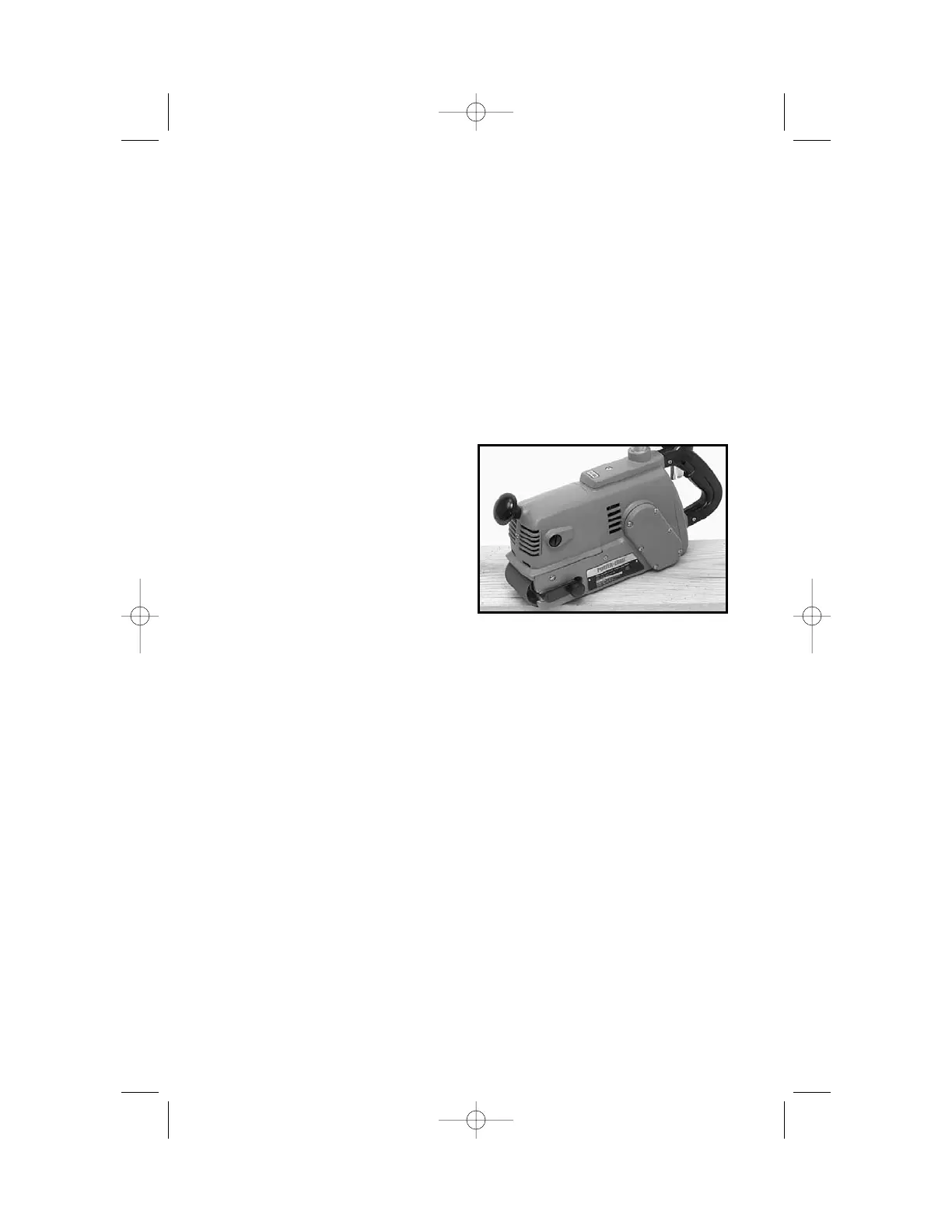
diagonally across the grain (see
Fig. 5), move the sander in the
direction of the grain. Overlap the
strokes and work the entire
surface from both sides of the
board (once with the sander
angled to the left and once angled
to the right). Smooth the surface by guiding the sander back and forth
with the grain. Change the belt to a medium grit and follow the same
procedure. Finish by thoroughly sanding over the grain lengthwise.
Change again to a fine grit and work back and forth with the grain.
Always finish by sanding with the grain.
REMOVING OLD PAINT AND VARNISH
This sander is an excellent tool for removing old paint and varnish from
flat surfaces. Two problems are common to such work: (1) loading the
abrasive with the material being removed and (2) overheating the paint or
varnish by working too long in one place.
Use a spaced grain or open coat abrasive belt and a single stroke action
to overcome the loading problem. Lower the sander at the far end of the
work and pull back. Raise the machine and do the same in a different
location. Overheating can be avoided by using a fairly quick stroke. A
piece of felt about ¼" thick can be inserted under the shoe for fast spot
sanding and for working on stubborn areas of paint and varnish.
SPECIAL SANDING PROCEDURES
Ordinarily the sanding stroke is back and forth. Some materials and some
types of operations, however, require a different technique. In rough
Fig. 5



 To Next Page