Need help?
Do you have a question about the POSEIDON PE 100-T and is the answer not in the manual?
Specifies the intended use of the PE 100-T breathing air compressor in diving applications.
Details the major assemblies comprising the compressor unit, illustrated in figures.
Explains various warning signs and notes displayed on compressors to ensure safe operation.
Highlights important instructions concerning personnel, technical, and operating safety.
Covers authorized use, organizational measures, and general safety practices for operation.
Defines personnel qualifications and fundamental duties for safe operation and maintenance.
Provides critical safety guidelines and procedures for operating the compressor unit.
Details specific hazards and critical safety precautions related to the unit's operation and components.
Outlines dangers and safe handling procedures for pressure vessels, including dynamic load considerations.
Lists relevant EC and German regulations governing filling systems and pressure vessels.
Specifies requirements for suitable outdoor and indoor locations for compressor placement.
Details electrical installation requirements, including compliance with local regulations and safety measures.
Covers preparation and general procedures for operating the compressor unit.
Explains the general steps and safety precautions for filling air bottles.
Addresses the critical aspect of breathing air quality and prescriptive limits according to DIN EN 12021.
Emphasizes the importance of clean intake air and potential risks associated with contaminants like CO.
Describes the procedure for flushing the compressor unit to remove residual CO2 before filling.
Provides detailed steps for safely connecting and filling air bottles with the compressor.
Details the correct procedure for safely shutting down the compressor unit after operation.
Recommends recording all maintenance work for warranty and efficient upkeep.
Provides essential safety instructions and procedures for performing maintenance on the compressor.
States that the maintenance schedule is provided in a separate service manual.
Introduces the chapter detailing specific maintenance tasks and component descriptions.
Explains the importance of correct oil selection, oil level check, and oil change intervals.
Describes the dry micronic filter for intake air and its maintenance procedures.
Details the function and maintenance of the intermediate separator for water and oil removal.
Explains the P11 filter system with TRIPLEX cartridge and safety bore for air purification.
Discusses the dynamic load on the filter system and its service lifetime based on load cycles.
Covers handling, storage, and replacement of new filter cartridges.
Explains how to determine filter cartridge lifetime based on operating hours and bottle fillings.
Provides instructions for changing filter cartridges, specifying types for petrol and electric units.
Details the filling valve, its components, and procedures for cleaning and maintenance.
Describes the function and adjustment of the pressure maintaining valve for optimal filtration.
Explains the safety valves for each stage, their function, and how to check them.
Describes the final pressure gauge and its maintenance for accurate readings.
Explains valve operation, initial checks, and procedures for changing intake and pressure valves.
Provides step-by-step instructions for changing the combined plate valve of the 1st stage.
Details the procedure for servicing intake and pressure valves on the 2nd stage.
Explains how to remove and install intake and pressure valves on the 3rd stage.
Covers the drive system, V-belt tension, and adjustment for optimal performance and longevity.
Describes the electrical system, including the drive motor and motor protection switches.
Explains how the compressor unit's cylinders and coolers are air-cooled by a fanwheel.
Steps to prepare the compressor unit before storage, including running warm and checking components.
Details the specific steps for preserving the compressor unit itself, like oil injection.
Refers to the motor/engine manufacturer's instructions for preservation.
Recommends periodic running of the compressor during storage.
Advises on draining and replacing oil after prolonged storage or every 2 years.
Guides on how to safely bring the compressor back into operation after storage.
Lists specific torque values for various bolts and screws used in assembly and maintenance.
Illustrates the correct sequence for tightening valve head and cylinder bolts for even assembly.
Shows the electrical schematic diagram for the motor protection switch of a three-phase current motor.
Provides a list of authorized lubricants for BAUER compressors, with application and suitability details.
 General
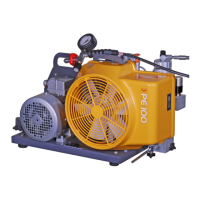
| Brand | POSEIDON |
|---|---|
| Model | PE 100-T |
| Category | Air Compressor |
| Language | English |

 To Next Page