Posey
®
Twice-As-Tough
®
Cuffs 2792, 2793, 2798, 2799
Application Instructions for Wrist or Ankle
I9266 REV D 2023-06-26
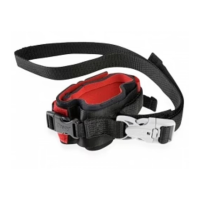
DESCRIPTION OF PRODUCT: Padded limb restraints with double-security
closure. For bed and stretcher use only.
INTENDED USE:
•
Patients assessed to be at risk of disrupting life-saving treatments
(e.g., chronic tube pulling) or in danger of injury to themselves or to others.
•
Follow your hospital’s restraint policies and procedures that are compliant
with USA CMS guidelines and state laws, or other governing agencies outside
the USA.
CONTRAINDICATIONS: None
APPLICATION INSTRUCTIONS: The order of either application or removal of the
straps to the bed OR the cu to the patient is to be determined by the clinician.
CAUTION: Posey Keys MUST be readily available to sta at all times. In an
emergency, it is diicult to cut the cus with scissors to free the patient. Follow
these steps to apply device (repeat steps 1-2 on each side):
1. Bring the ends of the strap down through the inside
of the side rails so they do not interfere when the side
rails are raised. Thread the end of the strap over the top,
around the frame, at least once, and through the lock.
Make sure that the straps are attached to the frame that
moves with the patient (Fig. 1) (do not attach to side rail
or head/footboard), out of the patient’s reach.
2. Pull the strap(s) snug and close the lock. Check that the lock “clicks” shut. If a
lock is not completely closed, it can pop open. Before leaving the patient’s side,
test the lock by trying to open it without the key.
APPLYING THE CUFFS: (Repeat steps 1-3 for each side):
1. Wrap the neoprene piece around wrist/ankle so the
buckle and connecting strap is on the ulnar side of the
wrist or lateral malleolus of the ankle. Attach the black
hook-and-loop pieces together and pull back the black
pull tab on the blue or red fuzzy piece, followed by
the blue or red hook-and-loop pieces. The fuzzy piece
should be sandwiched between the two pieces of hook
(Fig. 2). Be sure to overlap at least one inch (3 cm).
2. Press the hook-and-loop closure together rmly and
make sure it adheres securely. Slide ONE nger (at)
between the cu and the inside of the patient’s wrist/
ankle to ensure proper t (Fig. 3).
3. 2792/2793: Pass the end of the limb strap over the top
of the cu and through the two D-rings on the cu. Bring
the strap back over the rst ring and through the second
D-ring on the cu (Fig. 4). Slide one nger (at) between
the cu and limb strap.
2798/2799: Pass the end of the short strap through the lock and adjust it to
the desired length. Check that the lock “clicks” shut. If a lock is not completely
closed, it can pop open. Before leaving the patient’s side, test the lock by trying
to open it without a key.
ADJUSTING STRAP LENGTH: Adjust the connecting strap(s) length from the
frame to allow desired freedom of movement without compromising patient or
caregiver safety. Ensure the remaining strap end(s) are secured and out of the
reach of the patient.
Fig. 2
Fig. 1
TO REMOVE: Release the cu from the patient. Release the anchor strap from
the bed frame.
TO UNLOCK THE CUFFS: Insert the Posey Key
into the lock and turn counterclockwise. Turning
clockwise may cause jamming (Fig. 5).
NOTE: Universal Posey Keys t all Posey locks.
PRECAUTIONS:
•
A clinical assessment and decision are
required when used with monitoring lines or if patient has a wound or
dislocated/fractured limb.
•
Check the patient regularly to ensure that circulation is not impaired. Serious
injury may occur if the cus restricts circulation when the limb holder is applied.
• Some patients may require additional interventions in conjunction with a
restraint in order to prevent injury to self or others.
–
If the patient pulls violently against the bed straps.
–
To reduce the risk of the patient getting access to the line/wound/
tube site.
–
To prevent the patient from ailing or bucking up and down and
causing self-injury.
• It is a clinical decision to decide when a restraint is no longer deemed safe.
BED SAFETY: Refer to the Food and Drug Administration (FDA) , or other
governing agencies outside the USA, for the most recent Hospital Bed Safety
Guidelines and the bed manufacturer’s instructions for use.
POSEY TWICE-AS-TOUGH CUFFS LIMB HOLDER:
2792
D-Ring Cu (single strap with lock), Regular/Blue
2793
D-Ring Cu (single strap with lock), Large/Red
2798
Lock Cu (single strap with lock), Regular/Blue
2799
Lock Cu (single strap with lock), Large/Red
1074
Posey Universal Key
Fig. 5
Counterclockwise
TO OPEN
Fig. 3
Fig. 4
2798/2799
2792/2793
Rx ONLY
WARNING: Additional or dierent body or limb restraints may be needed
(visit tidiproducts.com):
© 2023 TIDI Products, LLC. All rights reserved. Posey is a registered trademark of TIDI Products, LLC.
Report any serious incident related to device use to TIDI Products and the Member
State Competent Authority. | Translations of this document in French, Spanish, Dutch,
German, Italian, and Portuguese are located at www.tidiproducts.com/IFU.
TIDI Products, LLC • 570 Enterprise Drive, Neenah, WI 54956 USA
Phone: 1.800.447.6739 • International: +1.920.751.4036 • www.tidiproducts.com
EN
MDSS GmbH
Schigraben 41
30175 Hannover, Germany
EC REP
UK Responsible Person
Emergo Consulting (UK) Limited
c/o Cr360 – UL International
Compass House, Vision Park Histon
Cambridge CB249BZ
United Kingdom
ADDITIONAL SAFETY AND LAUNDERING INSTRUCTIONS ON OTHER SIDE.


 To Next Page
 Need help?
 General