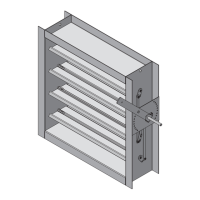
Industrial Damper
Installation, Operation, and Maintenance Manual
Sill Flashing
Storage
Dampers stored for any period of time before installation must be
protected from sunlight, dirt, and moisture. Keep all conduit entry plugs
and actuator access covers in place. Dampers should be stored on
pallets and not directly on the ground or on concrete. Dampers may be
stacked and stored horizontally with wood or equivalent spacers between
flanges to allow air circulation. Do not allow damper to be supported by
the blade(s) and never store with axles vertical. Dampers should be stored
in a dry, clean area; long term outdoor storage is not recommended and
could void the warranty. If the dampers are stored long term, please cycle
the damper with actuator once per year, a minimum of ten (10) open/
close cycles, to distribute grease in bearings and actuator. If the unit is
supplied with an actuator, refer to the actuator installation manual for
details on storage as well.
Installation
The goal of a proper installation is to secure the damper into the opening
or duct in a way that prevents distortion of the damper. The following
instructions will aid in completing the damper installation in a timely and
effective manner. If possible, to protect from damage, leave the damper
mounted on its skid/crate while moving to the installation location.
Remove the skid, crate, and packing materials carefully. Check the
opening or duct before installation to make sure it is free of obstructions
and is square, straight, and level. Ductwork must be properly supported
around damper to prevent sagging.
Figure 1
Lifting Lugs
Industrial Damper IOM 1 of 4, February, 2024 pottorff.com
General Information
Pottorff industrial dampers are designed for minimal pressure drop when
in the open position and minimal air leakage when in the closed position.
They are designed for industrial applications to provide seamless, problem
free operation for the life of the product. Each damper is fully inspected
by qualified factory personnel before shipping. When properly installed
and maintained, the damper will be trouble free. Improper installation,
adjustment, modifications, service, or maintenance can lead to property
damage, injury, or death. Please read these instructions thoroughly before
installing or servicing the damper.
Safety
The responsibility for providing proper guarding for Pottorff supplied
equipment is that of the installer and user of the equipment as
requirements will vary from one installation to the next. Dampers with
powered actuators (electric or pneumatic) must be reviewed for safety
guarding of the moving parts on the damper and the actuator itself.
Where inlets and outlets are not ducted, screens are recommended.
Users and installers of this equipment should carefully read all
accompanying literature pertaining to safe operation for both the damper
as well as the actuator. Pottorff dampers are designed to provide a long,
trouble-free life, but do require maintenance and inspection as described
in this manual.
When maintenance is required, it is critical that these safety
precautions are followed:
1. Turn off/disconnect all electrical and/or pneumatic connections.
2. Lock out electric and/or pneumatics.
3. Block damper blade(s) to prevent movement.
4. Follow general safety precautions when removing heavy
components.
Failure to follow these precautions could result in personal injury
or damage to equipment.
Preparation
Locate all crates, boxes, cartons, etc. associated with the order. Remove
the damper from the packaging and inspect for damage. Confirm
quantities and sizing with the packing list and the submittal drawings
(if applicable). Also, if submittal drawings were included, review for
associated tag numbers, location, and hardware item callouts. Notify your
Pottorff representative immediately of any shortages or shipping damage.
Handling
The damper should only be lifted by the lifting holes provided in the frame
on the damper assembly (see Figure 1 below). Never lift a damper by
the blade(s), shaft, actuator, or any damper part. Lifting decisions must
be left to trained personnel. Fork lift/crane capacity must be checked for
sufficient lifting capacity. Care must be taken not to drop, drag, crush,
or apply excessive bending, twisting, racking or skewing loads upon the
damper frame, blade(s), linkage, or accessories. Painted dampers must
be handled with extra care as even a small chipped spot will break the
continuity of the coating and destroy its value as a protective covering of
the metal.
INDUSTRIAL CD SERIES DAMPERS


 To Next Page
 Need help?
 General