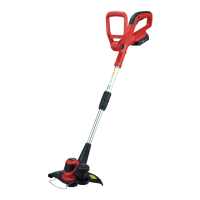
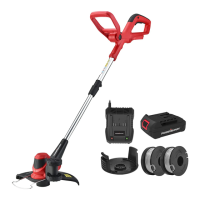
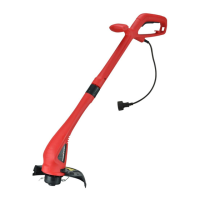
This document serves as an instruction manual for the PowerSmart 20V Cordless String Trimmer, Model # PS76112A. It provides comprehensive information on the safe operation, assembly, maintenance, and troubleshooting of the device. The manual emphasizes the importance of reading and understanding all instructions to prevent injury and machine damage.
The PowerSmart 20V Cordless String Trimmer is designed for trimming grass and light vegetation. It operates on a 20V Lithium-ion battery, offering cordless convenience for outdoor tasks. The trimmer features an auto-feed spool type and a 12-inch cutting diameter, making it suitable for maintaining lawn edges and flower beds.
Usage Features:
The trimmer is equipped with several features to enhance user experience and versatility. It includes a trigger switch and a lock-off button for safe operation, requiring both to be depressed to start the tool. The motor runs for approximately 3 seconds after the trigger is released, allowing it to come to a complete standstill before setting it down.
One of the key features is the adjustable cutting height, achieved by unscrewing a lock sleeve on the shaft and adjusting the telescopic shaft to the most comfortable operating position. The lock sleeve is then turned anti-clockwise to secure the shaft. This adjustability ensures ergonomic use for different users and tasks.
The front handle is also adjustable, offering 8 different angles to choose from. Users can press an adjustment button and push the front handle down to set the desired angle. The manual recommends adjusting the handle so that the front arm is straight when the trimmer is in the working position, promoting comfort and control.
The motor housing angle is adjustable, providing 7 different positions. This feature allows for greater flexibility in trimming various areas and angles.
A significant usage feature is the ability to convert the trimmer into an edger. The wheeled edge guide is specifically designed for edging mode, allowing the trimmer to cut overhanging grass along lawn edges and flower beds. To switch from trimming to edging, the user presses the edger function switch and turns the rear handle to the right while firmly holding the telescopic shaft. The guide wire needs to be inserted into a black slot on the motor housing, and the edger wheel must be firmly connected to the slot.
When operating the trimmer, users are advised to ensure the work area is free of rocks, debris, and other foreign objects. The protector should be lowered to prevent damage to the motor housing and trimming spool. The trimmer should be started before approaching the grass. Cutting should be done by moving the trimmer from right to left, with light cuts preferred over heavy ones, and the trimmer inclined forwards at about a 30° angle. For high grass, it should be cut in layers, starting from the top. The manual warns against cutting damp or wet grass and overloading the trimmer. Users should also be mindful of kickbacks when impacting hard objects. After use, the trimmer head should be kept close to ground level, the switch released, and the motor allowed to stop completely before removing the battery pack.
Maintenance Features:
The manual provides clear instructions for maintaining the string trimmer to ensure its longevity and safe operation. Before any adjustments, inspections, or cleaning, it is crucial to remove the battery pack to prevent personal injury, fire, or electric shock. When servicing, only identical replacement parts should be used to avoid creating hazards or product damage.
Cleaning the spool head is a regular maintenance task. This involves removing the battery pack, stopping the motor, and cleaning dirt and debris from the spool head with a damp cloth and mild detergent. The housing and plastic components should also be wiped with a moist, soft cloth, avoiding strong solvents or detergents that could cause damage or shock hazards.
General inspection is recommended, with users advised to regularly check that all fixing screws are tight, as they may vibrate loose over time.
For battery care, the manual suggests removing the battery pack from the charger once fully charged. For storage longer than 30 days, the battery pack should be stored in a location where the temperature is between 45°F and 104°F, away from moisture, and in a fully charged condition. It should be recharged every two months during storage. The battery pack should be kept dry, clean, and free from oil and grease, and never opened or mutilated.
Charger maintenance involves keeping it clean and free of debris, avoiding foreign material in the recessed cavity or on contacts. The charger should be unplugged when not in use and stored at normal room temperature, away from excessive heat or direct sunlight. If the battery pack is hot, it should be allowed to cool down before recharging.
The manual also includes instructions for fitting and replacing the line spool assembly. To replace the line, users need to press two clips on the spool cover, pull it out, remove the old line coil, and replace it with a new one. The line is then threaded through a hole on the spool cover, and the spool is pushed back onto the spindle, ensuring it sits completely. The spool cover is then reattached, making sure the clips fit into the recess places.
The manual emphasizes environmentally safe battery disposal, noting that the Lithium-ion batteries contain toxic and corrosive material. Users are instructed to contact their local waste disposal agency for information on recycling damaged or worn-out battery packs. The terminals should be covered with heavy-duty adhesive tape, and the battery pack should not be opened, mutilated, or placed in regular household trash or incinerated. Disposal should be at a certified recycling or disposal center.


 To Next Page
 General