STEP 4: Transmitter Power-Up & Battery Installation
IMPORTANT: ALWAYS TURN TRANSMITTER “ON” FIRST BEFORE POWERING UP VECTOR KITE™. ALWAYS
DE-POWER VECTOR KITE™ BEFORE TUNRNING TRANSMITTER OFF.
Make sure throttle control is all the way back (down). Make sure all trim controls are in the 1.
middle position.
Turn the transmitter on.2.
Plug the Battery into the Battery Extension Cable inside the body and then plug the upper part 3.
or the Battery Extension Cable to the Power Unit on top of the kite sail. The Battery Extension
Cable is located on a small opening on the Eagles back and goes through the sail of the kite
and ends inside the kite at the battery compartment area. To access the internal battery
compartment you must open the zipper in the lower body of the kite. The Battery Extension
Cable is to allow for ease of battery changing and also for ease of Power Unit removal. Close
the zipper on body before launch.
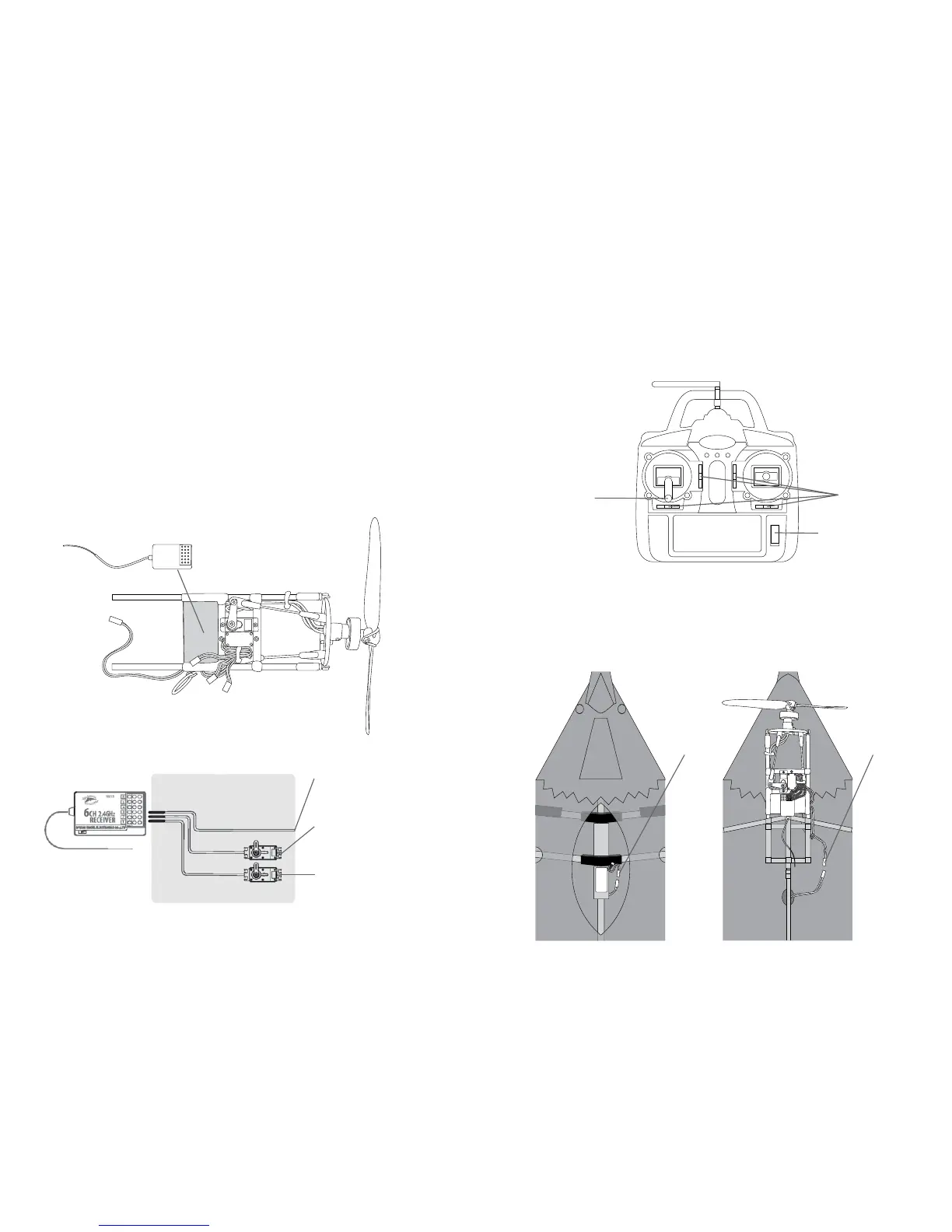
Throttle
Control
Receiver Port 3
Throttle and Power
(Typically Throttle ESC/Servo)
Receiver Port 2
Up/Down Gimbal Servo
(Typically CH-2 Elevator Servo)
Receiver Port 1
Right/Left Gimbal Servo
(Typically CH-1 Aileron Servo)
Trim
Controls
Turn Power
Switch to
'ON' Position
Connect Battery
to Battery
Extension Cable
Connect Battery
Extension Cable
to Power Unit
STEP 3: Receiver & Antenna Installation
NOTE: MANY DIFFERENT STYLES OF RECEIVERS CAN MOUNT ON YOUR GEN II VECTOR POWER UNIT.
THE MOST COMMON WAY TO MOUNT THE RECEIVER TO THE POWER UNIT IS BY USING VELCRO.
Adhere the 'soft' side of a small Velcro patch to the back of the receiver.1.
Mount the receiver to the panel of 'hook' side Velcro installed on the Power Unit.2.
Plug ESC and Servos into their proper receiver ports (see diagram).3.
IMPORTANT: NEVER WRAP YOUR ANTENNA AROUND ANY OF THE CARBON FRAMING STRUTS OF THE
KITE OR POWER UNIT. ANTENNAE SHOULD NEVER BE ATTACHED OR TOUCH ANY OF THE CARBON
STRUTS. CARBON ACTS AS A SIGNAL BLOCKING “SHIELD” AND WILL GREATLY INTERFERE WITH
RADIO RECEPTION. IT IS BEST TO HAVE YOUR ANTENNA IN OPEN AIR AND AWAY FROM THE CARBON
FRAME.
IMPORTANT: ALWAYS MAKE SURE YOUR ANTENNA IS WELL CLEAR OF ALL PROPELLER POSITIONS
WHEN GIMBAL IS OPERATED!
Typical Receiver (Manufacturers may vary, consult your Transmitter/Receiver Owners Manual)
Suggested Receiver
Placement



 To Next Page