2
Getting Acquainted
Your canner is a special, large capacity pressure vessel designed for home
canning a wide variety of fruits, vegetables, meats, poultry, fish, and seafood.
The canner uses pressure to achieve the high temperatures required for safely
processing foods while canning. The United States Department of Agriculture
(USDA) recommends the pressure canner as the only safe method for canning
low-acid foods: vegetables, meats, poultry, fish, and seafood.
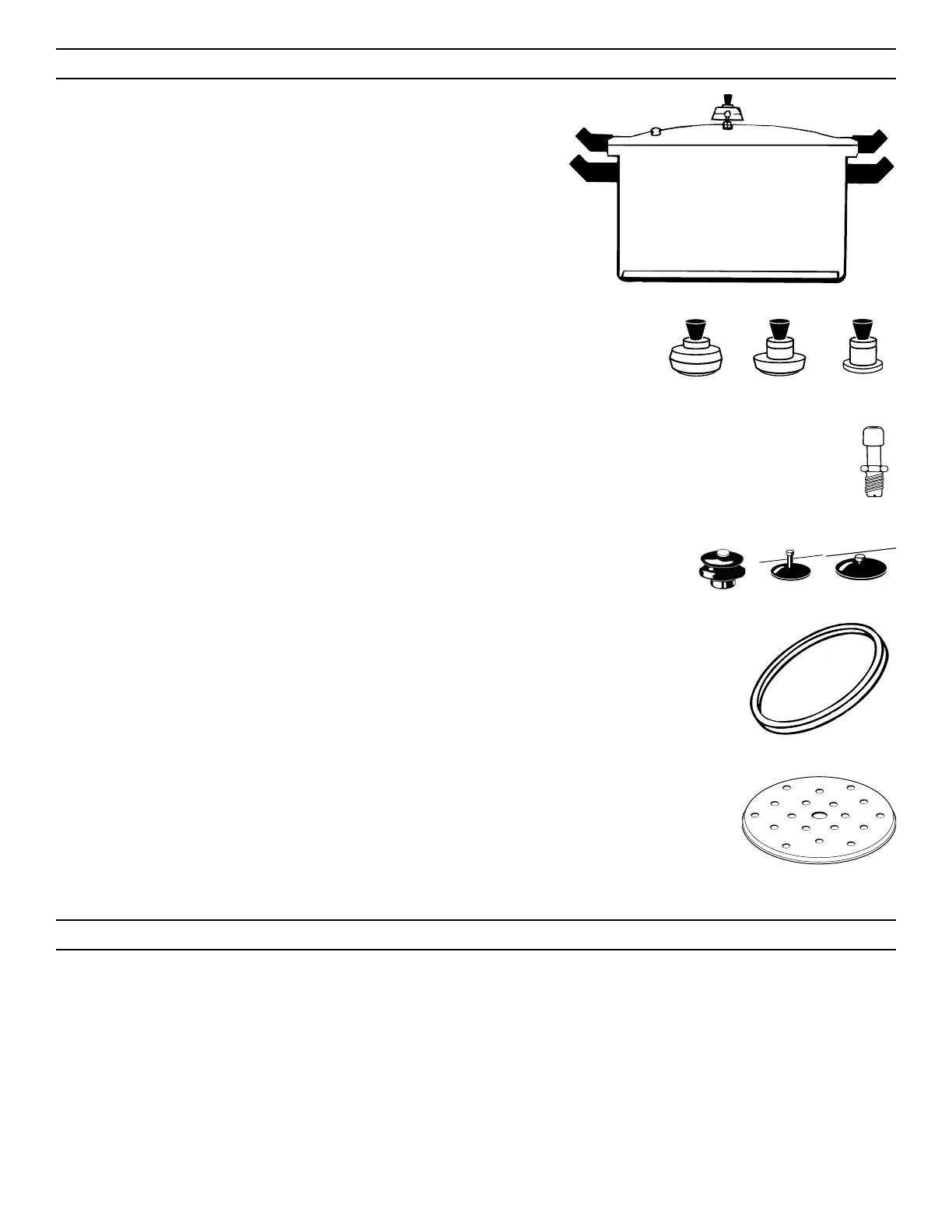
Become familiar with the various parts of the canner as shown in Fig. A.
Do not attempt to use your pressure canner before reading the
instructions on pages 4 and 5.
Introduction to Parts
Note: The parts shown are not to scale.
Pressure Regulator
The pressure regulator controls and maintains the selected pressure in the canner. When it is
rocking gently, the selected pressure has been obtained. Completely assembled, the regulator
will maintain 15 pounds of pressure. When one ring is removed, it will maintain 10 pounds
of pressure. When both rings are removed, it will maintain 5 pounds of pressure.
To remove the weight rings, hold the completely assembled regulator between the first two fingers of your hand; your
thumb should be on top of the knob. Press the knob down to force the weight rings over the lock ring on the regulator
body. To replace the weight rings, push them down over the lock ring at the top of the regulator body.
Vent Pipe
The vent pipe is the primary pressure relief valve and will release pressure in excess of the
desired pressure. The pressure regulator sits loosely on the vent pipe.
Automatic Air Vent
The automatic air vent automatically vents the air from the canner. When all the air has been
vented from the canner, the metal plunger will rise and seal the canner (A) so that pressure can build. If
the metal plunger is down (B), there is no pressure in the canner.
The automatic air vent will also automatically pop out and release steam in case the vent pipe becomes
blocked and pressure cannot be released normally. Replace the automatic air vent every time you replace
the sealing ring. This should be at least every 3 years, or sooner if either become hard or inflexible. Use
only genuine Presto
®
replacement parts.
Sealing Ring
The sealing ring fits into the canner cover and forms a pressure-tight seal between the cover and the body
during canning. Replace the sealing ring at least every 3 years. Use only genuine Presto
®
replacement
parts.
Canning Rack
The rack is placed in the bottom of the pressure canner to hold the jars off the bottom of the canner while
canning. Always use the rack as the jars may break if set directly on the bottom of the canner.
Canning Basics
Introduction
The key to successful canning is to understand the acidity and spoilage factor of the food you wish to can, as well as the acceptable
canning methods to process those foods. There are invisible microorganisms present all around us. Fruits, vegetables, and meat
contain these microorganisms naturally; yet they are not a problem unless food is left to sit for extended periods of time, causing food
spoilage. This is nature’s way of telling us when food is no longer fit to eat.
There are four basic agents of food spoilage: enzymes, mold, yeast, and bacteria. Canning interrupts the natural spoilage cycle so food
can be preserved safely. Molds, yeast, and enzymes are destroyed at temperatures below 212°F, the temperature at which water boils
(except in mountainous regions). Therefore, the boiling water method is sufficient to destroy those agents. Foods naturally high in acid
and acidified foods with a pH of 4.6 or less may be safely processed using the boiling water method.
Fig. A
(in cover
and not shown)
15 pounds
of pressure
10 pounds
of pressure
5 pounds
of pressure
A B



 To Next Page