3
However, bacteria are not as easily destroyed and thrive on low-acid foods in the absence of air. The bacteria Clostridium botulinum
produces a spore that makes a poisonous toxin, which causes botulism. This spore is not destroyed at 212°F. According to the USDA,
pressure canning is the only safe method of processing low-acid foods (vegetables, meats, poultry, fish, and seafood).
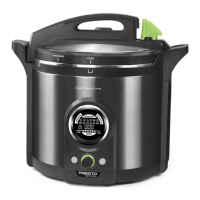
In pressure canning, some of the water in the pressure canner is converted to steam, which creates pressure within the canner. As the
pressure increases, so does the temperature: 5 pounds pressure reaches 228°F; 10 pounds pressure reaches 240°F; 15 pounds pressure
reaches 250°F. This pressurized heat destroys the potentially harmful bacterial spores. As the jars cool after processing, a vacuum is
formed, sealing the food within and preventing any new microorganisms from entering and spoiling the food.
Before Beginning
Selecting Jars
Glass home canning jars, often referred to as Mason jars, are made of heat-tempered glass for durability and reuse. These are the
only jars recommended for safe home canning. They are available in several standard sizes (half-pint, pint, and quart jars) and will
withstand the heat of a pressure canner. The diameter of Mason jars may vary from one manufacturer to another.
Before filling your Mason jars, test load your canner. A canning rack must be placed on the bottom of your canner to prevent jar
breakage. The jars may touch and it is not necessary to use a rack between the layers of jars. It may be necessary to double-deck the
pint and half-pint jars to reach the maximum load capacity of your canner. To double-deck, stagger the jars by placing one jar on top of
two. However, if using the boiling water method, do not double-deck the jars.
Canning Lids and Bands
The two-piece vacuum cap is the recommended closure for home canning. It consists of a flat metal lid with a sealing compound on
the outer edge and a separate metal screw band that secures the lid during processing. The flat lid is for one use only while the bands
can be used repeatedly if they remain in good condition. Always prepare lids and bands according to the manufacturer’s instructions.
Measuring Headspace
Headspace is the air space between the top of the food or its liquid and the lid. Leaving too much headspace can result in underproces-
sing because it may take too long to release the air from the jar. Leaving too little headspace will trap food between the jar and the lid,
resulting in an inadequate seal. As a general rule, allow ½-inch headspace for fruits and tomatoes and 1-inch headspace for vegetables,
meats, poultry, and seafood. All current and tested canning recipes will indicate the amount of headspace necessary for the food being
canned.
Removing Air Bubbles
After the food has been packed in the Mason jars, any air bubbles must be removed. Trapped air bubbles may rise to the top during
processing, resulting in too much headspace. Work quickly to remove the air bubbles that have become trapped between pieces of food
by moving a clean, nonmetallic spatula around the jar between the food and the side of the jar.
Preparing Jar Rims and Adjusting Lids
Immediately wipe the jar rims with a clean, damp cloth to remove any residue. Any food particles, such as seeds, grease, or syrup,
on the rim of the jar may prevent the jar from sealing. Place the flat lid on the rim of the jar, making sure the sealing compound is
touching the glass. Position a band over the lid and, using your fingertips, screw it onto the jar just until resistance is met. Do not
overtighten as the air must release from the jars during processing and cooling.
After Processing
Cooling Jars
After processing, remove the jars from the canner and place them on a dry towel on the countertop away from drafts. Leave 1 to
2 inches of space between the jars to allow for even cooling. Do not invert the jars or cover them with a cloth. Allow jars to cool
naturally for 12 to 24 hours before checking the seals.
Testing Seals
After the jars have cooled, test the jar lids to be sure a vacuum seal has formed. Press down on the center of the flat lid to determine if
it is concave (stays down when pressed). Then, remove the screw band and gently try to lift the lid with your fingertips. If the center
does not flex up and down, and you cannot lift the lid off, the lid has a good seal.
Detecting Spoilage
If up-to-date instructions, processing times, and canning pressures are followed carefully, spoilage is uncommon. However, it is still
recommended to check for signs of spoilage before tasting any canned food. Check for a broken seal, gassiness when opening, mold,
sliminess, cloudiness, or unpleasant odors. If any of these signs are present, discard the food.
As a safeguard against using canned low-acid foods and tomato products which may be affected with spoilage that is not readily
detected, boil food 10 minutes for altitudes up to 1,000 feet above sea level. Extend the boiling time by 1 minute for each 1,000 foot
increase in altitude. Many times odors that cannot be detected in the cold product will become evident by this method. After boiling,
if food does not smell or look right, discard it without tasting.



 To Next Page