21
NECTARINES AND PEACHES–YELLOW
Wash fully-ripened but not soft yellow nectarines or peaches. Do not process white esh nectarines or peaches.
Skin can be left on nectarines. For peaches, loosen skin by dipping them 1 minute in boiling water, then in cold water. Peel. Cut fruit
in halves and remove pits. Slice if desired. Place fruit in an ascorbic acid solution (page 19) to prevent darkening during preparation.
Drain well.
Hot Pack: Add fruit and syrup (page 19), juice, or water to a large pot and bring to a boil. Pack hot fruit, cut side down, in hot
jars, leaving ½-inch headspace. Cover with hot syrup, juice, or water, leaving ½-inch headspace. Remove air bubbles.
Clean jar rims. Position lids and secure with bands.
Boiling water canning: Process pints 20 minutes. For processing above 1,000 feet altitude, see page 19 for recommended time.
Raw Pack: Pack raw fruit, cut side down, in hot jars, leaving ½-inch headspace. Cover with hot syrup, juice, or water, leaving ½-inch
headspace. Remove air bubbles. Clean jar rims. Position lids and secure with bands.
Boiling water canning: Process pints 25 minutes. For processing above 1,000 feet altitude, see page 19 for recommended time.
PEARS
Wash pears. Peel, cut in halves lengthwise, and core. Place pears in an ascorbic acid solution (page 19) to prevent darkening during
preparation. Drain well.
Hot Pack: Add pears and syrup (page 19), juice, or water to a large pot and bring to a boil. Boil 5 minutes. Pack hot pears in hot
jars, leaving ½-inch headspace. Cover with hot syrup, juice, or water, leaving ½-inch headspace. Remove air bubbles.
Clean jar rims. Position lids and secure with bands.
Boiling water canning: Process pints 20 minutes. For processing above 1,000 feet altitude, see page 19 for recommended time.
PLUMS
Stem and wash rm, ripe plums. If plums are to be canned whole, prick each side with a fork. Freestone varieties may be cut in halves
and pitted.
Hot Pack: Add plums and syrup (page 19), juice, or water to a large pot and bring to a boil. Boil 2 minutes. Cover pot and let
stand 20 to 30 minutes. Pack hot plums in hot jars, leaving ½-inch headspace. Cover with hot syrup, juice, or water,
leaving ½-inch headspace. Remove air bubbles. Clean jar rims. Position lids and secure with bands.
Raw Pack: Pack raw plums rmly in hot jars, leaving ½-inch headspace. Cover with hot syrup (page 19), juice, or water, leaving
½-inch headspace. Remove air bubbles. Clean jar rims. Position lids and secure with bands.
Boiling water canning: Process pints 20 minutes. For processing above 1,000 feet altitude, see page 19 for recommended time.
RHUBARB
Trim off leaves. Wash stalks and cut into ½-inch to 1-inch pieces.
Hot Pack: Add rhubarb and ½ cup sugar per quart of rhubarb to a large pot. Let stand until juice appears. Heat rhubarb slowly to
boiling. Pack hot rhubarb in hot jars, leaving ½-inch headspace. Remove air bubbles. Clean jar rims. Position lids and
secure with bands.
Boiling water canning: Process pints 15 minutes. For processing above 1,000 feet altitude, see page 19 for recommended time.
BOILING WATER CANNING Tomatoes and Tomato Products
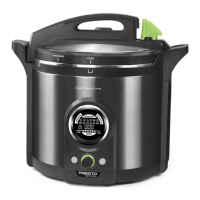
Your canner is designed for use as a boiling water canner to process half-pint and pint jars only. Do not use it for quart jars.
Tomatoes and tomato products may be safely processed using the boiling water method or pressure canning method. However, for
some tomato products, the pressure canning method may result in a more nutritious canned product. (For pressure canning instruc-
tions, see page 9).
Acidifying Tomatoes and Tomato Products
Tomatoes have a pH close to 4.6, which means it is necessary to take precautions to can them safely. First, carefully choose the toma-
toes for canning. Use only tomatoes that are disease-free, preferably vine-ripened, and rm.
Second, an acid must be added to tomatoes whether they are processed using the boiling water method or pressure canning method. To
ensure the safety of whole, crushed, or juiced tomatoes, add 1 tablespoon bottled lemon juice (not natural juice) or ¼ teaspoon citric
acid per pint jar.


 To Next Page
 Loading...