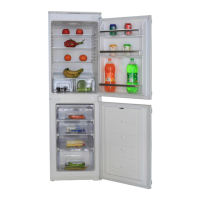
This document is a user manual for the Built-in 50/50 Frost Free Fridge Freezer, model PRRF500. It provides comprehensive instructions for installation, operation, maintenance, and troubleshooting, ensuring safe and efficient use of the appliance.
Function Description
The PRRF500 is a built-in 50/50 frost-free fridge freezer designed for domestic use. It features separate compartments for refrigeration and freezing, allowing for the storage of fresh and frozen foods. The "frost-free" designation indicates that the freezer compartment is designed to prevent the buildup of ice, eliminating the need for manual defrosting in that section. The "50/50" split refers to the approximate equal distribution of storage space between the fridge and freezer compartments.
Important Technical Specifications
The manual emphasizes the importance of checking the rating plate for specific technical data, including:
- Model number: PRRF500
- Gross capacity: (to be noted from rating plate)
- Net capacity: (to be noted from rating plate)
- Operation voltage: (to be noted from rating plate)
- Maximum input power: (to be noted from rating plate)
- Safety fuse: (to be noted from rating plate)
- Energy consumption: (to be noted from rating plate)
- Freezing capacity: (to be noted from rating plate)
The appliance is designed for use in room temperatures ranging from +10°C to 38°C, according to its climate category. It must be connected to an earthed power socket that complies with relevant standards, and the voltage and safety fuse must match the electrical supply. The refrigerating system is hermetically sealed and uses a refrigerant that may be easily flammable, necessitating careful handling and professional intervention for repairs. The internal lighting uses a Max. 15W bulb.
Usage Features
Installation and Initial Setup:
- The appliance should be unpacked by two people and placed on a firm, level surface in a cool, well-aired, dry room, away from direct sunlight or heat sources.
- A minimum distance of 3cm from a cooker and 30cm from an oven is recommended if placed nearby.
- After positioning, the appliance must stand for at least 2 hours before switching on to allow the refrigerant circulation to stabilize.
- The interior should be cleaned with lukewarm water and vinegar before first use.
- Door handles and other enclosed parts need to be mounted according to the instructions.
Operating the Fridge:
- The fridge switches on automatically when plugged in.
- Temperature is controlled via a dial: turning left for slight cooling (lowest setting) and right for lowest temperature (highest setting).
- A medium setting is generally recommended, with adjustments based on room temperature, food quantity, and frequency of door opening.
- Internal lighting comes on automatically when the door is opened.
Operating the Freezer:
- To switch on the freezer, turn the temperature dial to the right. If equipped with a super freeze switch, turn it on.
- The freezer compartment door should remain closed for about 12 hours after initial switch-on to allow the temperature to drop to the necessary level before filling with frozen food.
- When freezing fresh, chilled food, the super freeze switch (if present) should be activated, but switched off after 24 hours.
- The storage temperature in the freezer should always be at least -18°C.
- Frozen foods should be stored according to manufacturer's instructions on packaging.
- Do not store bottled liquids in the freezer as they may explode when frozen.
- Avoid storing explosive substances or aerosol cans with flammable propellants.
- Deep frozen ice cream should not be eaten immediately after removal to prevent injury.
- Defrosted or slightly frozen products should be used immediately and are generally not suitable for re-freezing.
- Packaging should be dry to prevent items from freezing together.
- Newly added fresh foods should not come into contact with already frozen foods.
Food Storage Guidelines:
- Fridge: Foods should be arranged to allow free air circulation. Coldest areas are over the salad crisper and against the back wall; warmest areas are in the front upper part and on the door.
- Door compartments: Butter, cheese, eggs, small jars/bottles, tins, seasonings, larger bottles.
- Fridge shelves/crisper: Preserves, pastries, ready-cooked foods, dairy/meats/sausages, vegetables, fruits, salad.
- High-proof spirits should be stored tightly closed in sealed containers.
- Vegetables, fruits, and salad can be stored unpacked in salad crispers.
- Plastic and aluminum foils, metal or glass containers are suitable for packing food.
- Hot foods and drinks must cool down before being placed in the fridge.
- Freezer: Almost all fresh products are suitable for freezing. Label portions with product name, weight, quantity, freezing date, and best-by date. A storage table provides approximate storage times for various foods (e.g., mincemeat, sausages, fish, ice cream, fruits, cheese, bread, pork, beef, lamb, mushrooms, asparagus, vegetables, strawberries, flans, chicken, turkey, duck, goose, cauliflower, beans, pepperoni, preserves, preserved fruit, ice lollies).
Maintenance Features
Cleaning:
- Always unplug the appliance or switch off the main fuse before cleaning or defrosting.
- The exterior should be cleaned regularly with furniture polish or an enamel protecting product.
- The door seal should be cleaned with warm water (avoid harsh cleaning products).
- Internal parts (shelves, drawers) are generally not dishwasher-safe and should be hand-washed with warm water and a little washing-up liquid. Avoid abrasive or acidic cleaning agents.
- Ensure no water runs onto electrical parts.
- The condenser (heat exchanger) at the back of the appliance should be cleaned regularly with a soft brush or duster to remove dust and dirt, which can impede heat release and increase energy consumption.
- The drain hole in the fridge should be cleaned periodically (e.g., with cotton buds) to keep it clear.
Defrosting (Freezer):
- The freezer is frost-free, so manual defrosting is generally not required under normal circumstances. However, if ice layers build up to a certain thickness on the inside walls (which can act as insulation), they must be removed.
- To remove ice, use a plastic or wood scraper (never metal tools). Remove drawers and place a cloth at the bottom to catch scraped ice.
- If equipped with a drip duct, pull it out and place a bowl underneath.
- To speed up defrosting, place a large bowl of warm water at the bottom of the appliance and close the door.
- If no drip duct, use an absorbent cloth and sponge to wipe up defrosting water.
- After defrosting, clean the inside with warm water and vinegar, rinse with clear water, dry thoroughly, and air for 3-4 minutes before plugging back in.
- Refill drawers with frozen food, placing oldest items at the top. This process should be completed within two hours to prevent frozen food from defrosting.
- Danger Warnings: Never use electrical appliances (hair dryer, fan heater, dehumidifiers), de-icing sprays, or naked flames to defrost. Do not use a steam cleaning device due to the risk of electric shock.
Switching Off for Longer Periods:
- If the appliance is to be switched off for an extended period, it should be left open to prevent odors. If it has a lock, set it to "closed" with doors open and keep the key away from children.
Light Bulb Replacement:
- Unplug the appliance from the main fuse.
- Remove the transparent lamp cover, unscrew the old bulb, and screw in the replacement bulb (Max. 15W).
- Replace the lamp cover. The voltage of the bulb must match the rating plate data.
Troubleshooting:
- The manual provides a troubleshooting guide for common issues such as the appliance not functioning (check plug, socket, electricity supply, thermostat setting), and insufficient cooling (check if left standing for 2 hours before switch-on, door seal).
- Slight bubbling noises from the refrigeration system are normal.
- Condensation on outer walls in unheated rooms is normal and will disappear as temperature increases.
- Warning: Do not undertake any technical interventions or repair attempts on the appliance yourself. Only professional experts from the nearest service department should intervene. Unauthorized repairs may void the guarantee and pose safety risks.
- In case of a fault or power failure, the appliance's insulation provides 2 to 5 hours of storage time for frozen foods. If the problem persists, move frozen food to another freezer or refrigerator.
Guarantee and Service:
- The general terms and duration of the guarantee are stated on the guarantee card.
- For service, consult the enclosed guarantee card or list of after-sales centers. If no service department is indicated, contact the dealer.
- Repairs due to non-adherence to user manual instructions will be charged to the customer.
- When contacting service, provide the model number, date of purchase, dealer name/place, and a description of the fault.
The manufacturer notes that products are subject to continual improvement and changes without prior notice.

 Need help?
 General

 To Next Page