8. Hints and troubleshooting
Primus cartridge gas (propane/butane mix) is
the ideal fuel for the OMNIFUEL stove. The
fuel is very easy to use, normally requires
no priming, and is efcient, environmentally
friendly and clean (no soot). Minimum
maintenance and cleaning are required.
High quality white gas (MSR® White Gas/
Coleman® Fuel) affords clean combustion -
although not as clean as cartridge gas - and
leaves practically no deposits in the fuel
system.
The stove is equipped with fuel lters in the
pump hose (35) and in the hose connection
(32). These lters normally require no other
attention than replacement as required. When
replacing the lter in the hose connection, the
existing lter may be removed by sticking a
pointed object (such as a needle) in the lter
and prying it out, taking care to avoid damage
to the sealing faces. Carry out leak testing as
described in 4.5.
The factors which govern the output of stoves
running on cartridge gas are listed below, with
hints on how to increase (a maintain) output in
cold weather.
Factors affecting heat output
• Quantity of gas in cartridge
• Temperature of ambient air
• Initial temperature of gas
How to increase output in cold weather
• Preheat the cartridge with a Primus heat
pad.
• Preheat the cartridge by placing it upright in
1” (2.5 cm) of warm water.
• Preheat the cartridge with your hands or
place it inside your jacket before connecting it
to the appliance.
Possible causes of reduced power
• Insufcient pressure in liquid fuel bottle
• Incorrect jet tted
• Jet or jet lter blocked
• Control spindle grooves blocked (see 7.5
above)
• Fuel tter blocked
• Appliance not shielded from wind etc.
Possible causes of unstable, yellow ame
• Insufcient priming
• incorrect jet
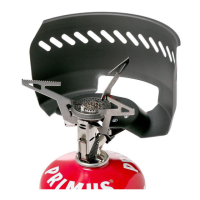
• Appliance not shielded from wind etc. Use
Primus windscreen arid heal reector or move
stove to sheltered location.
• Excessive pressure in tot bottle due to
excessive pumping. Reduce power by closing
gas control





 To Next Page